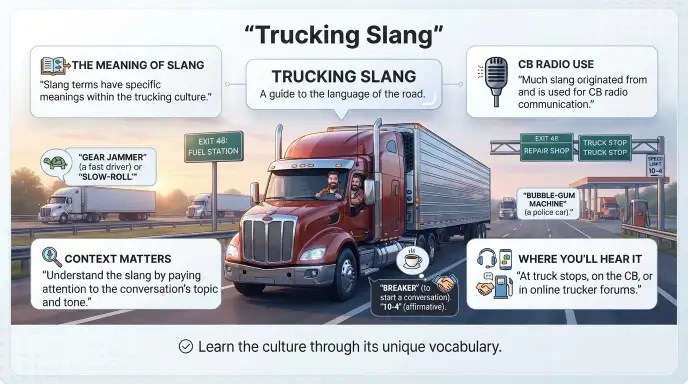
If you are new to trucking, truck driver conversations can sometimes sound like a completely different language. Drivers use short phrases and trucking terms slang to communicate quickly about roads, loads, traffic, weather, fuel, and other situations on the job.
Many of these expressions are common on CB radio, trucking apps, dispatch calls, truck stops, and driver-to-driver conversations. Some terms are also used casually online by people who follow trucking culture.
Learning this vocabulary can make trucker conversations much easier to understand. If you are a new driver, dispatcher, trucking enthusiast, or simply curious about trucker language, knowing the common terms can help you follow what drivers are saying.
What Is Trucking Slang?
Trucking slang is the informal language truck drivers use to describe common situations, equipment, roads, vehicles, and people in the trucking industry.
Some expressions developed through CB radio communication, where drivers needed short and easy ways to exchange information while driving. Others came from trucking culture and have been passed from one generation of drivers to another.
For example, a driver may say:
“There’s a bear ahead.”
A person unfamiliar with trucking might think the driver is talking about an actual animal. In trucking slang, however, “bear” commonly refers to a police officer.
Another driver might say:
“I’m hauling a reefer.”
Here, reefer means a refrigerated trailer, not the slang meaning associated with cannabis.
Context is therefore extremely important.
Quick Answer: Trucking Terms Slang
Trucking slang is informal language used by truck drivers to communicate quickly about vehicles, roads, freight, police, traffic, loading, and other parts of life on the road. Common examples include bear, smokey, four-wheeler, big rig, bobtail, deadhead, reefer, hammer down, detention, and drop and hook.
Why Do Truck Drivers Use Slang?
Trucking slang developed for practical reasons. Drivers spend long hours on the road and often need to communicate information quickly.
Short expressions can make radio conversations easier and faster.
Trucking slang can help drivers communicate about:
- Police activity
- Traffic
- Road conditions
- Accidents
- Weather
- Trucks
- Trailers
- Loads
- Fuel
- Rest stops
- Weigh stations
Some terms have been around for decades, while others continue to evolve as trucking technology and culture change.
Common Trucking Terms Slang
1. Bear
Bear commonly means a police officer or law-enforcement officer.
Example:
“Watch out, there’s a bear near the next exit.”
The driver is warning others about police presence.
2. Smokey
Smokey is another traditional CB expression for a police officer, particularly a highway patrol officer.
Example:
“Smokey is sitting on the shoulder.”
The driver is alerting other drivers to a police vehicle.
3. Hammer Down
Hammer down means to drive or continue moving quickly, often suggesting that the driver is making good progress.
Example:
“Traffic is clear, so I’m hammer down.”
The phrase has a strong trucking and CB-radio feel.
4. Four-Wheeler
A four-wheeler generally refers to a passenger vehicle, such as a car or SUV.
Truckers use the term because passenger vehicles have four wheels compared with large commercial trucks.
Example:
“A four-wheeler just cut me off.”
The driver is talking about a passenger car.
5. Big Rig
A big rig is a large commercial truck, especially a tractor-trailer combination.
Example:
“There were several big rigs at the truck stop.”
This is one of the most recognizable informal terms for a large truck.
6. Rig
Rig is a shorter informal term for a truck, especially a tractor-trailer.
Example:
“My rig is parked at the terminal.”
The driver is referring to their truck.
7. Bobtail
A truck is bobtailing when the tractor is being driven without a trailer attached.
Example:
“I’m bobtailing back to the terminal.”
This means the driver is operating the tractor without a trailer.
8. Deadhead
Deadhead means driving without a loaded trailer or without freight, often while traveling to pick up another load.
Example:
“I have to deadhead 100 miles for the next pickup.”
The truck is traveling without a revenue-producing load.
9. Reefer
A reefer is a refrigerated trailer used to transport temperature-sensitive goods.
It can carry products such as:
- Food
- Produce
- Meat
- Dairy products
- Frozen goods
- Certain pharmaceuticals
Example:
“The reefer needs to stay at the required temperature.”
In trucking, the meaning is usually clear from the context.
10. Dry Van
A dry van is an enclosed trailer commonly used to transport goods that do not require temperature control.
Example:
“I’m pulling a dry van today.”
Dry vans are widely used for general freight.
11. Flatbed
A flatbed is a trailer with an open, flat platform rather than a fully enclosed cargo area.
Flatbeds are often used for:
- Machinery
- Construction materials
- Steel
- Lumber
- Large equipment
Example:
“He’s hauling steel on a flatbed.”
12. Chicken Coop
Chicken coop is an informal trucking term sometimes used for a weigh station or inspection facility, particularly in traditional CB slang.
Example:
“The chicken coop is open ahead.”
Drivers may use such terms differently depending on region and trucking culture.
13. Wiggle Wagon
Wiggle wagon is an informal term for a trailer combination with multiple sections, commonly associated with certain doubles configurations.
Example:
“There’s a wiggle wagon coming up behind us.”
This is more specialized than everyday trucking vocabulary.
14. Yard
A yard is an area where trucks, trailers, and freight may be parked, moved, loaded, or unloaded.
Example:
“Check in at the yard before heading to the dock.”
The term is common in trucking and logistics.
15. Shipper
A shipper is the person or company that provides the freight for transportation.
Example:
“The shipper says the load will be ready at noon.”
The shipper is typically the starting point for the freight.
16. Receiver
A receiver is the person or company that receives the freight at the destination.
Example:
“The receiver closes at five.”
This tells the driver when the delivery location stops accepting freight.
17. Dock
A dock is the loading or unloading area at a warehouse or distribution facility.
Example:
“They assigned me door 12 at the dock.”
The driver may back the trailer into a dock door to load or unload freight.
18. Lumper
A lumper is a person or service that handles loading or unloading freight at some facilities.
Example:
“The receiver requires a lumper for this load.”
The exact arrangements and fees can vary by facility and shipment.
19. Detention
Detention refers to time spent waiting at a shipper or receiver beyond the allowed loading or unloading time.
Example:
“I’ve been here for three hours. I’m going into detention.”
Long waiting times can affect a driver’s schedule and may involve detention compensation depending on the agreement.
20. Layover
A layover occurs when a driver has to remain somewhere for an extended period before continuing with their next assignment.
Example:
“I have a layover until tomorrow morning.”
It can happen because of scheduling, freight availability, maintenance, or other circumstances.
21. Sleeper
A sleeper is the sleeping compartment attached to certain tractor units.
Example:
“I’ll be back in the sleeper after dinner.”
Long-haul trucks commonly have sleeper compartments for drivers who spend extended periods away from home.
22. Yard Goat
A yard goat is a specialized vehicle used to move trailers around a yard or facility.
It is also commonly called a yard truck or terminal tractor.
Example:
“The yard goat moved my trailer to another door.”
23. Fifth Wheel
The fifth wheel is the coupling device on a tractor that connects it to a semi-trailer.
Example:
“Check the fifth wheel before pulling out.”
It is an important part of the tractor-trailer connection.
24. Drop and Hook
Drop and hook means a driver drops one trailer and connects to another trailer instead of waiting for their current trailer to be unloaded or loaded.
Example:
“This is a drop-and-hook load, so I should be out quickly.”
This process can save time compared with live loading or unloading.
25. Live Load
A live load means the driver waits while the facility loads the trailer.
Example:
“It’s a live load, so I’ll have to wait at the dock.”
The opposite process may involve dropping a trailer and picking up another one.
Why Trucking Slang Still Matters
Although trucking technology has changed significantly, informal driver language remains part of trucking culture.
Drivers now communicate through:
- CB radio
- Mobile phones
- Dispatch systems
- Trucking apps
- Online forums
- Social media
Traditional terms can still appear alongside newer industry language.
For someone entering trucking, learning these expressions can make conversations with experienced drivers easier to follow. It can also help new drivers understand terminology they may encounter at truck stops, terminals, warehouses, and on the road.
26. Alligator
An alligator is a piece of tire tread lying on the road after separating from a truck tire.
Example:
“Watch the alligator in the right lane.”
Truck drivers pay attention to these pieces because hitting them can damage tires, vehicles, or other equipment.
27. Gator
Gator is a shorter version of alligator and refers to loose tire tread on the roadway.
Example:
“There’s a gator ahead, so move over if you can.”
The terms gator and alligator can be used interchangeably in this context.
28. Brake Check
A brake check happens when a vehicle suddenly slows down or brakes, sometimes intentionally to make another driver slow down.
Example:
“That car just brake-checked me.”
For truck drivers, sudden braking by passenger vehicles can create a serious safety concern because heavy trucks need more distance to stop.
29. Flip-Flop
Flip-flop can describe making a return trip or traveling back and forth between locations.
Example:
“I’m doing a flip-flop between these two terminals.”
The exact use can vary among drivers and companies.
30. Backhaul
A backhaul is a load carried on the return portion of a trip, often after delivering the original load.
Example:
“I got a backhaul for the trip home.”
Backhauls can help reduce the amount of time a truck travels without freight.
31. Power Only
Power only means the carrier provides the tractor while another company provides the trailer.
Example:
“This assignment is power only, so I’ll pick up their trailer.”
The term is common in trucking and logistics.
32. Hot Load
A hot load is a shipment that requires urgent or especially fast transportation.
Example:
“This is a hot load, so we need to leave immediately.”
The phrase usually signals that timing is important.
33. High Value
A high-value load contains freight that has significant monetary value.
Example:
“The carrier assigned an experienced driver to the high-value load.”
Such shipments may have additional security or handling requirements.
34. Oversize
An oversize load is freight that exceeds standard legal dimensions or weight limits and may require special permits or procedures.
Example:
“That truck is hauling an oversize load.”
Oversize transportation often involves additional planning.
35. Pilot Car
A pilot car is a vehicle that helps escort certain large or oversize loads.
Example:
“The oversize truck has a pilot car in front.”
Pilot cars can help with visibility, communication, and safety during specialized moves.
36. Parking Lot
Truckers may casually call a truck parking area a parking lot, but finding available parking can be a major issue during long-distance trips.
Example:
“I need to find a parking lot before my driving time runs out.”
37. Full Stop
A full stop simply means coming to a complete stop rather than slowing down and continuing.
Example:
“Make a full stop before entering the yard.”
This is not exclusive to trucking, but drivers commonly use the phrase when discussing safe driving.
38. Scale
A scale usually refers to a truck weigh station or commercial vehicle scale.
Example:
“I’m stopping at the scale before the next pickup.”
Drivers use scales to check vehicle and axle weights.
39. Weigh Station
A weigh station is a facility where commercial vehicles may be inspected or weighed.
Example:
“The weigh station is open ahead.”
Truck drivers may need to follow specific procedures when entering.
40. Pre-Trip
A pre-trip is the inspection a commercial driver performs before starting a trip.
Example:
“I need to finish my pre-trip before leaving.”
The inspection helps identify potential safety or equipment problems.
41. Post-Trip
A post-trip is an inspection performed after completing a driving period or trip.
Example:
“I’ll do my post-trip before shutting down for the night.”
It can help identify issues that need attention before the truck is used again.
42. Logbook
A logbook traditionally refers to a driver’s record of duty status.
Today, many drivers use an electronic logging device (ELD) rather than a paper logbook.
Example:
“I need to update my logs before I go off duty.”
43. Hours of Service
Hours of Service, often shortened to HOS, are regulations governing how long commercial drivers can drive and work before taking required rest periods.
Example:
“I’m close to my HOS limit.”
Drivers need to manage their schedules around applicable HOS rules.
44. ELD
ELD stands for Electronic Logging Device.
It records important information about a commercial driver’s driving activity and duty status.
Example:
“The ELD shows that I have limited driving time left.”
45. Sleeper Berth
A sleeper berth is the sleeping compartment in a truck equipped for overnight or extended trips.
Example:
“I’m taking my break in the sleeper berth.”
The term is common in regulations as well as everyday trucking conversations.
Trucking CB Radio Slang
CB radio played a major role in developing traditional trucking slang. Drivers used short expressions to share information about traffic, police, weather, and road conditions.
Some classic expressions include:
| Term | Common meaning |
|---|---|
| Bear | Police officer |
| Smokey | Police officer/highway patrol |
| Four-wheeler | Passenger vehicle |
| Hammer down | Drive or continue quickly |
| Alligator/Gator | Loose tire tread |
| Chicken coop | Weigh station or inspection facility |
| Big rig | Large truck |
| Four-lane | Divided highway |
| Back door | Behind or following you |
| Front door | Ahead of you |
Not every driver uses all of these expressions today. Some are strongly associated with older CB-radio culture.
Trucking Terms for Roads and Traffic
Drivers also have informal ways to describe what is happening on the road.
Four-Lane
A four-lane commonly describes a road with four lanes of traffic, depending on the driver’s regional usage.
Example:
“Traffic is heavy on the four-lane.”
Back Door
Back door can refer to the area behind a truck or driver.
Example:
“There’s a vehicle coming up on my back door.”
The speaker is referring to something approaching from behind.
Front Door
Front door can refer to the area ahead of the driver.
Example:
“Traffic is slowing down at the front door.”
This means traffic is slowing ahead.
Trucking Slang for Freight
Freight has its own vocabulary too.
Load
A load refers to the freight a truck is transporting.
“I picked up my load this morning.”
Hot Load
A hot load is urgent freight that needs quick transportation.
“This is a hot load, so there’s no time to waste.”
Backhaul
A backhaul is freight carried on a return trip.
“I found a backhaul heading home.”
Deadhead
Deadhead means traveling without a load.
“I’ll be deadheading to the next pickup.”
These terms are particularly useful for understanding dispatch conversations.
Trucking Slang for Drivers
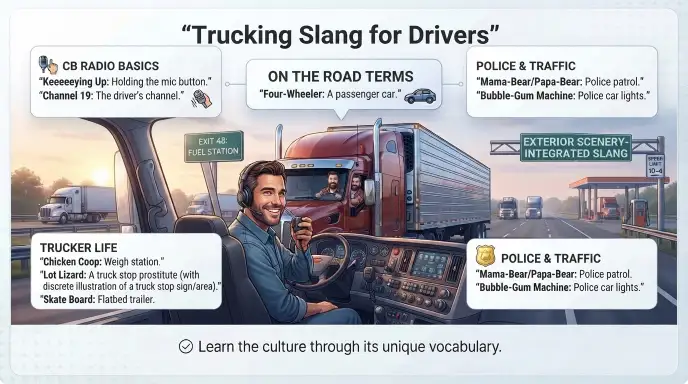
Drivers themselves may also use informal terms.
Trucker
A trucker is a person who drives a truck professionally.
Road Warrior
Road warrior is an informal term for someone who spends a great deal of time traveling or working on the road.
Example:
“Long-haul drivers are true road warriors.”
Newbie
A newbie is an informal term for someone who is new to trucking or a particular job.
Example:
“He’s still a newbie, but he’s learning quickly.”
Trucking Abbreviations You May See
Not all trucking language is slang. Some terms are standard industry abbreviations.
| Abbreviation | Meaning |
|---|---|
| CDL | Commercial Driver’s License |
| ELD | Electronic Logging Device |
| HOS | Hours of Service |
| OTR | Over the Road |
| LTL | Less Than Truckload |
| FTL | Full Truckload |
| ETA | Estimated Time of Arrival |
| POD | Proof of Delivery |
| BOL | Bill of Lading |
| DOT | Department of Transportation |
These abbreviations are widely used in trucking and logistics.
Trucking Slang vs. Official Trucking Terms
It is useful to separate informal slang from official industry language.
Slang includes expressions such as:
- Bear
- Smokey
- Four-wheeler
- Big rig
- Hammer down
- Gator
Industry terminology includes:
- CDL
- ELD
- HOS
- BOL
- POD
- FTL
- LTL
Some terms can be both informal and widely recognized within the industry. The distinction mainly comes down to how the word is used.
Why Trucking Slang Changes Over Time
Trucking language is not fixed. Older expressions developed during the CB-radio era, while modern drivers have added terminology connected with technology, logistics, and electronic communication.
Today, drivers may communicate through:
- CB radios
- Smartphones
- Dispatch software
- ELD systems
- GPS devices
- Trucking apps
- Online forums
- Social media
As technology changes, trucking vocabulary changes with it.
Common Mistakes When Learning Trucking Slang
1. Taking Every Term Literally
A bear in a trucking conversation may mean a police officer rather than an animal.
2. Assuming Every Driver Uses the Same Slang
Regional differences are common. A phrase that is familiar to one group may be uncommon to another.
3. Confusing Slang With Regulations
Terms such as HOS and ELD relate to official trucking requirements and equipment, not simply slang.
4. Using Old CB Terms Everywhere
Some traditional expressions are still recognized but may sound old-fashioned to modern drivers.
5. Ignoring Context
The same word can have different meanings outside trucking.
Quick Reference: Trucking Terms Slang
| Trucking term | Meaning |
|---|---|
| Bear | Police officer |
| Smokey | Police officer |
| Four-wheeler | Passenger vehicle |
| Big rig | Large truck |
| Bobtail | Tractor without a trailer |
| Deadhead | Driving without freight |
| Reefer | Refrigerated trailer |
| Dry van | Enclosed non-refrigerated trailer |
| Hammer down | Drive or continue quickly |
| Gator | Loose tire tread |
| Backhaul | Return-trip freight |
| Hot load | Urgent shipment |
| Detention | Extended waiting time |
| Layover | Extended waiting period |
| Yard goat | Vehicle used to move trailers |
| Drop and hook | Swap trailers without waiting for loading/unloading |
| Live load | Waiting while freight is loaded |
| Scale | Truck weighing facility |
| ELD | Electronic Logging Device |
| HOS | Hours of Service |
FAQs About Trucking Terms Slang
1. What Is Trucking Slang?
Trucking slang is informal language used by truck drivers to describe roads, vehicles, freight, police, traffic, equipment, and situations on the job.
2. What Does “Bear” Mean in Trucking Slang?
Bear commonly refers to a police officer or law-enforcement officer, especially in traditional CB-radio slang.
3. What Does “Four-Wheeler” Mean?
A four-wheeler generally means a passenger vehicle such as a car or SUV.
4. What Does “Deadhead” Mean in Trucking?
Deadhead means driving without a load, often while traveling to another location to pick up freight.
5. What Does “Reefer” Mean in Trucking?
A reefer is a refrigerated trailer designed to transport freight that needs temperature control.
6. What Does “Bobtail” Mean?
Bobtailing means operating a tractor without a trailer attached.
7. What Does “Hammer Down” Mean?
Hammer down is an informal trucking expression meaning to continue driving or make good progress, often at a faster pace.
8. What Is the Most Common Trucking Slang?
Common examples include bear, four-wheeler, big rig, bobtail, deadhead, reefer, gator, hammer down, and smokey. Usage varies by driver and region.
Final Thoughts
Trucking has a language of its own, and learning common expressions makes driver conversations much easier to understand. Terms such as bear, smokey, four-wheeler, big rig, bobtail, deadhead, reefer, gator, and hammer down are especially recognizable examples.
Some expressions come from traditional CB-radio culture, while others are connected to modern trucking operations. Industry abbreviations such as CDL, ELD, HOS, FTL, and LTL are also important, although they are better described as trucking terminology than slang.
The most important thing to remember is that trucking slang can vary by region, generation, and company. When you encounter an unfamiliar term, look at the surrounding conversation to understand what the driver means.
Explore more slang!

Daniel Carter – Short Bio (First Person)
Hi, I’m Daniel Carter, a slang language researcher and content writer. I enjoy exploring internet slang, texting abbreviations, and modern expressions to make them easy for everyone to understand. My goal is to explain slang in clear, simple English with real-life examples so readers can communicate confidently online and stay up to date with the latest language trends.