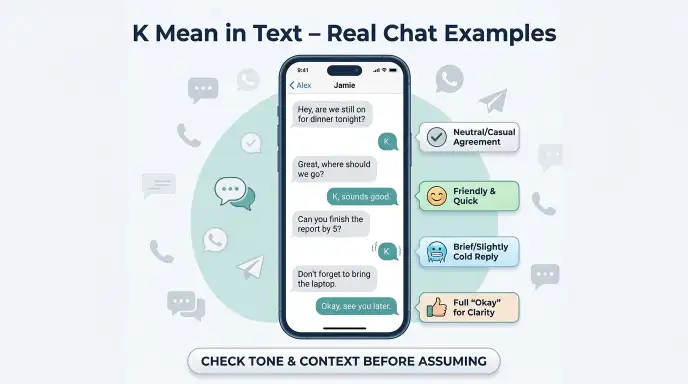
If you see k mean in text while texting, “K” usually means “okay.” It is a very short reply used in texting, Snapchat, Instagram, WhatsApp, and other casual online conversations.
The meaning is simple, but the tone can change depending on the situation. A single “K” may sound neutral, rushed, annoyed, or distant depending on the conversation.
People often search for k mean in text because they receive a message containing only “K” and are unsure if the sender is simply agreeing or showing irritation.
Understanding the surrounding messages is important. The same one letter response can feel completely different when sent by a close friend, coworker, family member, or stranger.
Quick Answer
In text messages, K usually means “okay.” It is a shortened version of “OK” or “okay” and is commonly used when someone wants to acknowledge something quickly.
For example:
A: I’ll call you later.
B: K.
The sender probably means “Okay” or “Alright.”
However, tone matters. In some conversations, “K.” can sound cold, annoyed, or dismissive, especially when the person normally writes longer replies.
k mean in text: What Does K Mean?
The letter K is one of the shortest ways to say “okay” in a text conversation.
People use it when they want to acknowledge information without writing a complete sentence.
For example:
A: Meet me outside at 7.
B: K.
Here, K simply means “Okay, I understand.”
It saves time and keeps the conversation moving.
Is K Slang, an Acronym, or an Abbreviation?
K is best understood as a shortened form of “okay.”
It is not normally treated as an acronym because the letter does not represent several separate words.
It is more like an informal abbreviation or shortened texting form.
Unlike terms such as IDK (“I don’t know”) or BRB (“be right back”), K does not stand for a phrase made from multiple words.
Why Do People Use K Instead of Okay?
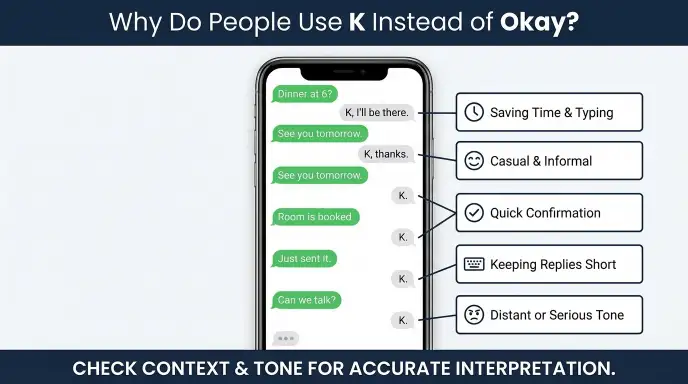
The main reason is convenience.
Typing one letter is faster than typing “okay,” especially when the message only requires a quick acknowledgment.
People may also use K because they do not have anything else to add.
For example:
A: The meeting starts at 10 tomorrow.
B: K.
There is no need for a long response because the second person is simply confirming that they received the information.
Does K Always Mean Okay?
Usually, yes, but the tone can vary.
Consider these messages:
K
K!
Okay!
K 😂
K.
They can all communicate acknowledgment, but they may feel different.
A message ending with a period can sometimes feel more serious or distant than a casual “okay!” However, punctuation habits differ from person to person, so you should not assume that a period automatically means anger.
Where People Use K
The shortened form is common in casual digital communication because it is quick and easy to type.
You may see it in private messages, social media comments, group chats, and ordinary text conversations.
K on TikTok
TikTok users may use K in comments or direct messages when they want to acknowledge something quickly.
For example:
A: “The new video is up.”
B: “K, I’ll watch it.”
In a comment section, however, a single “K” may sometimes be used sarcastically or dismissively.
That meaning comes from the surrounding conversation rather than the letter itself.
K on Snapchat
Snapchat conversations are often short and informal, making K a natural quick response.
For example:
A: “Send me the address.”
B: “K.”
The response usually means that the person understands or agrees.
If someone normally sends emojis and longer messages but suddenly replies only with “K,” you might wonder if their mood has changed. That is where context becomes important.
K on Instagram
On Instagram, K can appear in direct messages, group chats, or comments.
A person might use it to confirm that they saw your message:
A: “I posted the pictures.”
B: “K, checking now.”
It can also be used as a very short response when the conversation is not especially important.
K on WhatsApp
WhatsApp is another place where you may frequently encounter short responses.
For example:
A: “I’m leaving in five minutes.”
B: “K.”
The person is most likely saying “Okay.”
WhatsApp conversations between friends and family can also contain personal communication styles. Some people use K frequently, while others prefer “okay,” “sure,” “alright,” or an emoji.
K in SMS
The use of K is also common in traditional text messages.
Because SMS originally encouraged short messages, abbreviations and shortened responses became a natural part of texting culture.
Someone might reply:
“K, see you soon.”
In this case, there is little reason to interpret the message negatively.
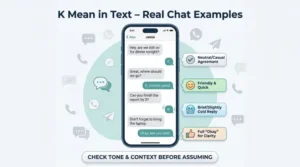
Real Chat Examples
Here are realistic examples showing how people might use K in everyday conversations.
Example 1: Making Plans
A: Are you coming to the party tonight?
B: Yeah, probably around 8.
A: K, see you then.
Here, K simply means “okay.”
Example 2: Confirming Information
A: Your appointment is at 3 PM tomorrow.
B: K, thanks.
A: No problem.
The response is a simple acknowledgment.
Example 3: Giving Directions
A: Take the second street after the gas station.
B: K.
A: Let me know if you get lost.
The sender confirms that they understand the directions.
Example 4: Casual Conversation
A: I’m going to grab some food.
B: K.
A: Want anything?
The K is neutral and does not necessarily carry any negative feeling.
Example 5: School Group Chat
A: Don’t forget to bring your project tomorrow.
B: K.
C: I almost forgot 😂
The response simply confirms that the person saw the reminder.
Example 6: Family Text
A: I’ll be home late tonight.
B: K, drive carefully.
A: I will.
Here, K is followed by a caring message, so there is no reason to read it as rude.
Example 7: Quick Confirmation
A: Can you send me the file?
B: K.
A: Thanks!
The sender is simply confirming the request.
Example 8: Slightly Tense Conversation
A: I already explained this yesterday.
B: K.
A: Are you upset?
In this situation, K could feel short or dismissive because of the conversation’s tone.
Example 9: Friendly Chat
A: Movie at 9?
B: K 😂
A: Perfect.
The emoji makes the message feel more relaxed.
Example 10: Ending a Conversation
A: I don’t have anything else to say about it.
B: K.
A: Goodnight.
Here, K may simply indicate that the person accepts the end of the discussion.
How to Reply When Someone Says “K”
Your response depends on what the person means and how the conversation feels.
If they simply acknowledge your message, you may not need to reply at all.
Funny Replies
If you’re talking to a close friend, you could respond playfully:
- “That’s it? 😂”
- “Only K? 😂”
- “K is so mysterious.”
- “One letter saved the day.”
- “Very detailed response 😂”
These work best in relaxed conversations where both people understand the joke.
Casual Replies
For everyday conversations, you can simply continue:
- “Cool.”
- “Alright.”
- “Sounds good.”
- “See you then.”
- “Thanks.”
You don’t have to make the conversation longer than necessary.
Friendly Replies
If you want to keep the conversation warm:
- “Okay, sounds good!”
- “Perfect, thanks!”
- “Alright, see you soon.”
- “Great! Talk later.”
- “Thanks for letting me know.”
These responses add a little more friendliness.
Neutral Replies
In a neutral conversation, you can use:
- “Okay.”
- “Alright.”
- “Understood.”
- “Sounds good.”
- “Thanks.”
These are useful when you don’t want to assume anything about the sender’s mood.
Is K Rude or Offensive?
K is not inherently rude or offensive.
The basic meaning is simply “okay.”
However, some people interpret a one letter reply as cold, impatient, or dismissive. This usually depends on the situation.
Why Can K Sound Rude?
Imagine sending a long emotional message and receiving only:
K.
You might feel that the other person is not taking your message seriously.
Now compare that with:
A: “The movie starts at 8.”
B: “K.”
The second example is much less likely to feel rude because the conversation only requires a quick confirmation.
The length and emotional importance of the conversation can therefore affect how K is interpreted.
Is K Safe to Use?
K is generally safe in casual texting.
Still, your audience matters.
If you’re talking to a close friend, K may feel completely normal. If you’re responding to someone who expects a more thoughtful answer, a longer response may be better.
Is K Appropriate at School?
For casual messages with classmates, K is generally understandable.
However, if you’re communicating with a teacher, professor, or school administrator, writing “Okay” or “Thank you” can sound clearer and more respectful.
For example:
Less formal: K.
More appropriate: Okay, thank you for letting me know.
Is K Appropriate at Work?
In professional communication, context matters even more.
A one letter response can appear abrupt in an email or workplace chat.
Instead of:
K.
you could write:
Okay, thanks for the update.
This gives the same basic acknowledgment while sounding more complete.
Who Uses This Term?
K is not limited to one particular age group.
Teenagers, young adults, older adults, students, coworkers, family members, and other people who use digital messaging may use it.
Gen Z Usage
Gen Z frequently uses short forms and casual digital language, but K is not exclusively a Gen Z term.
It has been used in texting for many years and can be found across different age groups.
The way people interpret it may differ, though.
One person may see K as perfectly normal, while another may consider it unusually cold.
Common Platforms
You may see K on:
- TikTok
- Snapchat
- SMS
- Discord
- Facebook Messenger
- Group chats
- Other messaging apps
Its basic meaning remains similar, although the tone can change according to the platform and conversation.
How Often Does K Appear Online?
K is a very short and familiar response, so it can appear frequently in casual digital communication.
However, people have different texting habits.
Some prefer:
K
Others prefer:
Okay
or:
Ok
or:
Sure
or:
Alright
There is no single correct way to respond.
The Difference Between K, OK, Okay, and Okay!
These responses can all communicate agreement, but their tone may differ.
K
Very short and direct.
Example:
“Can you pick me up?”
“K.”
OK
Short but slightly more complete.
Example:
“Meet me at 7.”
“OK.”
Okay
More conversational.
Example:
“I’m going to be late.”
“Okay.”
Okay!
The exclamation mark can make the message feel more energetic or friendly.
Example:
“Let’s meet at 6!”
“Okay!”
These differences are not strict rules. Individual texting styles vary.
Origin of K in Texting
The shortened use of K developed from the longer forms OK and okay.
As digital communication became more common, people began using extremely short responses to save time and effort.
Texting encouraged this kind of communication because people often wanted to send quick messages without typing complete sentences.
Over time, K became familiar as a shorthand acknowledgment.
Its history is therefore connected more broadly to the development of informal digital communication than to one specific social media platform.
Internet Culture and Short Messages
Online communication has made brevity normal.
People use abbreviations, emojis, shortened words, and single letter responses because conversations move quickly.
K fits naturally into this environment.
At the same time, extremely short messages can create misunderstandings because they provide very little information about emotion or intention.
That is why a simple K can sometimes create more confusion than a longer response.
K vs Common Texting Abbreviations
| Term | Meaning | Type | Usage | Popularity |
| K | Okay | Shortened form | Quick acknowledgment | Common |
| IDK | I Don’t Know | Texting abbreviation | Showing uncertainty | Very common |
| IDC | I Don’t Care | Texting abbreviation | Showing lack of concern | Common |
| IMO | In My Opinion | Texting abbreviation | Sharing an opinion | Common |
| BRB | Be Right Back | Texting abbreviation | Temporarily leaving a chat | Very common |
The main difference is that K is a shortened version of one word, while IDK, IDC, IMO, and BRB are abbreviations formed from multiple words.
Real World Usage Example
Imagine two friends planning to meet after school.
One person sends:
“I’ll meet you outside the library at 4.”
The other replies:
“K.”
In this situation, K most likely means:
“Okay, I understand.”
There is no need for the second person to repeat the entire plan.
Now imagine a different conversation.
Someone sends a long message explaining why they are upset. The other person responds:
“K.”
The recipient might interpret that response as dismissive.
The word has not necessarily changed meaning. The context and tone have changed.
This is one of the most important things to remember about texting language.
When K Can Be Misunderstood
A short message does not show facial expressions, voice, or body language.
When someone says “okay” in person, their tone can tell you if they are happy, annoyed, confused, or simply acknowledging information.
A text message does not provide those same clues.
Because of this, K can sometimes be misunderstood.
If the conversation is important or emotional, consider using a fuller response.
Instead of:
K.
you could say:
“Okay, I understand.”
That gives the other person more information and reduces the chance of confusion.
Should You Use K in Every Conversation?
Not necessarily.
K works well when the conversation is casual and the meaning is obvious.
For example:
Friend: “I’ll be there at 7.”
You: “K.”
That’s simple and efficient.
But if someone has shared something important, a more thoughtful response may be better.
For example:
Friend: “I’m having a really difficult day.”
Responding with only “K” could easily sound uncaring.
A better response might be:
“I’m sorry. Do you want to talk about it?”
The key is not the abbreviation itself. It is if the response fits the situation.
When You Should Avoid Guessing the Meaning
If someone sends only K, you usually don’t need to overthink it.
However, if the conversation is emotional, serious, or confusing, don’t assume you know the sender’s intention.
Consider the following:
Look at the Previous Messages
Read what was said before K.
A short reply to a simple question is different from a short reply after an argument.
Consider the Person’s Normal Style
Some people always use K.
Others almost never use it.
Knowing someone’s usual texting habits can help you understand their tone.
Look at Punctuation
“K” and “K.” may feel different to some readers, but punctuation habits vary widely.
Don’t treat punctuation as definite proof of someone’s mood.
Ask If You’re Unsure
If the conversation matters, simply ask:
“Everything okay?”
or:
“Did you mean okay?”
A quick clarification can prevent an unnecessary misunderstanding.
Frequently Asked Questions
What does k mean in text messages?
K usually means “okay.” It is a very short way to acknowledge a message or show agreement.
What does k mean on TikTok?
On TikTok, K usually means “okay” when used as a reply, although the tone can depend on the comment or conversation.
Is k slang?
K is an informal shortened form of “okay.” It is commonly used in casual texting and online communication.
Is k rude or offensive?
K is not inherently rude or offensive, but a very short reply can sometimes sound cold or dismissive depending on the context.
How should you reply to k?
You can reply with “Okay,” “Sounds good,” “Alright,” or simply continue the conversation. If K seems unusual or confusing, ask what the sender means.
Conclusion
K usually means “okay” in text messages. It is a short, informal response used to acknowledge information, agree with something, or show that a message was received.
You can see K in texting, TikTok, Snapchat, Instagram, WhatsApp, SMS, and other online conversations. It is especially common when people want to keep a conversation quick and simple.
The important thing to remember is that tone depends on context. A K after a simple question may be completely neutral, while the same response during an emotional conversation could feel distant or dismissive.
For casual conversations, K is usually fine. In school, work, or sensitive conversations, a fuller response such as “Okay, thank you” or “I understand” can make your meaning clearer.
Related slang terms!

Hi, I’m Michael Harris, a writer with a strong interest in language, communication, and modern slang. I enjoy researching the origins and meanings of everyday words and turning that knowledge into simple, engaging content. My goal is to help readers understand English expressions with clear explanations, practical examples, and easy-to-read guides.