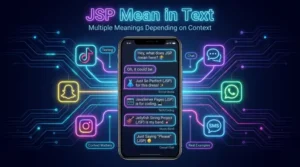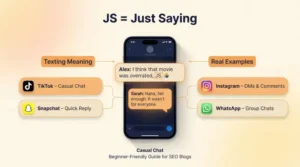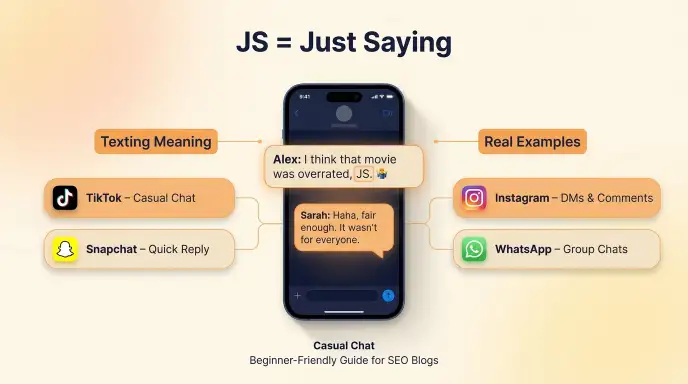
JS usually means “just saying” in text messages and casual online conversations. People use it to add an opinion, observation, or suggestion without making it sound too serious. You may see JS in texting, TikTok comments, Snapchat, Instagram, and WhatsApp chats.
For example, someone might text, “That restaurant is expensive, JS.” Here, JS means “just saying.” The person is simply pointing something out.
People often search for JS meaning in text because the abbreviation can have different meanings depending on context. In casual conversations, it can mean “just saying,” while in technology related discussions, JS commonly means JavaScript.
This guide explains the texting meaning of JS, where people use it, how to reply, and how to tell if someone means “just saying” or “JavaScript.”
What Does JS Mean in Text?
In casual texting, JS usually means “just saying.” It is an informal abbreviation used when someone wants to make a comment, opinion, suggestion, or observation.
For example:
“ You should probably leave earlier, JS.”
The speaker is giving a suggestion without making it sound like an order.
Simple Meaning of JS
The easiest way to understand JS is:
JS = Just Saying
It can be similar to phrases such as:
- “I’m just saying.”
- “Just a thought.”
- “That’s all I’m saying.”
- “I’m only pointing it out.”
- “Just my observation.”
The exact tone depends on the conversation.
Is JS Slang or an Abbreviation?
In texting, JS is an abbreviation or initialism rather than a traditional slang word.
It comes from the first letters of “just saying.”
People use it because typing two letters is quicker than writing the entire phrase. It also fits the short and informal style of digital conversations.
What Does JS Mean in Everyday Chat?
Imagine a friend says:
“You have ordered pizza three times this week, JS.”
The person is not necessarily criticizing you. They are simply pointing something out.
Another example is:
“You two would actually make a cute couple, JS 😂”
Here, JS makes the statement sound more casual.
However, JS does not automatically make every statement friendly. Someone can use it after criticism or sarcasm.
For example:
“Maybe you should check the instructions next time, JS.”
The tone comes from the entire message, not just the abbreviation.
JS Can Have More Than One Meaning
One reason JS can be confusing is that it has more than one common meaning.
In casual texting:
JS = Just Saying
In technology:
JS = JavaScript
For example:
“I’m learning JS for my website.”
Here, the person most likely means JavaScript.
The subject of the conversation is the biggest clue.
JS in a Casual Conversation
“That movie was way too long, JS.”
In this situation, JS most likely means “just saying.”
JS in a Technology Conversation
“This project uses JS and HTML.”
Here, JS means JavaScript because the conversation is about programming.
Why Context Matters
Short abbreviations can have different meanings depending on the subject.
If someone is talking about friends, relationships, food, fashion, or everyday life, “just saying” may be the intended meaning.
If they are talking about coding, websites, software, or programming, JS probably means JavaScript.
Where People Use JS
JS can appear across many casual communication platforms.
JS on TikTok
On TikTok, people may use JS in comments, replies, captions, or private messages.
For example:
“That transition was actually perfect, JS.”
The person is simply sharing an observation.
Another example:
“You should make more videos like this, JS.”
The abbreviation keeps the comment informal.
JS on Snapchat
Snapchat conversations are generally casual, so short abbreviations can fit naturally.
Someone might send:
“You looked really happy in that picture, JS.”
Or:
“You should definitely go 😂 JS.”
The sender is giving an observation or suggestion.
JS on Instagram
Instagram users may use JS in comments and DMs.
For example:
“That color actually suits you, JS.”
Or:
“You guys look like siblings, JS 😂”
The abbreviation can make the message feel conversational.
JS on WhatsApp
WhatsApp users often use short forms when chatting with friends and family.
A conversation might include:
“I think we should leave earlier tomorrow, JS.”
Here, JS means “just saying.”
It can also appear in group chats when someone wants to share an opinion without turning it into a serious debate.
JS in SMS and Text Messages
JS can also appear in traditional text messages.
For example:
“You might want to bring a jacket tonight, JS.”
The sender is making a suggestion while keeping the message informal.
Real Chat Examples
Seeing JS in realistic conversations makes the meaning easier to understand.
Example 1: Talking About Food
A: We should order pizza tonight.
B: Again? 😂
A: You know you want some.
B: I really do.
A: We’ve had pizza three times this week, JS.
Here, JS means “just saying.”
Example 2: Giving a Friend Advice
A: Should I apply for that job?
B: Definitely.
A: Even though I don’t have much experience?
B: You should try anyway, JS.
The speaker is offering an opinion.
Example 3: Commenting on an Outfit
A: What do you think of this jacket?
B: Honestly, it looks great.
A: Really?
B: Yeah, it suits you, JS.
The abbreviation makes the comment sound casual.
Example 4: Talking About a Movie
A: Did you like the new movie?
B: It was okay.
A: I thought it was too long.
B: Same, JS.
Here, JS adds emphasis to the speaker’s observation.
Example 5: Friendly Teasing
A: I’m not buying anything today.
B: You said that last weekend.
A: And I meant it.
B: Your shopping bag says otherwise 😂
A: Okay, JS.
The conversation uses JS in a playful way.
Example 6: Relationship Advice
A: Should I text her first?
B: If you want to talk to her, yes.
A: I don’t want to seem desperate.
B: One message isn’t desperate, JS.
The speaker is giving an opinion without making it sound overly serious.
Example 7: School Conversation
A: Did you finish the assignment?
B: Almost.
A: You should probably check the last question.
B: Why?
A: It looks different from the others, JS.
Here, JS means the person is simply pointing something out.
Example 8: Instagram DM
A: Did you see my new picture?
B: Yeah!
A: What do you think?
B: The background looks really good, JS.
The speaker is giving a casual observation.
Example 9: Group Chat
A: Who wants to go out Saturday?
B: Me.
C: Same.
D: We should go somewhere new, JS.
The abbreviation makes the suggestion informal.
Example 10: Casual Text
A: I might start going to the gym again.
B: You should.
A: You think so?
B: Yeah, you always feel better afterward, JS.
Here, JS works like “that’s just my opinion.”
How to Reply When Someone Says “JS”
How you respond depends on what the person is saying.
If JS means “just saying,” you can simply respond to the actual statement.
Funny Replies
If the conversation is playful, you could say:
- “Okay, Captain Obvious 😂”
- “You really had to say it.”
- “I heard you 😂”
- “Noted!”
- “You’re not wrong.”
- “Fair enough 😂”
Casual Replies
For a normal conversation, try:
- “Yeah, fair point.”
- “I get what you mean.”
- “True.”
- “That makes sense.”
- “Good point.”
- “I see your point.”
Friendly Replies
If you want to keep the conversation warm:
- “Haha, I know what you mean.”
- “You might be right.”
- “Thanks for pointing that out.”
- “Honestly, I agree.”
- “Fair enough 😂”
Neutral Replies
If you are unsure about the person’s tone:
- “Okay, I understand.”
- “Got it.”
- “I see.”
- “Thanks for letting me know.”
- “That’s a fair observation.”
The best response usually depends more on the sentence before JS than on the abbreviation itself.
Is JS Rude or Offensive?
JS is not inherently rude or offensive. It is a casual abbreviation that normally means “just saying.”
However, the tone can change depending on how someone uses it.
Can JS Sound Sarcastic?
Yes.
Consider:
“Maybe you should read the instructions next time, JS.”
Although JS itself is harmless, the complete message may sound sarcastic or critical.
Compare it with:
“That color looks really good on you, JS.”
The second example sounds much more positive.
Is JS Safe to Use?
In casual conversations, JS is generally fine when everyone understands texting abbreviations.
It can work well between:
- Friends
- Family members
- Online friends
- Group chat members
- Social media users
Is JS Appropriate at School?
It depends on the setting.
A casual text to a friend can easily contain JS.
Formal school assignments should not normally use texting abbreviations unless the assignment is specifically about internet language.
Is JS Appropriate at Work?
In professional emails and formal workplace communication, it is better to avoid ambiguous texting abbreviations.
Instead of:
The numbers may need another review, JS.
It might be a good idea to check the numbers again.
That sounds clearer and more professional.
Who Uses This Term?
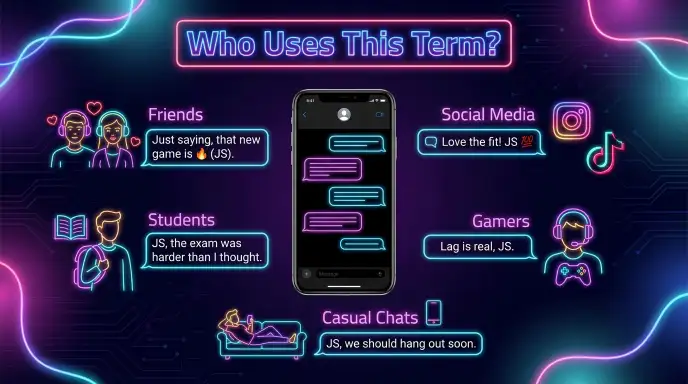
JS as “just saying” is mainly used by people who are comfortable with informal digital communication.
Teenagers and Young Adults
Younger people frequently encounter abbreviations through texting, social media, gaming, and group chats.
Gen Z Usage
Gen Z users often communicate through short messages, abbreviations, emojis, and internet expressions. JS can fit naturally into that style.
However, not every Gen Z user uses JS. Internet slang varies between individuals, platforms, and communities.
Adults Can Use JS Too
JS is not limited to teenagers.
Adults may also use it when texting friends, family members, or people they know well.
Common Platforms
You may see JS in:
- TikTok comments
- Instagram DMs
- Snapchat messages
- WhatsApp chats
- SMS
- Group chats
- Online forums
- Gaming communities
Origin of the Term
The exact moment when people first started using JS as an abbreviation for “just saying” is difficult to identify.
It follows a common pattern in internet language: people shorten frequently used phrases to save time while typing.
The phrase “just saying” existed long before social media. As texting and online messaging became more common, users began shortening familiar expressions.
Why “Just Saying” Became Shortened
Instead of typing:
“I’m just saying.”
someone can write:
“JS.”
This is convenient when both people already understand the abbreviation.
Internet Culture and JS
Social media helped popularize many short forms of communication.
Users communicate through abbreviations, acronyms, emojis, initialisms, and shortened phrases.
There does not appear to be one universally accepted person or event that can be identified as the creator of JS meaning “just saying.” Its development is better understood as part of the broader evolution of informal digital language.
JS vs JavaScript: How to Tell the Difference
One of the most important things to remember is that JS does not always mean “just saying.”
In technology and programming, JS is a common abbreviation for JavaScript.
Example of “Just Saying”
“You should give that restaurant another chance, JS.”
This is a casual conversation, so “just saying” makes sense.
Example of “JavaScript”
“I’m learning JS because I want to build websites.”
Here, the topic is programming, so JS means JavaScript.
Quick Context Test
Ask yourself if the conversation is about opinions or everyday life.
If yes, JS may mean “just saying.”
If the conversation is about programming, websites, coding, or software, JS probably means JavaScript.
Context usually solves the confusion.
Comparison: JS, IDK, IDC, IMO, and BRB
| Term | Meaning | Type | Usage | Popularity |
| JS | Just Saying | Texting abbreviation | Casual observations, opinions, or comments | Common in informal chats |
| IDK | I Don’t Know | Texting abbreviation | Showing uncertainty or lack of knowledge | Very common |
| IDC | I Don’t Care | Texting abbreviation | Showing indifference | Very common |
| IMO | In My Opinion | Texting abbreviation | Introducing a personal opinion | Common |
| BRB | Be Right Back | Texting abbreviation | Temporarily leaving a conversation | Very common |
These abbreviations are not interchangeable. Each one serves a different purpose in a conversation.
Real World Usage Example
Imagine two friends are planning what to eat after school.
One friend says:
“I don’t really care where we go.”
The other replies:
“That new restaurant looks good, JS.”
In this situation, JS means “just saying.”
The person is not demanding that they go to the restaurant. They are simply making a suggestion.
Another everyday example could happen while shopping.
A friend tries on a jacket and asks:
“Does this look good?”
The other person says:
“The black one suits you more, JS.”
Again, the speaker is offering an opinion rather than giving an order.
How JS Changes the Tone of a Message
The placement of JS can slightly affect how a message feels.
At the End of a Sentence
“You should probably leave earlier, JS.”
This sounds like a casual suggestion.
With an Opinion
“I think the first option is better, JS.”
This makes the opinion sound less forceful.
With Humor
“You have ordered coffee four times today, JS 😂”
The emoji can make the observation feel more playful.
With Criticism
“Maybe check your spelling next time, JS.”
This may sound more critical depending on the relationship between the speakers.
The abbreviation does not completely control the tone. The words, punctuation, emojis, and relationship between the speakers all matter.
Common Mistakes When Understanding JS
Because JS has multiple meanings, beginners can easily misunderstand it.
Assuming It Always Means “Just Saying”
If someone writes:
“This website was built with JS.”
they almost certainly mean JavaScript.
Ignoring the Conversation
Always consider what people are discussing before interpreting an abbreviation.
Thinking JS Automatically Makes a Statement Friendly
It does not.
A sarcastic or rude statement can still sound rude even if JS appears at the end.
Using It in Formal Writing
Texting abbreviations are usually better suited to casual communication.
If you are writing a report, application, essay, or professional email, write the full phrase instead.
JS in Group Chats
Group chats are a common place to encounter short abbreviations.
A: We should meet earlier tomorrow.
B: Why?
A: Traffic is usually terrible at that time.
C: Yeah, leaving early makes sense, JS.
Here, JS allows C to add an opinion without making it sound like an instruction.
Group chats also move quickly, so short forms can make conversations easier to follow.
JS in Social Media Comments
Social media comments often contain very short messages.
Someone might comment:
“You should definitely post more videos like this, JS.”
Or:
“That second outfit was better, JS 😂.”
In these cases, JS functions like a casual way of saying “That’s just my observation.”
It can be useful when someone wants to express an opinion without sounding too demanding.
When You Should Avoid Using JS
Although JS is useful in casual conversations, there are situations where the full phrase is better.
Avoid using JS when:
- Writing a formal school assignment
- Sending a professional email
- Communicating with customers
- Writing an official document
- Discussing a serious issue
- Talking to someone who may not understand internet abbreviations
For example, instead of:
“You may want to check that again, JS.”
a professional message could say:
“You may want to review that again.”
The second version is clearer and more appropriate for formal communication.
Frequently Asked Questions
What does JS mean in text messages?
JS usually means “just saying.” It is used to introduce a casual opinion, observation, suggestion, or comment.
What does JS mean on TikTok?
On TikTok, JS can mean “just saying” when it appears in a casual comment, caption, reply, or DM. Context is important because JS can also mean JavaScript.
Is JS slang?
JS is a casual texting abbreviation or initialism. When it means “just saying,” it is mainly used in informal digital communication.
Is JS rude or offensive?
JS is not inherently rude or offensive. However, the complete sentence can sound sarcastic or critical depending on the words and context.
How should you reply to JS?
Reply to the statement itself. You can say “fair point,” “I get what you mean,” “true,” or simply continue the conversation. If the meaning is unclear, ask for clarification.
Conclusion
The most common texting meaning of JS is “just saying.” People use it to add a casual opinion, observation, suggestion, or comment. It is informal and generally suitable for conversations with friends and other people who understand texting abbreviations.
You may see JS across TikTok, Snapchat, Instagram, WhatsApp, SMS, and group chats. However, it is not appropriate for every situation. For school assignments, professional emails, and formal communication, writing the complete phrase or explaining the idea directly is clearer.
Remember that JS can also mean JavaScript. If you see it in a conversation about coding, websites, programming, or technology, JavaScript is probably the intended meaning. Looking at the surrounding context is the easiest way to understand JS correctly.
Explore more slang!

Hi, I’m Liam Carter, a slang language enthusiast and content writer. I research internet slang, social media terms, texting abbreviations, and online expressions to help readers understand modern English. I enjoy breaking down trending slang into simple, easy-to-read explanations with real-world examples, making online communication clearer and more enjoyable.