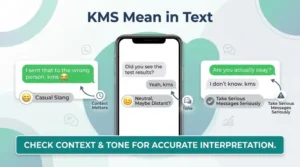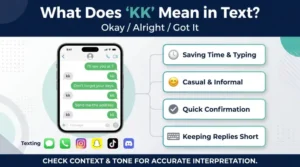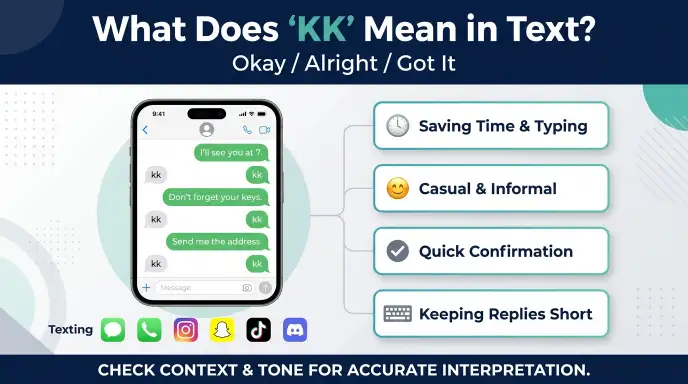
“kk mean in text” usually refers to “kk,” a casual way to say “okay,” “alright,” or “got it” in texting. You may see it in everyday chats, TikTok, Snapchat, Instagram, WhatsApp, and other messaging platforms.
People use kk when they want to acknowledge a message quickly without typing the full word “okay.” It is especially common in relaxed conversations with friends, family, classmates, or online contacts.
If you searched for kk mean in text, you may have seen someone reply with “kk” and wondered if it has a hidden meaning. In most everyday conversations, it is simply a short way to acknowledge what someone said.
The exact tone can depend on context. A simple “kk” may sound neutral and casual, while the same reply during a serious conversation could feel brief or distant.
Quick Answer
KK usually means “okay,” “alright,” “sure,” or “got it” in text messages. It is an informal chat expression used to acknowledge information, agree to something, or confirm that a message was understood.
For example:
A: “I’ll meet you at 7.”
B: “kk”
Here, kk means “okay” or “alright.”
It is generally casual rather than formal, so it is more suitable for everyday conversations than professional emails or formal messages.
kk mean in text: What Does KK Mean?
The most common meaning of KK in texting is “okay.”
It works as a quick acknowledgment. Instead of typing “okay,” “alright,” or “got it,” someone may simply type kk.
For example:
A: “Don’t forget your charger.”
B: “kk”
The response means:
“Okay, I got it.”
KK is not normally an acronym where each K represents a separate word. It is better understood as an informal chat abbreviation or expression.
Is KK Slang or an Abbreviation?
KK is generally treated as an informal texting abbreviation or chat expression.
It is related to the use of K as a short form of “okay.” Repeating the K creates KK, which many people use as a casual acknowledgment.
You may notice small differences between these replies:
K : extremely short and sometimes perceived as cold.
KK : usually casual and slightly more relaxed.
OK : direct and neutral.
Okay : more complete and clear.
Okay! : can sound more positive or enthusiastic.
These are not strict rules. People have different texting habits, so the meaning and tone should always be considered in context.
What Does KK Mean in Everyday Chat?
In everyday conversations, kk can communicate several similar ideas.
It may mean:
- “Okay.”
- “Alright.”
- “Got it.”
- “Sure.”
- “Understood.”
- “Sounds good.”
For example:
A: “We are leaving at 8 instead.”
B: “kk sounds good”
Here, the person is saying:
“Okay, that sounds good.”
Another example:
A: “Send me the address when you get it.”
B: “kk”
The response means the person understands the request.
The surrounding conversation is important because short texting expressions often depend on context.
Where People Use KK
KK is mostly used in informal digital communication. It can appear in private messages, group chats, social media conversations, gaming chats, and regular texting.
KK on TikTok
On TikTok, people may use kk in comments, direct messages, or conversations with other users.
For example:
A: “I’ll send you the video later.”
B: “kk”
Here, KK simply acknowledges the message.
TikTok users often communicate with short expressions because online conversations can move quickly. Terms such as lol, idk, brb, and kk can all appear in casual conversations.
However, context still matters. A username, fandom term, or community specific expression could have a different meaning.
KK on Snapchat
Snapchat conversations are usually informal, making short replies such as kk fairly natural.
For example:
A: “Send me the location.”
B: “kk”
This means the person has understood the request.
You may also see:
“kk lol”
or
“kk I got it.”
Adding other words can make the message feel more conversational.
KK on Instagram
On Instagram, kk can appear in DMs and casual conversations.
For example:
A: “I posted the pictures.”
B: “kk I’ll check them.”
Here, KK means something like “okay” or “alright.”
It is more likely to appear in informal messages than in formal communication.
KK on WhatsApp
WhatsApp is another common setting for short acknowledgment messages.
For example:
A: “I’m going to the store. Do you need anything?”
B: “kk no thanks”
The person is essentially saying:
“Okay, no thanks.”
In a group conversation, someone might write:
“kk see you there.”
Again, the basic meaning is “okay.”
KK in SMS
People can also use KK in traditional SMS conversations.
For example:
A: “Your appointment is at 4 tomorrow.”
B: “kk”
The reply confirms that the person received the information.
Although messaging apps are now widely used, short texting expressions remain common in casual digital communication.
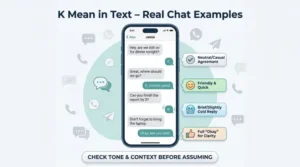
Real Chat Examples
The easiest way to understand kk is to see it in realistic conversations.
Example 1: Confirming a Plan
A: “We’re meeting at 6 instead.”
B: “kk”
B is simply saying “okay.”
Example 2: Agreeing to Something
A: “Can you send me the notes tonight?”
B: “kk sure”
B is agreeing to send the notes.
Example 3: A Quick Acknowledgment
A: “Don’t forget your keys.”
B: “kk”
Here, KK means “got it.”
Example 4: Casual Conversation
A: “I’m going offline for a while.”
B: “kk talk later”
The reply is casual and relaxed.
Example 5: Making Plans
A: “Let’s meet outside the café.”
B: “kk what time?”
The first part acknowledges the plan, while the second part asks for more information.
Example 6: Responding to a Request
A: “Can you call me when you get home?”
B: “kk”
This means the person has acknowledged the request.
Example 7: School Friends
A: “The assignment is due tomorrow.”
B: “kk thanks”
Here, KK means “okay,” followed by thanks.
Example 8: Group Chat
A: “Everyone meet at the entrance.”
B: “kk”
This is a short confirmation.
Example 9: Changing Plans
A: “I can’t come at 5. Is 7 okay?”
B: “kk 7 works”
B agrees to the new time.
Example 10: Ending a Conversation
A: “I have to go now. I’ll message you later.”
B: “kk bye”
KK works as a casual acknowledgment before ending the conversation.
How to Reply When Someone Says “KK”
If someone sends you kk, your response depends on the conversation.
Sometimes you do not need to reply because KK may already be a natural ending.
If you want to continue the conversation, you can respond normally.
Funny Replies
With a close friend, you could use a playful response.
You: “Only two Ks? 😂”
You: “The double K has spoken.”
You: “kk accepted.”
These replies are best for casual conversations where both people understand the humor.
Casual Replies
You can simply answer:
- “Cool.”
- “Sounds good.”
- “Alright.”
- “Okay.”
- “Gotcha.”
- “Perfect.”
For example:
A: “I’ll meet you there at 7.”
B: “kk”
A: “Sounds good.”
Friendly Replies
If you want your response to sound warmer, you can say:
- “Okay, thanks!”
- “Sounds good 😊”
- “Alright, see you then!”
- “Perfect, thanks!”
These responses can make the conversation feel more friendly.
Neutral Replies
For a simple and clear response, use:
- “Okay.”
- “Alright.”
- “Sure.”
- “Got it.”
- “Understood.”
The best response depends on the situation rather than the expression alone.
Is KK Rude or Offensive?
KK is not normally considered rude or offensive.
It is a common informal way to acknowledge a message.
However, because it is very short, some people may interpret it differently depending on the situation.
For example:
“kk”
is much shorter than:
“Okay, thanks!”
The first could sound casual, rushed, or slightly distant to some readers.
That does not necessarily mean the sender is being rude.
Is KK Safe to Use?
In casual conversations with friends, classmates, family members, and online contacts, kk is generally fine.
The main thing to remember is that it is informal.
In a professional setting, a complete response is usually clearer.
For example, instead of:
“kk”
you could write:
“Okay, understood. Thanks.”
Can You Use KK at School?
Among friends or classmates, KK is generally appropriate.
For example:
Friend: “The project is due tomorrow.”
You: “kk thanks”
That sounds natural in a casual conversation.
When communicating with a teacher, however, a more complete response is usually better.
For example:
“Okay, thank you for letting me know.”
Can You Use KK at Work?
This depends on the workplace and the person you are messaging.
A close coworker may understand kk as a casual acknowledgment. However, in formal emails, client communication, or important professional messages, clearer wording is preferable.
Instead of:
“kk”
you could say:
“Okay, understood. Thank you.”
This makes the message more professional.
Who Uses This Term?
KK is mainly associated with informal texting and online communication.
People from different age groups can use it, particularly those who regularly communicate through messaging apps.
Gen Z Usage
You may see kk in conversations involving Gen Z because short digital expressions are common in fast paced online communication.
However, KK is not exclusive to Gen Z.
Older internet users can also use the expression, especially if they regularly communicate through text or instant messaging.
Common Platforms
KK can appear on:
- TikTok
- Snapchat
- SMS
- Discord
- Online gaming chats
- Private messaging apps
The basic meaning usually stays the same across these platforms.
How Often Does KK Appear Online?
KK is a recognizable casual texting expression, but its frequency depends on the platform, community, age group, and individual writing style.
Some people prefer “k.”
Others prefer “kk.”
Some people simply write “okay,” “ok,” “alright,” or “sure.”
There is no universal rule about which one everyone should use.
Origin of the Term
The exact origin of kk as a texting expression is not completely clear.
It developed within the broader culture of shortened digital communication. As people began communicating through instant messaging and text, shorter responses became increasingly common.
The single letter K became a widely recognized shorthand for “okay.” Repeating the letter created KK, which became another casual way to acknowledge a message.
There is no universally accepted single person, website, or event that can be identified as the definitive origin of modern texting KK.
Its development is better understood as part of the evolution of informal internet and texting language.
KK vs Other Common Texting Abbreviations
| Term | Meaning | Type | Usage | Popularity |
| KK | Okay / alright | Chat abbreviation | Quick acknowledgment | Common |
| IDK | I don’t know | Acronym | Expressing uncertainty | Very common |
| IDC | I don’t care | Acronym | Showing indifference | Common |
| IMO | In my opinion | Acronym | Giving an opinion | Common |
| BRB | Be right back | Acronym | Temporarily leaving a chat | Common |
These expressions have different purposes.
KK acknowledges something.
IDK communicates uncertainty.
IDC communicates indifference.
IMO introduces an opinion.
BRB tells someone that the speaker is temporarily leaving the conversation.
Understanding these differences can make texting and social media conversations easier to follow.
Real World Usage Example
Imagine two friends are making plans for the weekend.
One friend sends:
“The movie starts at 8, so let’s meet at 7:30.”
The other replies:
“kk I’ll be there.”
In this situation, KK is simply a quick confirmation.
The person is saying that they understand the plan and agree to it.
Now consider another conversation:
A: “Are you still coming?”
B: “kk”
This response may be less clear.
Depending on the previous conversation, B could mean “okay,” “yes,” or simply “I understand.”
This shows why context matters when interpreting short texting expressions.
When KK Can Be Misunderstood
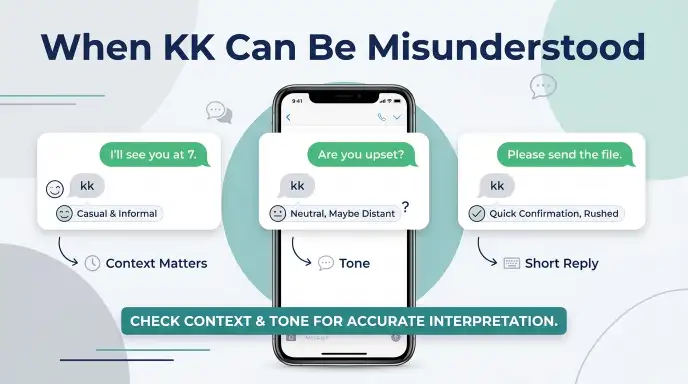
Although the basic meaning is simple, the tone can sometimes be unclear.
Consider this conversation:
A: “Do you want to come with us?”
B: “kk”
A might wonder exactly what B means.
Does B mean:
- “Okay, I’ll come.”
- “Okay, I understand.”
- “Sure.”
- “Okay, whatever.”
The previous messages usually provide the answer.
These are tone differences rather than different dictionary meanings.
KK vs K: Are They Different?
KK and K can both mean “okay,” but they can sometimes create different impressions.
A single K is extremely brief.
Because of this, some people may interpret it as cold or dismissive, especially during a serious conversation.
KK often feels more casual.
For example:
A: “I’ll see you tomorrow.”
B: “K”
This can simply mean “okay.”
But:
A: “I’ll see you tomorrow.”
B: “kk”
may feel slightly more relaxed.
Still, you should not automatically assume that someone using K is angry or someone using KK is friendly. Personal texting habits vary.
Should You Use KK in Every Conversation?
Not necessarily.
KK works best when the conversation is informal and the other person understands casual texting language.
It can work well with:
- Friends
- Family members
- Classmates
- Casual group chats
- Online friends
- Gaming communities
- Informal social media conversations
You may want to avoid it in:
- Formal emails
- Job applications
- Professional messages
- Academic communication
- Important customer communication
In these situations, a complete response is usually more appropriate.
Instead of:
“kk”
you could write:
“Okay, understood.”
or:
“Sure, thank you.”
This makes your meaning clearer.
Frequently Asked Questions
1. What does kk mean in text messages?
KK usually means “okay,” “alright,” or “got it.” It is an informal texting expression used for quick acknowledgment.
2. What does kk mean on TikTok?
On TikTok, KK usually means “okay” or “alright” when used in comments, DMs, or casual conversations.
3. Is kk slang?
Yes. KK is commonly used as an informal texting or chat expression rather than formal written English.
4. Is kk rude or offensive?
No. KK is not normally rude or offensive, although its short format can sometimes feel distant depending on the conversation.
5. How should you reply to kk?
You can reply with “okay,” “sure,” “sounds good,” “alright,” or another natural response. If the conversation is finished, you may not need to reply.
Conclusion
KK usually means “okay,” “alright,” “sure,” or “got it” in text conversations. It is an informal expression commonly used in casual digital communication.
You may see it on TikTok, Snapchat, Instagram, WhatsApp, SMS, Discord, and other messaging platforms. People mainly use it to acknowledge information, confirm a plan, or show agreement quickly.
KK is generally not rude or offensive, but its short format can sometimes be interpreted differently depending on the conversation. For formal school or workplace communication, a clearer response such as “Okay, understood” is usually more suitable.
Discover more about slang!

Hi, I’m Michael Harris, a writer with a strong interest in language, communication, and modern slang. I enjoy researching the origins and meanings of everyday words and turning that knowledge into simple, engaging content. My goal is to help readers understand English expressions with clear explanations, practical examples, and easy-to-read guides.