If you’ve heard someone say “No tengo pisto” or “Necesito más pisto,” you may be wondering what the word “pisto” means. Although “pisto” has a standard meaning in Spanish as the name of a traditional vegetable dish in Spain, it’s also a popular slang word in several Latin American countries.
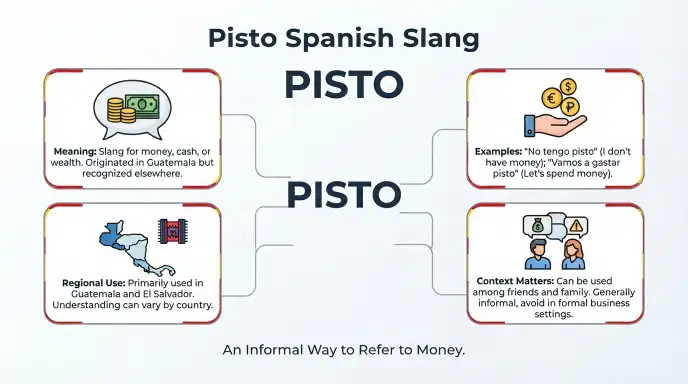
In slang, “pisto” most commonly means “money.” It’s an informal term used in everyday conversations, especially in countries like Guatemala, El Salvador, Honduras, and parts of Central America. Depending on the country, however, the word can have different meanings, so understanding the context is important.
In this guide, you’ll learn the pisto Spanish slang meaning, where it’s used, its different definitions, pronunciation, and plenty of real life examples.
What Does Pisto Mean in Spanish Slang?
Quick Answer
In Spanish slang, “pisto” most commonly means “money” or “cash.” It’s an informal word people use when talking about having money, spending money, or needing money.
For example:
“No tengo pisto.”
Meaning:
“I don’t have any money.”
What Does Pisto Literally Mean?
Outside of slang, “pisto” has a completely different meaning.
In Spain, pisto is a traditional vegetable dish made with tomatoes, peppers, onions, zucchini, and olive oil. It’s similar to the French dish ratatouille.
Because of these two meanings, the context tells you if someone is talking about food or money.
Where Is Pisto Used as Slang?
The slang meaning of “pisto” is most common in Central America, especially in countries such as Guatemala, El Salvador, and Honduras. In these places, it’s a normal part of everyday speech and is widely understood.
Spanish speakers from other countries may recognize the term, but they often use different slang words for “money,” such as “lana,” “plata,” “varo,” or “feria.”
Meaning 1: Money or Cash
Meaning
This is the most common slang meaning of “pisto.”
People use it when talking about money in general.
Tone and Context
The tone is casual and informal. Friends and family commonly use it in everyday conversations.
Examples
“No tengo pisto para salir esta noche.”
Meaning:
“I don’t have money to go out tonight.”
“Necesito ganar más pisto.”
Meaning:
“I need to earn more money.”
Meaning 2: Having Enough Money
Meaning
“Pisto” can also refer to having enough cash to buy something or pay for an activity.
Tone and Context
It’s often heard when discussing shopping, travel, food, or daily expenses.
Examples
“¿Tienes pisto?”
Meaning:
“Do you have any money?”
“Ya tengo pisto para comprar el teléfono.”
Meaning:
“Now I have enough money to buy the phone.”
How Do You Pronounce Pisto?
“Pisto” is pronounced:
PEES toh
The stress falls on the first syllable:
PIS to
The pronunciation stays the same if it’s used as slang or in its standard dictionary meaning.
Is Pisto Formal or Informal?
“Pisto” is an informal slang word when it means “money.”
It’s appropriate for conversations with friends, relatives, classmates, and coworkers you know well.
In formal situations, Spanish speakers usually choose words like:
- Dinero
- Efectivo
- Fondos
These are more suitable for business or academic settings.
How to Use Pisto in Everyday Conversations
When “pisto” means money, it is used just like the English words “cash” or “bucks.” Native speakers use it naturally in casual conversations about work, shopping, bills, travel, or daily expenses.
Example 1
Carlos: “¿Vamos al cine?”
Miguel: “No tengo pisto.”
Meaning:
Carlos: “Are we going to the movies?”
Miguel: “I don’t have any money.”
Example
Ana: “¿Ya te pagaron?”
Luis: “Sí, ya tengo pisto.”
Meaning:
Ana: “Did you get paid?”
Luis: “Yes, now I have money.”
Example 3
Friend: “¿Cuánto pisto necesitas?”
Meaning:
“How much money do you need?”
Example 4
Friend: “Estoy ahorrando pisto para viajar.”
Meaning:
“I’m saving money to travel.”
Example 5
Friend: “Gasté todo mi pisto.”
Meaning:
“I spent all my money.”
Is Pisto Used on Social Media?
Yes. In countries where “pisto” is common slang, you’ll often see it used on social media platforms like Facebook, TikTok, Instagram, X (formerly Twitter), and YouTube comments.
People use it when talking about salaries, shopping, vacations, funny memes, or everyday life.
For example:
“Necesito más pisto para estas vacaciones.”
Meaning:
“I need more money for this vacation.”
Although it’s not as common internationally as some internet slang, it’s widely understood in Central America.
Pisto vs. Dinero
Many Spanish learners wonder if they should use “pisto” or “dinero.”
Pisto
“Pisto” is informal slang that means money. It’s mainly used in Guatemala, El Salvador, Honduras, and nearby countries.
Example:
“No tengo pisto.”
Dinero
“Dinero” is the standard Spanish word for money. It is understood in every Spanish speaking country and works in both formal and informal situations.
Example:
“No tengo dinero.”
If you’re learning Spanish for general communication, “dinero” is always the safest choice. If you’re speaking with people from Central America, “pisto” will sound more natural in casual conversations.
Similar Spanish Slang Words for Money
Different Spanish speaking countries have their own slang terms for money.
Plata
One of the most common slang words for money in many Latin American countries.
Example:
“No tengo plata.”
Lana
Common in Mexico.
Example:
“Necesito más lana.”
Varo
Another popular Mexican slang word for money.
Example:
“No traigo varo.”
Feria
Used in parts of Mexico and Central America to refer to money or loose change.
Example:
“¿Tienes feria?”
Billete
Literally means “banknote,” but it can also refer to money in casual conversations.
Example:
“Tiene mucho billete.”
Is Pisto Positive or Negative?
“Pisto” itself is a neutral slang word. It simply refers to money and doesn’t carry a positive or negative meaning.
if it sounds positive or negative depends on the sentence.
Positive example:
“Por fin tengo pisto.”
Meaning:
“I finally have money.”
Negative example:
“Me quedé sin pisto.”
Meaning:
“I ran out of money.”
Can Tourists Use Pisto?
Yes, but only in the right places.
If you’re traveling in Guatemala, El Salvador, or Honduras, using “pisto” in casual conversations will sound natural.
However, if you’re visiting Spain, Argentina, Colombia, Peru, or many other Spanish speaking countries, people are more likely to use different slang words or simply say “dinero.”
For this reason, it’s helpful to learn which slang terms are common in the country you’re visiting.
Common Mistakes About Pisto
Because “pisto” has different meanings depending on the country, many Spanish learners misunderstand how to use it.
Mistake 1: Thinking Pisto Always Means Money
In Central America, “pisto” usually means “money.” However, in Spain, “pisto” is the name of a traditional vegetable dish. The meaning depends on the country and the context.
For example:
“Comimos pisto para la cena.”
Here, “pisto” refers to the Spanish dish, not money.
Mistake 2: Using Pisto in Formal Situations
“Pisto” is informal slang. It’s perfectly acceptable in casual conversations with friends or family, but it shouldn’t be used in business meetings, official documents, or academic writing.
Instead, use the standard Spanish word “dinero.”
Mistake 3: Assuming Every Spanish Speaker Uses Pisto
Not every Spanish speaking country uses “pisto” as slang for money.
Someone from Guatemala or El Salvador will likely understand it immediately, while someone from Spain, Chile, or Argentina may not use the word in the same way.
Learning regional slang helps you communicate more naturally.
Should You Use Pisto?
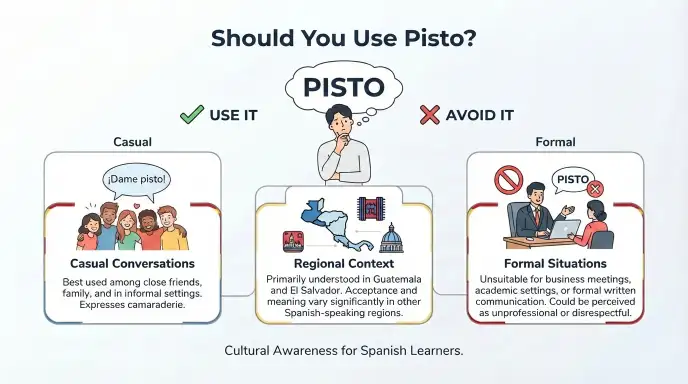
Yes, if you’re speaking casually with people from countries where the slang is commonly used.
When You Can Use Pisto
“Pisto” sounds natural when talking with friends, family members, classmates, or coworkers in Guatemala, El Salvador, Honduras, and nearby regions.
It’s commonly used when discussing salaries, shopping, travel, food, and everyday expenses.
When You Should Avoid Pisto
Avoid using “pisto” in:
- Business meetings
- Professional emails
- Academic writing
- Government documents
- Formal speeches
In these situations, “dinero” is the more appropriate choice.
Tips for Using Pisto Naturally
Understanding your audience is the key to using “pisto” correctly.
If you’re talking with Central American Spanish speakers, “pisto” is a natural and common way to say “money.”
If you’re unsure which regional slang people use, choosing “dinero” is always a safe option because it’s understood throughout the Spanish speaking world.
Listening to native speakers and paying attention to regional vocabulary will also help you know when slang like “pisto” fits naturally into a conversation.
Frequently Asked Questions
What does pisto mean in Spanish slang?
In Spanish slang, “pisto” usually means “money” or “cash.” It is commonly used in Guatemala, El Salvador, Honduras, and other parts of Central America.
Does pisto always mean money?
No. In Spain, “pisto” is a traditional vegetable dish. In several Central American countries, it’s informal slang for money.
Which countries use pisto as slang?
The slang meaning is most common in Guatemala, El Salvador, Honduras, and some neighboring Central American countries.
Is pisto formal or informal?
“Pisto” is an informal slang word. For formal situations, use “dinero” instead.
Can I use pisto in Spain?
If you say “pisto” in Spain, many people will think you’re talking about the traditional vegetable dish rather than money. To avoid confusion, use “dinero” when referring to money.
What is the difference between pisto and dinero?
“Dinero” is the standard Spanish word for money and is understood everywhere. “Pisto” is regional slang that is mainly used in parts of Central America.
Is pisto still commonly used?
Yes. In countries where it’s part of everyday speech, “pisto” remains a popular and widely used slang word for money.
Can Spanish learners use pisto?
Yes. If you’re speaking with people from regions where the slang is common, using “pisto” can make your Spanish sound more natural. Just be aware that not every Spanish speaking country uses this word.
Final Thoughts
The slang word “pisto” is a great example of how Spanish vocabulary changes from one country to another. While it refers to a traditional vegetable dish in Spain, it’s a common informal word for “money” in much of Central America.
Knowing the regional meaning of “pisto” will help you better understand conversations, social media posts, and everyday Spanish. if you’re learning Spanish, traveling, or chatting with native speakers, understanding when and where to use “pisto” will make your communication more natural and culturally accurate.
Related slang terms!

Daniel Carter – Short Bio (First Person)
Hi, I’m Daniel Carter, a slang language researcher and content writer. I enjoy exploring internet slang, texting abbreviations, and modern expressions to make them easy for everyone to understand. My goal is to explain slang in clear, simple English with real-life examples so readers can communicate confidently online and stay up to date with the latest language trends.