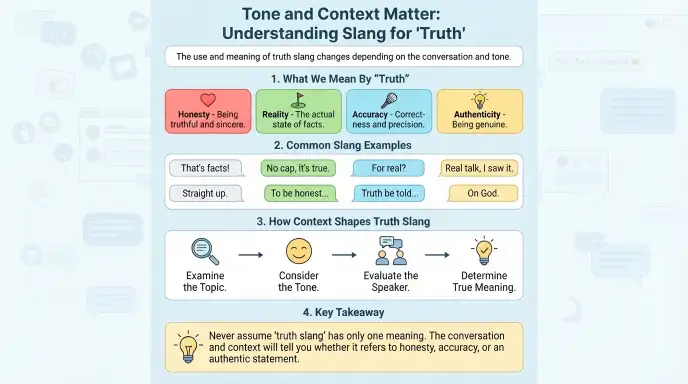
People rarely use the word “truth” by itself in casual conversations online. Instead, they often use slang expressions that make their messages sound more natural, expressive, or entertaining.
if you’re scrolling through TikTok, reading comments on X, chatting on Discord, or texting friends, you’ve probably seen phrases like “facts,” “no cap,” or “real talk.”
These slang terms all relate to truth, but they are not always interchangeable. Some emphasize honesty, while others show agreement or confirm that something is genuine.
This guide explains the most common slang for truth, what each term means, where people use it, and how to use it naturally in everyday conversations.
What Is Slang for Truth?
Slang for truth includes informal words and phrases people use to say that something is honest, accurate, genuine, or believable.
Some expressions simply mean “this is true,” while others emphasize that someone is speaking honestly or that a statement is completely correct.
Featured Snippet Answer
What is slang for truth?
Popular slang for truth includes:
- Facts
- No Cap
- For Real
- Real Talk
- Straight Facts
- Deadass
- On God
- Legit
- For Sure
- Word
Each expression has a slightly different tone and is used in different situations.
Most Common Slang for Truth
Facts
Facts is one of the most common slang words for agreeing that something is completely true.
Tone:
Casual, positive, and supportive.
Examples:
- Facts. I couldn’t agree more.
- That’s facts.
- You’re speaking facts.
No Cap
No cap means “I’m telling the truth” or “I’m not lying.”
Tone:
Confident and informal.
Examples:
- No cap, that movie was amazing.
- He’s the fastest player here, no cap.
For Real
For real asks if something is true or confirms honesty.
Tone:
Friendly and conversational.
Examples:
- Are you for real?
- I’m for real this time.
Real Talk
Real talk introduces an honest opinion or serious conversation.
Tone:
Sincere and thoughtful.
Examples:
- Real talk, you did an amazing job.
- Can we have some real talk?
Straight Facts
Straight facts emphasizes that a statement is completely accurate.
Tone:
Confident and direct.
Examples:
- That’s straight facts.
- Everything she said is straight facts.
Why Do People Use Slang for Truth?
People use slang because it makes conversations sound more natural and expressive.
Instead of repeatedly saying “That’s true,” they choose shorter phrases that better match modern online communication.
These expressions are especially popular among younger users on social media and in texting.
Where Is Slang for Truth Commonly Used?
These expressions appear across many online platforms and everyday conversations.
TikTok
Creators use phrases like “facts” and “no cap” to react to videos or share honest opinions.
Example:
- No cap, this is the best recipe I’ve tried.
People often use truth related slang in comments, captions, and Stories.
Example:
- Facts. Everyone should read this.
X
Users write short replies such as “Real talk” or “That’s facts” to agree with a post.
Example:
- Real talk, this needs more attention.
Discord
Gaming communities use these phrases during chats and voice conversations.
Example:
- No cap, that was our best match today.
Some slang terms appear in casual discussions, although usage varies by community.
Example:
- Facts. I had the same experience.
Text Messages
Friends use these expressions in everyday conversations to sound more natural.
Example:
- For real, I’m coming this time.
Popular Slang Words Related to Truth
Deadass
Deadass means someone is being completely serious or telling the truth.
Tone:
Very casual and common in American slang.
Example:
- I’m deadass. I saw it happen.
On God
On God is used to strongly promise that something is true.
Tone:
Very informal and should be used carefully because it refers to a religious expression.
Example:
- On God, I didn’t touch your phone.
Legit
Legit means something is genuine, real, or trustworthy.
Tone:
Positive and casual.
Example:
- That offer is legit.
Word
Word is used to show agreement or confirm that something is true.
Tone:
Relaxed and conversational.
Example:
- Word. That’s exactly what I was thinking.
For Sure
For sure confirms that something is true or certain.
Tone:
Friendly and widely accepted.
Example:
- For sure, I’ll be there tomorrow.
How to Choose the Right Slang
Not every slang expression fits every situation.
Talking With Friends
Words like “facts,” “for real,” and “no cap” sound natural in casual conversations.
Commenting on Social Media
Short phrases such as “That’s facts” or “legit” work well in comments and replies.
Gaming Chats
Gamers often use “no cap,” “for real,” and “word” during conversations.
Serious Conversations
If you’re discussing an important topic, “real talk” is usually the best choice because it sounds honest without being overly casual.
When Should You Avoid These Slang Terms?
Truth related slang is best for informal communication.
Avoid using it in:
- Business emails
- Job applications
- Academic essays
- Research papers
- Legal documents
- Professional presentations
In formal situations, use words like “true,” “accurate,” “correct,” or “honest” instead.
Common Mistakes When Using Slang for Truth
Thinking Every Term Means the Same Thing
Although these expressions relate to truth, they are not identical.
For example, “no cap” means “I’m not lying,” while “facts” is usually used to agree with someone. “Real talk” often introduces an honest opinion rather than confirming a fact.
Using Slang in Formal Writing
Truth related slang is meant for casual conversations. It should not be used in business reports, academic assignments, or professional emails.
Ignoring Your Audience
Some expressions, such as “deadass” or “on God,” may not be familiar to everyone. Choose words your audience is likely to understand.
Similar Expressions
Honest Truth
This phrase emphasizes complete honesty.
Example:
- That’s the honest truth.
No Lie
No lie means the speaker is being truthful.
Example:
- No lie, that was the best pizza I’ve ever had.
Believe Me
This expression asks someone to trust what you are saying.
Example:
- Believe me, you’ll enjoy the trip.
Seriously

Seriously is often used to show that a statement is genuine.
Example:
- Seriously, you should watch this movie.
Honestly
Honestly introduces a sincere opinion or truthful statement.
Example:
- Honestly, I expected a different result.
Frequently Asked Questions
What is the most common slang for truth?
“Facts” and “no cap” are two of the most popular slang expressions for truth on social media and in everyday conversations.
What does “no cap” mean?
No cap means “I’m telling the truth” or “I’m not exaggerating.”
Is “facts” the same as “truth”?
Not exactly. “Facts” is usually used to agree that someone has made a true or accurate statement.
Is “deadass” a slang word for truth?
Yes. Deadass means someone is completely serious or telling the truth. It is very informal and is mainly used in casual conversations.
Can I use truth related slang at work?
It is better to avoid slang in professional settings. Use clear and formal words such as “true,” “accurate,” or “correct.”
Final Thoughts
Slang for truth helps make conversations sound more natural, expressive, and engaging. Popular expressions like “facts,” “no cap,” “for real,” “real talk,” “deadass,” and “legit” are widely used across texting, social media, gaming, and everyday conversations. Since each phrase has a slightly different tone and purpose, understanding the context is the best way to choose the right one. Learning these expressions will help you communicate more confidently and better understand modern internet slang.
Read more about!
BBB Slang: Meanings, Uses, and Examples
PFP Slang: Meaning, Uses, and Examples

Hi, I’m Ethan Carter. I write easy-to-read articles about slang, texting abbreviations, and digital communication. My goal is to make modern English simple and useful for students, professionals, and anyone curious about internet language.