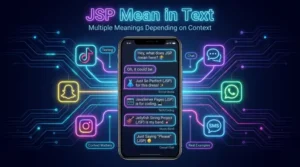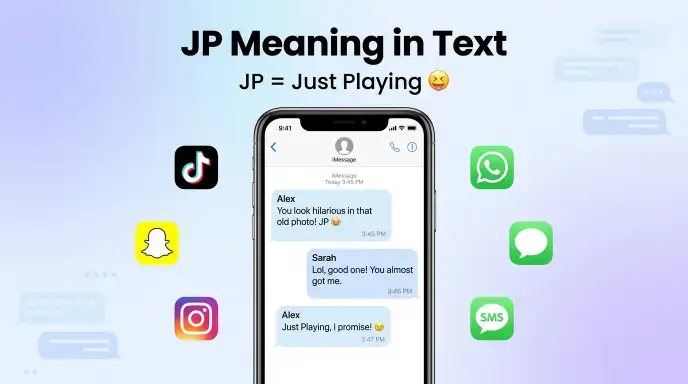
JP usually means “just playing” in text messages and online chats. People use it after joking, teasing, or saying something they do not actually mean seriously. You may see JP in texting, Snapchat, Instagram, TikTok, WhatsApp, and casual conversations.
For example, someone might text, “You really believed me? 😂 JP!” Here, JP tells the other person that the previous message was only a joke.
People search for JP meaning in text because short internet abbreviations can have different meanings depending on context. Understanding the surrounding conversation is the easiest way to know what someone means.
JP Meaning in Text
In everyday texting, JP most commonly means “just playing.” It is a casual way of telling someone that you were joking, teasing, or pretending.
For example:
“I’m never talking to you again. JP 😂”
The person probably does not mean that they are actually ending the friendship. The JP at the end changes the tone and shows that the statement was playful.
Is JP Slang, an Acronym, or an Abbreviation?
JP is a texting abbreviation or initialism used in informal online communication. It comes from the first letters of “just playing.”
Unlike a regular English word, JP is mainly used in casual digital conversations. It helps people communicate quickly without typing the complete phrase.
You may also see variations such as:
- JP : just playing
- Just playing : full version
- J/P : an occasional variation
- Just playin’ : informal spoken style version
The exact meaning can change in a different context, but “just playing” is a common interpretation when JP appears after a joke or teasing comment.
What Does “Just Playing” Mean?
When someone says “just playing,” they mean that they were not being completely serious.
It can be similar to saying:
- “I’m joking.”
- “I’m kidding.”
- “I’m only teasing.”
- “I didn’t mean that seriously.”
- “I’m messing with you.”
For example:
A: “I’m taking your last slice of pizza.”
B: “Seriously?”
A: “JP 😂”
Here, JP tells B that the person was only joking.
JP Can Change the Tone of a Message
Text messages do not include facial expressions or voice tone, so jokes can sometimes sound serious.
Adding JP helps make the intention clearer.
Compare these two messages:
“You’re annoying.”
and:
“You’re annoying 😂 JP.”
The second message is much more likely to be understood as playful teasing.
However, JP does not automatically make every statement harmless. If someone says something insulting or hurtful and adds “JP” afterward, the other person may still feel offended.
Where People Use JP
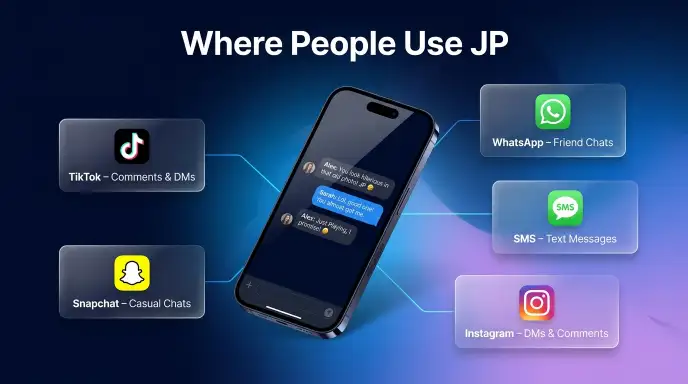
JP is mainly associated with informal digital communication. People can use it anywhere they normally use casual texting language.
JP on TikTok
On TikTok, people may use JP in comments, captions, direct messages, or conversations about a video.
For example:
“I thought you actually quit TikTok 😭 JP”
A creator or viewer may use the abbreviation to show that the statement was meant humorously.
TikTok conversations often include short expressions, emojis, and abbreviations because users communicate quickly in comments and messages.
JP on Snapchat
Snapchat is another place where short texting expressions can appear naturally.
Someone might send a Snap saying:
“I deleted your number. JP 😂”
The abbreviation signals that the person is joking.
Because Snapchat conversations are usually casual and personal, JP can fit naturally between friends.
JP on Instagram
On Instagram, you might see JP in comments, DMs, captions, or replies.
For example:
“You really posted that picture? JP 😂”
The meaning depends on the conversation, but in a joking exchange, it can mean “just playing.”
JP on WhatsApp
WhatsApp users often use abbreviations to make messages shorter.
A conversation could look like:
“I’m coming over at 6.”
“Actually 5.”
“Wait, I’m joking. JP 😂”
Friends and family members may use the term when having playful conversations.
JP in SMS and Regular Text Messages
JP can also appear in traditional SMS messages.
For example:
“I told Mom you broke the TV. JP lol.”
Here, the sender uses JP to explain that the previous statement was a joke.
It is most suitable for casual conversations rather than formal communication.
Real Chat Examples
The easiest way to understand JP is to see how people might actually use it.
Example 1: Teasing a Friend
A: You seriously forgot my birthday?
B: I’m kidding, I didn’t forget.
A: JP 😂
In this conversation, JP means the speaker was just playing.
Example 2: Talking About Food
A: I’m eating your fries.
B: Don’t you dare.
A: Relax, JP 😂
The person is teasing rather than seriously taking the fries.
Example 3: A Fake Announcement
A: I’m moving to another country tomorrow.
B: WHAT?
A: JP 😭
The first message was intentionally surprising, and JP reveals that it was only a joke.
Example 4: Gaming Conversation
A: I’m never playing with you again.
B: What did I do?
A: JP, you’re good 😂
Here, JP softens the dramatic statement.
Example 5: Friendly Teasing
A: Your new haircut is terrible.
B: Wow, thanks.
A: JP! It actually looks good.
The speaker uses JP to clarify that the criticism was playful.
Example 6: School Friends
A: Did you finish the homework?
B: Nope. I’m dropping out.
A: JP 😂
B: I know, I need to finish it tonight.
The abbreviation shows that the dramatic statement was not serious.
Example 7: Instagram DM
A: I saw your new profile picture.
B: And?
A: You look famous now.
B: Haha thanks.
A: JP, don’t let it get to your head 😂
Here, JP introduces playful teasing.
Example 8: Snapchat
A: I’m blocking you.
B: Why?!
A: JP 😂 You know I’m joking.
The speaker uses JP to reassure the other person.
Example 9: Group Chat
A: Guys, I ate the last pizza.
B: NOOO.
C: JP, there are two slices left 😂
B: You scared me.
The abbreviation signals that the statement was intentionally misleading.
Example 10: Casual Texting
A: You’re officially my least favorite person.
B: Seriously?
A: Nah, JP. You’re still number one 😂
Here, JP means the first statement was playful.
How to Reply When Someone Says “JP”
Your response depends on the conversation and your relationship with the person.
You do not always need to mention the abbreviation directly. Sometimes a laughing emoji or another playful message is enough.
Funny Replies
If the conversation is clearly joking, you can answer with humor.
- “You almost got me 😂”
- “I knew you were joking!”
- “Nice try 😭”
- “You really had me for a second.”
- “Not funny 😂”
- “I almost believed you!”
Casual Replies
For a relaxed conversation, simple responses work well.
- “Lol okay.”
- “Haha, got it.”
- “I figured.”
- “Fair enough 😂”
- “All good.”
- “Haha you’re funny.”
Friendly Replies
If you want to keep the conversation warm and playful, try:
- “Haha, I know you’re joking.”
- “You always do that 😂”
- “You got me this time.”
- “I knew you weren’t serious.”
- “Okay, I’ll let that one slide.”
Neutral Replies
Sometimes you may not know if someone is joking.
You can respond without making assumptions:
- “Oh, okay.”
- “Got it.”
- “I understand.”
- “No worries.”
- “Okay, thanks for clarifying.”
If a message seems confusing, asking directly is completely fine:
“Do you mean you’re joking?”
That is especially useful when the conversation is not clearly playful.
Is JP Rude or Offensive?
JP itself is not generally a rude or offensive expression. It is normally a casual way to say that someone was joking or teasing.
However, the statement before JP still matters.
For example:
“You’re so bad at this. JP 😂”
This could be harmless teasing between close friends, but it might feel insulting if the relationship is not familiar enough for that type of joke.
Is JP Safe to Use?
In casual conversations, JP is generally harmless when both people understand the playful tone.
It can be useful when you want to make it clear that something was not meant seriously.
Still, abbreviations should not be used as an excuse for inappropriate comments. Saying “JP” afterward does not necessarily remove the impact of something offensive.
Is JP Appropriate at School?
With friends, JP can be fine in casual texting.
However, school assignments, essays, presentations, and formal communication are different. You would normally write “just joking,” “I was kidding,” or another complete phrase if you need to clarify your meaning.
For example, avoid writing:
“JP”
in a formal school essay.
Is JP Appropriate at Work?
JP is usually better suited to casual conversations with coworkers you know well.
For professional emails, business messages, applications, reports, or communication with customers, it is safer to use clear language instead of relying on texting abbreviations.
For example:
“I was only joking.”
is clearer and more professional than:
“JP 😂”
The right choice depends on the relationship and communication setting.
Who Uses This Term?
JP is mostly found in casual online communication, especially when people are joking with friends.
Teenagers and Young Adults
Younger internet users are generally more familiar with short abbreviations because they encounter them frequently in messaging, social media, gaming, and online communities.
That does not mean JP is limited to a particular age group. Adults can also use it in casual conversations.
Gen Z Usage
Gen Z commonly uses abbreviations, shortened phrases, emojis, and internet expressions while communicating online.
JP can fit into this style because it is quick to type and easy to understand when the surrounding conversation is clearly humorous.
However, not every Gen Z user uses JP regularly. Internet slang changes quickly, and individual habits vary.
Common Platforms
You may encounter JP in:
- Text messages
- Snapchat
- TikTok
- Gaming chats
- Group chats
- Online communities
- Private messages
The frequency can vary significantly from one community to another.
How Often Does JP Appear Online?
JP is not necessarily as universally recognized as very common texting abbreviations such as IDK or BRB.
Some people may use it regularly, while others may rarely or never use it.
That is why context is important when interpreting a short abbreviation.
Origin of the Term
The exact origin of JP as an internet abbreviation is not completely clear.
It follows a common pattern in online communication: people shorten familiar phrases by taking the first letters of important words.
In this case:
J = Just
P = Playing
The phrase “just playing” has long been used in everyday English to explain that someone is joking, teasing, or not being serious. Online communication simply makes the phrase shorter.
Internet Culture and Shortened Language
Internet culture has encouraged people to communicate quickly.
Instead of typing:
“I’m only joking with you.”
someone might write:
“JP 😂”
This kind of shortening is especially useful in fast moving conversations where people are already familiar with common abbreviations.
Is the Origin Certain?
Not every internet abbreviation has a single documented creator or exact starting date.
JP appears to be a straightforward abbreviation formed from the phrase “just playing.” Because slang develops naturally across different communities, it can be difficult to identify one specific person or website where the expression began.
JP vs IDK vs IDC vs IMO vs BRB
These abbreviations may appear in the same types of online conversations, but they have completely different meanings.
| Term | Meaning | Type | Usage | Popularity |
| JP | Just Playing | Texting abbreviation | Jokes, teasing, casual chats | Common in some online conversations |
| IDK | I Don’t Know | Texting abbreviation | Uncertainty or lack of knowledge | Very common |
| IDC | I Don’t Care | Texting abbreviation | Indifference or lack of concern | Very common |
| IMO | In My Opinion | Texting abbreviation | Giving a personal opinion | Common |
| BRB | Be Right Back | Texting abbreviation | Temporarily leaving a conversation | Very common |
These terms should not be treated as interchangeable.
For example:
“JP” = Just playing
while:
“IDK” = I don’t know
and:
“BRB” = Be right back
Understanding the full phrase behind an abbreviation makes online conversations much easier to follow.
Real World Usage Example
Imagine two friends are sitting together after school and texting each other while one of them is waiting for a ride.
One friend sends:
“I’m leaving without you.”
The other friend replies:
“Wait! I’m almost there.”
The first friend responds:
“JP 😂 I’ll wait.”
In this situation, JP makes it clear that the first person was teasing. They were not actually planning to leave their friend behind.
This is the kind of situation where the abbreviation works naturally because the conversation is informal and the relationship is familiar.
In a more serious situation, however, it is better to be direct. If someone is discussing an important problem, a joke followed by “JP” could create confusion.
How Context Changes the Meaning of JP
Short abbreviations can sometimes have more than one interpretation.
If you see JP by itself, do not immediately assume that it means “just playing.”
Look at the surrounding words.
For example:
“JP 😂 I was only kidding.”
Here, the meaning is obvious.
But if you see:
“JP is coming tomorrow.”
that could refer to a person’s initials, username, name, organization, or something completely different.
This is an important point when reading internet slang: the surrounding conversation often provides the strongest clue.
JP at the End of a Message
When JP appears after a surprising or teasing statement, “just playing” becomes a particularly likely interpretation.
For example:
“I’m selling your favorite hoodie. JP 😂”
The placement helps explain the sender’s intention.
JP Without an Emoji
JP does not require an emoji.
Someone might simply write:
“JP, I was joking.”
Or:
“Relax, JP.”
However, emojis such as 😂, 😭, or 😆 can make the playful tone more obvious.
JP in Group Chats
Group chats can make abbreviations even more useful.
Several people may be talking at the same time, and short expressions allow messages to move quickly.
For example:
A: I’m deleting the group.
B: What happened?
A: Nothing, JP 😂
C: You scared everyone.
Here, JP quickly tells the group that the dramatic announcement was not serious.
Still, group conversations can be tricky because not everyone has the same sense of humor. If a joke could easily be misunderstood, a clearer explanation may be better.
JP in Gaming Conversations
Gamers often use short expressions because conversations can happen quickly during matches.
A player might write:
“I’m leaving this team. JP 😂”
Another player may understand that the statement is just teasing.
Gaming communities also develop their own abbreviations, so context is particularly important. A term that has one meaning in ordinary texting could potentially mean something else inside a specific gaming community.
Why Do People Use JP Instead of “Just Playing”?
The biggest reason is convenience.
Typing two letters is faster than typing the entire phrase.
It can also make a message feel more casual and connected to online communication.
Compare:
“I am just playing.”
with:
“JP 😂”
The second version feels much more like a quick text between friends.
Abbreviations can also help communicate tone. In a short conversation, adding JP immediately after a joke can tell the reader that the statement should not be taken literally.
When You Should Avoid Using JP
Although JP is useful in casual conversations, there are situations where writing the full phrase is better.
Avoid relying on JP when:
- You are writing a formal email.
- You are contacting a teacher about an important matter.
- You are communicating with a customer.
- You are writing a professional document.
- The topic is serious or sensitive.
- The other person may not understand texting abbreviations.
For formal communication, clarity matters more than saving a few characters.
Instead of:
“JP”
you could write:
“I was only joking.”
That removes any possible confusion.
Frequently Asked Questions
1. What does JP mean in text messages?
JP usually means “just playing.” It tells someone that a previous statement was meant as a joke, tease, or playful comment.
2. What does JP mean on TikTok?
On TikTok, JP can mean “just playing” when someone is joking or teasing in a comment, caption, DM, or conversation.
3. Is JP slang?
JP is a casual texting abbreviation. It comes from the phrase “just playing” and is mainly used in informal digital communication.
4. Is JP rude or offensive?
JP itself is not generally rude or offensive. However, the statement surrounding it can still be hurtful or inappropriate depending on the situation.
5. How should you reply to JP?
You can respond casually with “lol,” “haha,” “you got me,” or “I knew you were joking.” If the meaning is unclear, simply ask what they mean.
Conclusion
JP in text usually means “just playing.” People use it when they are joking, teasing, or explaining that something they said should not be taken seriously.
You may see JP in text messages, TikTok, Snapchat, Instagram, WhatsApp, gaming chats, and group conversations. It is mainly a casual abbreviation, so it works best when talking with friends or people who understand informal internet language.
If you see JP in a message, check the words around it before deciding what it means. In most joking conversations, it means “just playing,” but abbreviations can have different meanings in different contexts.
For school, work, or other formal situations, writing the complete phrase is usually clearer than using JP.
Related slang terms!

Hi, I’m Liam Carter, a slang language enthusiast and content writer. I research internet slang, social media terms, texting abbreviations, and online expressions to help readers understand modern English. I enjoy breaking down trending slang into simple, easy-to-read explanations with real-world examples, making online communication clearer and more enjoyable.