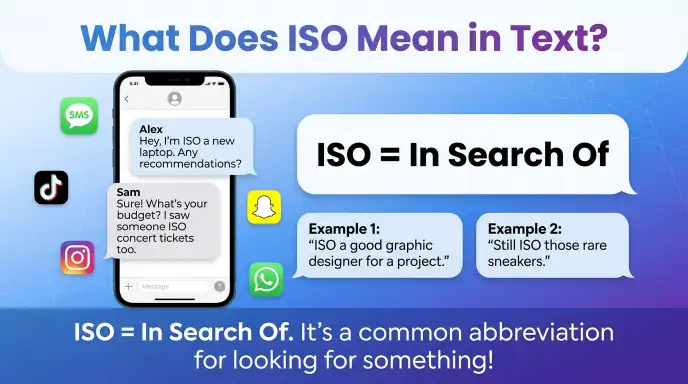
If you see ISO in a text, it usually means “In Search Of.” People use it when they are looking for something, someone, advice, or a recommendation. You may notice it in texting, TikTok posts, Instagram comments, Snapchat messages, and online groups.
For example, someone might write, “ISO a good laptop,” which simply means “I’m looking for a good laptop.” The abbreviation makes the request shorter and easier to understand.
People often search for iso mean in text because the same three letters can have different meanings in other situations. In photography, technology, business, and other fields, ISO can refer to something completely different.
In casual online communication, though, “In Search Of” is the meaning to consider when ISO introduces something a person wants to find.
ISO Meaning in Text
In texting and online communication, ISO usually means “In Search Of.” It works as a short way of saying that someone is looking for something or someone.
Think of it as a quick label that tells other people, “I’m looking for this.”
For example:
ISO a used bike in good condition.
This means:
I’m in search of a used bike in good condition.
The abbreviation is especially useful when someone is asking a group for recommendations, products, services, tickets, information, or help.
Is ISO Slang or an Abbreviation?
ISO is better described as an abbreviation or shorthand expression rather than traditional slang. It is informal because it commonly appears in online communities, classified listings, social media posts, and casual conversations.
Unlike slang words that can express humor, attitude, or identity, ISO mainly serves a practical purpose. It saves typing while making a request clear.
You might see:
- ISO a roommate
- ISO concert tickets
- ISO good restaurant recommendations
- ISO someone who can fix my laptop
- ISO a study partner
In every example, the person is searching for something.
What Does ISO Mean in Everyday Chat?
In everyday chat, ISO can mean “looking for” or “trying to find.”
For example:
ISO a movie to watch tonight 😂
The person isn’t using ISO in a complicated way. They simply want movie suggestions.
Another example is:
ISO someone who knows a good mechanic.
That means the person wants to find someone who can recommend a mechanic.
One important detail is that ISO often appears before the thing being sought. This makes it easy for readers to understand the purpose of the message quickly.
Where People Use ISO
ISO isn’t limited to one social media platform. Its meaning generally stays the same across different online spaces. You can encounter it in posts, comments, community groups, and private messages.
ISO on TikTok
On TikTok, people may use ISO when they are trying to find a product, creator, video, recommendation, or specific item they have seen.
For example:
ISO this jacket. Does anyone know where it’s from?
Here, the person is looking for information about the jacket.
You might also see:
ISO good study tips for finals.
That means the person is searching for useful study recommendations.
ISO is not exclusive TikTok slang. Its meaning comes from broader internet and classified-advertising usage, so context still matters.
ISO on Snapchat
On Snapchat, ISO can appear in casual conversations when someone wants to find something.
For example:
ISO a good place to eat tonight.
A friend might reply with a restaurant recommendation.
Because Snapchat conversations are usually informal, the abbreviation can make a request feel quick and conversational.
ISO on Instagram
Instagram users can use ISO in captions, comments, stories, or messages when looking for an item, service, recommendation, or information.
For example:
ISO someone who makes custom cakes.
Another person might respond with a recommendation.
You may also see:
ISO this bag! Anyone know the brand?
In this case, the writer has seen a bag and wants to identify or locate it.
ISO on WhatsApp
WhatsApp groups can be a natural place to see ISO, particularly in community, school, neighborhood, hobby, or buying-and-selling groups.
For example:
ISO a math tutor for my son.
Someone in the group may know a suitable tutor and respond.
You could also see:
ISO recommendations for a plumber.
The abbreviation helps the writer get straight to the point.
ISO in SMS
ISO can also appear in ordinary text messages, although people may choose more familiar phrases such as “looking for” instead.
For example:
ISO dinner ideas. Any suggestions?
A friend could answer:
Try the new Italian place downtown.
In private texting, ISO is usually understandable from the words that follow it.
Real Chat Examples
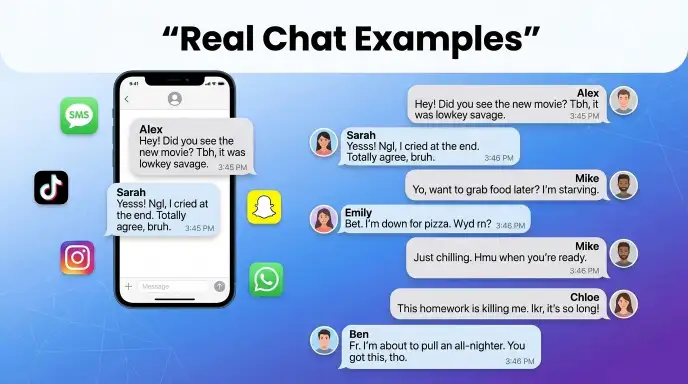
Here are some realistic examples showing how people might use ISO in everyday conversations.
Example 1: Looking for a Laptop
A: I need a laptop for college.
B: What kind are you looking for?
A: ISO something affordable with good battery life.
B: I know a few models you could check.
Example 2: Restaurant Recommendation
A: ISO a good pizza place tonight.
B: You should try the one near the mall.
A: Is it expensive?
B: Not really. Their prices are pretty reasonable.
Example 3: Concert Tickets
A: ISO two tickets for Saturday’s concert.
B: I might know someone selling two.
A: Really? Please let me know!
Example 4: Finding a Tutor
A: ISO a math tutor for my little brother.
B: What grade is he in?
A: Ninth grade.
B: My cousin teaches math. I’ll ask him.
Example 5: Looking for a Product
A: ISO this exact pair of sneakers.
B: Where did you see them?
A: On Instagram yesterday.
B: Send me the picture. I might know the brand.
Example 6: Finding a Service
A: ISO someone who can repair laptops.
B: My usual repair guy is really good.
A: Can you send me his number?
Example 7: Asking for Advice
A: ISO some advice about choosing a college.
B: What are you studying?
A: Computer science.
B: I can tell you about my experience.
Example 8: Looking for a Roommate
A: ISO a roommate starting next month.
B: Is the room furnished?
A: Yes, and it’s close to campus.
B: I might know someone interested.
Example 9: Finding an Item
A: ISO a used camera in good condition.
B: What’s your budget?
A: Around $300.
B: I saw one listed yesterday.
Example 10: Casual Recommendation
A: ISO a good show to satiate this weekend 😂
B: Have you watched that new mystery series?
A: Nope. Is it actually good?
B: Definitely worth trying.
These examples show why the surrounding words are useful. ISO itself tells you that the person is looking for something, while the rest of the message explains exactly what they want.
How to Reply When Someone Says “ISO”
Replying to ISO is usually easy because the person is making a request. Your response depends on if you have an answer, recommendation, or useful information.
Funny Replies
If you’re talking with a close friend, you can make the response playful.
- “ISO a miracle too? 😂”
- “I’m also ISO a solution to that problem.”
- “ISO a million dollars first. 😂”
- “Let me know when you find one!”
These replies work best in casual conversations where joking is already normal.
Casual Replies
A simple recommendation is often enough.
- “I know a place.”
- “Try the shop downtown.”
- “I can send you a link.”
- “My friend might have one.”
- “I’ll ask around.”
Friendly Replies
If someone is genuinely asking for help, you can offer useful information.
- “I know someone who can help.”
- “I have a recommendation for you.”
- “My cousin does that. I can give you their details.”
- “I saw one recently. Let me check.”
Neutral Replies
For a group chat or a less personal conversation, keep the answer straightforward.
- “What exactly are you looking for?”
- “What is your budget?”
- “Do you have a preferred location?”
- “I don’t know anyone right now.”
- “I can ask around.”
The best reply depends on the request, not on ISO itself.
Is ISO Rude or Offensive?
No, ISO is generally not rude or offensive.
The abbreviation simply communicates that someone is looking for something. It does not contain an insulting or aggressive meaning.
For example:
ISO a used desk for my office.
This is a straightforward request.
Similarly:
ISO recommendations for a good dentist.
is simply asking other people for suggestions.
Is It Safe to Use?
Yes. ISO is generally safe for casual online communication when the people reading it understand the abbreviation.
It can be particularly useful in:
- Community groups
- Marketplace posts
- Hobby groups
- Group chats
- Social media comments
- Online forums
However, clarity should come first. If you’re writing to someone who may not know the abbreviation, saying “I’m looking for…” may be easier.
Is ISO Appropriate at School or Work?
It depends on the situation.
In an informal school group or workplace chat, ISO may be perfectly understandable:
ISO a volunteer for Friday’s event.
In a formal email, report, application, or professional document, writing “looking for” or “seeking” is usually clearer and more polished.
For example:
Casual:
ISO a designer for this project.
More formal:
We are looking for a designer for this project.
The message is essentially the same, but the second version fits formal communication better.
Who Uses This Term?
ISO can be used by people of different ages. It isn’t restricted to one particular generation.
You may see it among people who regularly participate in online communities, marketplaces, classified listings, hobby groups, and social media discussions.
Gen Z Usage
Gen Z users may encounter ISO on social platforms and in community conversations, but it isn’t accurate to treat it as a Gen Z-only expression.
Unlike newer slang that may be strongly connected to a particular generation, ISO has been used as shorthand for “in search of” in classified and online contexts for years.
Common Platforms
The abbreviation can appear on:
- TikTok
- Snapchat
- Discord
- Facebook groups
- Online marketplaces
- Community forums
Its purpose remains fairly consistent: announcing that someone is looking for something.
How Often Does It Appear Online?
There isn’t a single reliable number that measures how often ISO appears across every platform.
Its frequency also varies by community. You are more likely to notice it in buying-and-selling groups, local communities, recommendation threads, and classified-style posts than in ordinary one-to-one conversations.
Origin of the Term
The exact history of ISO in online slang is not completely tied to one website or one social media platform.
The phrase “in search of” has a long history in classified and personal advertisements. Shortened forms became useful because advertisements traditionally benefited from saving space and communicating information quickly.
As internet forums, classifieds, marketplaces, and social networks grew, the abbreviation fit naturally into digital communication.
A post could begin:
ISO a used bicycle
instead of:
I am in search of a used bicycle.
That shorter version is quick to read and immediately tells other users that the writer wants to find something.
Internet Culture and ISO
Online communities helped keep this style of shorthand useful. Forums, marketplace posts, community boards, and social media all encourage people to communicate information quickly.
Today, ISO can introduce requests for products, services, advice, recommendations, tickets, people, and information.
One important point is that ISO is not exclusively an internet term. The phrase existed before modern social media, while the abbreviation became especially useful in digital spaces.
Why Context Still Matters
ISO has several meanings outside casual texting.
For example, photographers use ISO when discussing camera sensitivity, while the International Organization for Standardization is also commonly called ISO. ISO can also refer to an optical disc image in computing.
So if someone says:
Increase the ISO on your camera.
they are obviously not saying “in search of.”
The surrounding words tell you which meaning applies.
ISO vs. IDK, IDC, IMO, and BRB
ISO belongs to the same broad world of digital shorthand as IDK, IDC, IMO, and BRB, but each abbreviation serves a different purpose.
| Term | Meaning | Type | Usage | Popularity |
| ISO | In Search Of | Abbreviation | Requests and searches | Common in specific online communities |
| IDK | I Don’t Know | Text abbreviation | Expressing uncertainty | Very common |
| IDC | I Don’t Care | Text abbreviation | Showing indifference | Very common |
| IMO | In My Opinion | Text abbreviation | Giving an opinion | Very common |
| BRB | Be Right Back | Text abbreviation | Temporarily leaving a chat | Common |
The biggest difference is what each term does in a conversation.
ISO usually introduces a request.
IDK communicates that someone doesn’t know something.
IDC communicates a lack of concern or preference.
IMO signals that the following statement is the speaker’s opinion.
BRB tells someone that the speaker is temporarily stepping away.
Understanding the purpose of the abbreviation can make the message easier to interpret.
Real-World Usage Example
Imagine a neighborhood WhatsApp group where people regularly share recommendations and help each other find local services.
One afternoon, someone posts:
ISO a reliable electrician who works on weekends.
Another group member replies:
“I used one last month. I’ll send you his number.”
A third person might add:
“I recommend him too.”
Here, ISO works almost like a short heading. It immediately tells the group that the person needs a recommendation.
A similar situation could happen in a college group:
ISO someone who can tutor chemistry.
Students who know a tutor can respond directly.
The abbreviation is useful because it turns a longer sentence into a quick, recognizable request. You don’t need to interpret hidden slang or a joke. The context after ISO normally tells you what the person wants.
Other Meanings of ISO
Although “In Search Of” is the relevant meaning in casual texting, don’t automatically assume that every ISO you see has that definition.
For example, in photography, ISO refers to a camera setting associated with light sensitivity. In business and manufacturing, ISO can refer to international standards and the organization associated with them. In computing, an ISO file is a disc-image file.
This is why context is important.
Compare these two sentences:
ISO a used laptop.
Here, ISO means In Search Of.
My camera is set to ISO 800.
Here, ISO refers to photography.
The letters are identical, but the meaning is completely different.
Frequently Asked Questions
1. What does ISO mean in text messages?
In text messages, ISO usually means “In Search Of.” It tells someone that the writer is looking for something, someone, advice, or a recommendation.
2. What does ISO mean on TikTok?
On TikTok, ISO generally means “In Search Of.” Users may use it when looking for products, recommendations, creators, information, or other things.
3. Is ISO slang?
ISO is better described as an informal abbreviation or shorthand than traditional slang. It is commonly used in online communities and casual communication.
4. Is ISO rude or offensive?
No. ISO is generally neutral and not offensive. The tone comes from the rest of the message and the situation.
5. How should you reply to ISO?
Read what comes after ISO and answer the request if you can. You could give a recommendation, ask for more details, or simply say that you don’t know.
Conclusion
ISO in text usually means “In Search Of.” It is a convenient abbreviation people use when they are looking for a product, service, person, recommendation, ticket, or information.
You’ll most often understand it from the words that follow. A message such as “ISO a good laptop” simply means “I’m looking for a good laptop.”
ISO can appear on TikTok, Instagram, Snapchat, WhatsApp, Reddit, marketplaces, and other online communities. It is generally neutral and isn’t considered rude or offensive.
Just remember that ISO has other meanings outside texting, especially in photography, business, and technology. When you’re unsure, look at the surrounding words and context.
Discover more slang!

Hi, I’m Liam Carter, a slang language enthusiast and content writer. I research internet slang, social media terms, texting abbreviations, and online expressions to help readers understand modern English. I enjoy breaking down trending slang into simple, easy-to-read explanations with real-world examples, making online communication clearer and more enjoyable.