If you’re planning a trip to Cuba, chatting with Cuban friends, or simply curious about Caribbean Spanish, learning Cuba slang is one of the best ways to understand the local culture. While standard Spanish is spoken throughout the country, Cubans use many unique slang words and expressions that you won’t usually find in textbooks.
From friendly greetings to funny nicknames and everyday phrases, Cuban slang reflects the island’s history, music, humor, and relaxed lifestyle. You’ll hear these expressions in Havana’s busy streets, local markets, family gatherings, songs, and even on social media.
In this guide, you’ll discover the most popular Cuba slang words, what they mean, when to use them, and real-life examples. you’re a traveler, Spanish learner, or language enthusiast, these expressions will help you sound more natural and better understand everyday conversations in Cuba.
What Is Cuba Slang?
Cuba slang refers to the informal words, phrases, and expressions commonly used by people in Cuba. Many of these terms are unique to Cuban Spanish, while others are shared with nearby Caribbean countries but may have different meanings.
Cuban slang is often:
- Friendly and informal
- Influenced by African, Spanish, and Caribbean cultures
- Common in everyday conversations
- Frequently heard in music and local entertainment
- Different from Spanish spoken in Spain or Mexico
Why Learn Cuba Slang?
Learning Cuba slang can help you:
- Understand local conversations.
- Connect better with Cuban people.
- Enjoy Cuban music and movies.
- Travel with more confidence.
- Learn authentic Caribbean Spanish.
Even knowing a few common expressions can make conversations feel more natural.
50 slang words
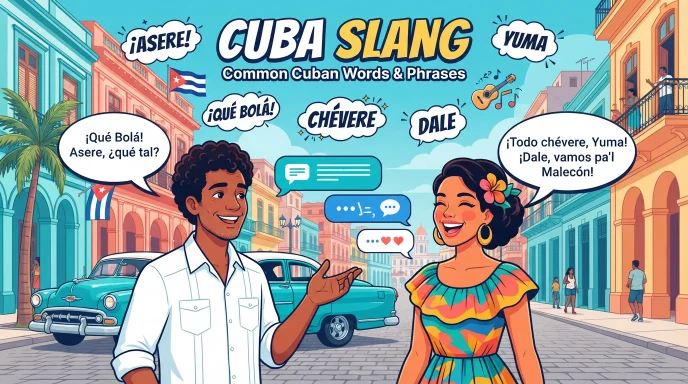
1. Asere
Meaning: Friend, buddy, or mate.
Example:
“Asere, how have you been?”
When to Use:
Use it when greeting close friends or people you know well.
2. Acere
Meaning: Another common spelling of “Asere.”
Example:
“Acere, let’s grab some coffee.”
When to Use:
Used exactly like “Asere” in casual conversations.
3. Guagua
Meaning: Bus.
Example:
“We missed the guagua this morning.”
When to Use:
Used daily when talking about public transportation.
4. Yuma
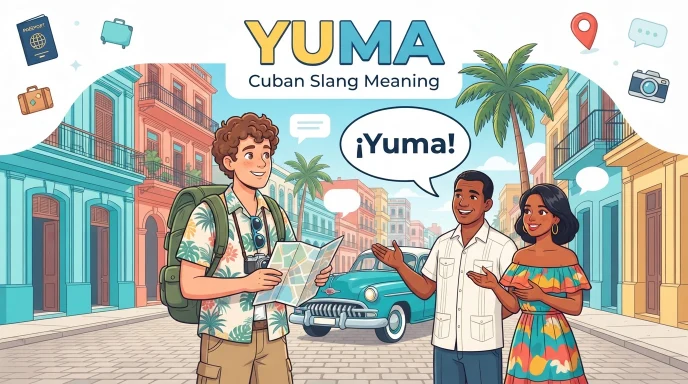
Meaning: A foreigner, especially someone from the United States.
Example:
“Many yumas visit Havana every year.”
When to Use:
Common when talking about tourists.
5. Jamar
Meaning: To eat.
Example:
“Let’s jamar before we leave.”
When to Use:
A very common informal way to say “eat.”
6. Pincha
Meaning: Work or job.
Example:
“I have to go to my pincha.”
When to Use:
Used in everyday conversations about work.
7. Pinchar
Meaning: To work.
Example:
“I’ll be pinching all day tomorrow.”
When to Use:
Informal alternative to the standard Spanish word for work.
8. Qué Bolá
Meaning: What’s up? How’s it going?
Example:
“¡Qué bolá, asere?”
When to Use:
One of Cuba’s most famous greetings.
9. Fula
Meaning: Money or U.S. dollars depending on context.
Example:
“I don’t have enough fula today.”
When to Use:
Common in casual conversations.
10. Chévere
Meaning: Cool, great, or awesome.
Example:
“That restaurant is really chévere.”
When to Use:
Used to compliment people, places, or things.
11. Pipo
Pipo meaning cuban refers to a friendly word used in Cuban Spanish for a friend or buddy.
Meaning: Friend or buddy.
Example:
“Hey pipo, let’s go.”
When to Use:
Friendly conversations.
12. Ecobio
Meaning: Close friend or trusted companion.
Example:
“He’s my ecobio.”
When to Use:
Talking about close friendships.
13. Guajiro
Meaning: Farmer or someone from the countryside.
Example:
“My grandfather is a guajiro.”
When to Use:
Describing rural life.
14. Consorte
Meaning: Close friend or partner.
Example:
“My consorte is coming over later.”
When to Use:
Informal conversations.
15. Tremendo
Meaning: Amazing, unbelievable, or intense depending on context.
Example:
“That was a tremendo game.”
When to Use:
Describing impressive situations.
16. Dale
Meaning: Okay, let’s do it, or go ahead.
Example:
“Dale, see you tomorrow.”
When to Use:
Very common in daily conversations.
17. Socio
Meaning: Buddy, friend, or pal.
Example:
“Thanks for helping me, socio.”
When to Use:
Casual conversations among friends.
18. Guapo
Meaning: Brave, tough, or someone acting fearless. In Cuba, it can also describe someone who is quick to argue.
Example:
“No seas guapo. Let’s solve the problem calmly.”
19. Jeva
Meaning: Girlfriend or an attractive young woman.
Example:
“His jeva is coming to the party tonight.”
20. Jevo
Meaning: Boyfriend or a young man.
Example:
“She introduced us to her jevo.”
21. Mongo
Meaning: Someone acting silly or foolish.
Example:
“Don’t be mongo. Think before you speak.”
22. Embullo
Meaning: Excitement, enthusiasm, or motivation.
Example:
“Everyone was full of embullo before the concert.”
23. Embullarse
Meaning: To become excited or motivated.
Example:
“They embullaron after hearing the good news.”
24. Bomba
Meaning: Something amazing, exciting, or impressive.
Example:
“That concert was bomba.”
25. Coger botella
Meaning: To hitchhike or get a ride from someone.
Example:
“We had to coger botella to reach the beach.”
26. Resolver
Meaning: To find a solution or make things work.
Example:
“Don’t worry. We’ll resolver somehow.”
27. Botar
Meaning: To throw away or waste something.
Example:
“Don’t botar your food.”
28. Chao
Meaning: Goodbye.
Example:
“Chao, see you tomorrow.”
29. Barbaro
Meaning: Excellent, awesome, or fantastic.
Example:
“Your new car looks barbaro.”
30. Oye
Meaning: Hey or listen.
Example:
“Oye, can I ask you something?”
31. Tipo
Meaning: Guy or person.
Example:
“That tipo is very friendly.”
32. Tipa
Meaning: Girl or woman.
Example:
“She’s a really nice tipa.”
33. Compay
Meaning: Friend, buddy, or companion.
Example:
“My compay always helps me when I need it.”
34. Caballero
Meaning: Friend, man, or an expression used to get someone’s attention.
Example:
“Caballero, what happened here?”
35. Guapería
Meaning: Acting tough or showing off bravery.
Example:
“His guapería got him into trouble.”
36. Candela
Meaning: A difficult, dangerous, or intense situation.
Example:
“This project is candela.”
37. Billete
Meaning: Money or cash.
Example:
“I don’t have enough billete today.”
38. Mala leche
Meaning: Bad luck or a bad attitude.
Example:
“He always seems to have mala leche.”
39. Ponerse las pilas
Meaning: To start working harder or pay attention.
Example:
“You need to ponerse las pilas before the exam.”
40. Volao meaning
Volao meaning refers to being very fast, rushed, or in a hurry, depending on the context.
Meaning: Very fast or in a hurry.
Example:
“He left the house volao.”
41. Meter muela
Meaning: To talk a lot, persuade someone, or flirt with them.
Example:
“He spent all afternoon metiendo muela.”
42. Fiesta
Meaning: A party or celebration.
Example:
“We’re going to a fiesta this weekend.”
43. Rumba
Meaning: A lively party with music and dancing.
Example:
“They enjoyed a rumba until midnight.”
44. Pesao
Meaning: Someone who is annoying or bothersome.
Example:
“That guy is really pesao today.”
45. Chucho
Meaning: Joke, teasing, or playful fun.
Example:
“Relax, it was only a chucho.”
46. Dar muela
Meaning: To keep talking in order to convince someone.
Example:
“He tried to dar muela until everyone agreed.”
47. Full
Meaning: Full, busy, or completely occupied.
Example:
“The restaurant is full tonight.”
48. Buena onda
Meaning: Friendly, relaxed, or having a positive attitude.
Example:
“She’s always buena onda with everyone.”
49. Alante
Meaning: Move forward, keep going, or don’t give up.
Example:
“No matter what happens, alante.”
50. Echando pa’lante
Meaning: Moving forward despite difficulties.
Example:
“The family keeps echando pa’lante every day.”
Common Cuban Phrases and Expressions
Cuban Spanish has many everyday expressions that are useful for travelers and Spanish learners. Common cuban phrases slang include casual greetings, friendly expressions, and words used in daily conversations. You may also hear cuban spanish phrases, common cuban phrases, and popular cuban phrases when talking with locals.
Some useful expressions include cuban expressions, cuban phrase, and cuban phrases that make conversations sound more natural.
Cuban Greetings and Hello Expressions
If you’re wondering how to say hello in cuban, common greetings include qué bolá and asere. You may also hear hello in cuba or hello in cuban when learning how locals greet each other. If you’re asking how to say hello in cuba, these casual expressions are a useful starting point.
Greetings from Cuba can also be friendly and informal, especially among people who know each other.
Learners often search for cuban slang, cuban slang phrases, cuban spanish slang, and cuban slangs when trying to understand informal Cuban Spanish. A cuban dictionary or cuban dictionary slang guide can also help explain unfamiliar expressions.
You may also come across cuban spanish words, cuban words translation, and cuban saying when exploring Cuban vocabulary. You may also find famous cuban sayings that reflect Cuban humor and culture.
For names and friendly expressions, cuban nicknames, cuba nicknames, and cuban terms of endearment can be useful to learn.
Frequently Asked Questions
What is the most common Cuba slang?
Some of the most common Cuba slang words are asere, qué bolá, guagua, jamar, and yuma. These are heard daily in conversations across Cuba.
What does “asere” mean in Cuba?
Asere is a friendly way to say “friend,” “buddy,” or “mate.” It is one of the most recognizable Cuban slang terms.
What does “qué bolá” mean?
Qué bolá means “What’s up?” or “How’s it going?” It is a popular greeting used among friends.
Is Cuba slang different from Spanish spoken in Spain?
Yes. Cuban Spanish has many unique slang words, pronunciation differences, and local expressions that are uncommon in Spain or other Spanish-speaking countries.
Should tourists use Cuba slang?
Yes, but use it naturally and respectfully. Learning a few common expressions can help you connect with locals and make conversations more enjoyable.
Qué Bolá Asere Meaning in English
One common Cuban greeting is que bola asere meaning, which is roughly used like “What’s up, buddy?” If you’re searching for what does que bola mean, it is a casual way to ask how someone is doing. The phrase que bola asere in english can therefore be understood as a friendly greeting between people.
Conclusion
Cuba slang is an important part of everyday life and reflects the country’s warm, friendly, and lively culture. if you’re greeting someone with qué bolá, calling a friend asere, or talking about taking the guagua, these expressions help you understand authentic Cuban Spanish beyond what you’ll find in textbooks.
By learning these 50 popular Cuba slang words and phrases, you’ll be better prepared for conversations, travel, and cultural experiences. Practice them in the right situations, listen to native speakers, and you’ll soon feel more confident communicating in Cuban Spanish.
Read more about!
Slang for Angry: Popular English Expressions
Funny Canadian Slang: 35 Words and Phrases

Daniel Carter – Short Bio (First Person)
Hi, I’m Daniel Carter, a slang language researcher and content writer. I enjoy exploring internet slang, texting abbreviations, and modern expressions to make them easy for everyone to understand. My goal is to explain slang in clear, simple English with real-life examples so readers can communicate confidently online and stay up to date with the latest language trends.