Jamaican speech has a lively style that has influenced music, movies, social media, and everyday conversations around the world. If you have heard Jamaican slang in reggae, dancehall, TikTok videos, or casual conversations, you may have noticed expressions that sound different from standard English.
Many Jamaican expressions come from Jamaican Patois, also called Patwa. It is an English-based creole with its own vocabulary, pronunciation, and grammar. Words such as wah gwaan, irie, bredren, pickney, nyam, and likkle are widely recognized examples.
Understanding these expressions is about more than translating individual words. Context, tone, and the relationship between speakers can affect how an expression is understood. This guide explains popular Jamaican words and phrases in simple English, with natural examples to make them easier to understand.
What Is Jamaican Slang?
Jamaican slang refers to informal words and expressions associated with Jamaican speech and culture. Many of the expressions people call slang are connected to Jamaican Patois, which is widely spoken in Jamaica.
Jamaican Patois developed through the island’s complex linguistic history. It has strong English influence as well as influences from West African languages and other languages brought to Jamaica over time.
For example:
“Wah gwaan?”
In standard English, this can mean:
“What’s going on?”
Depending on the situation, it can also work as a casual way of asking “What’s up?” or “How are you?”
Jamaican Slang vs. Jamaican Patois
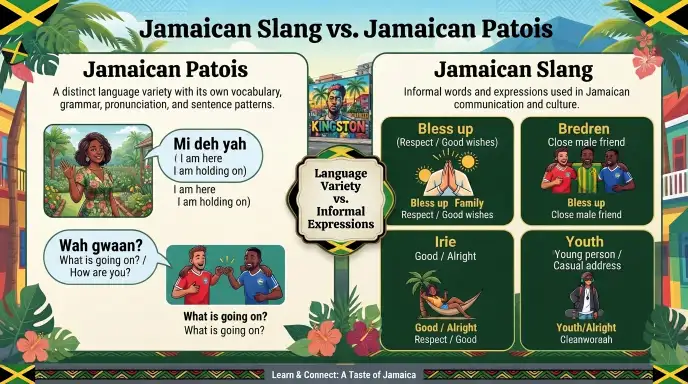
These terms are often confused, but they do not mean exactly the same thing.
Jamaican Patois
Known as Jamaican Patois, this language variety has its own vocabulary, grammar, pronunciation, and sentence patterns.
Jamaican Slang
In contrast, Jamaican slang is a broader term for informal expressions and words associated with Jamaican communication and culture.
Some expressions commonly labeled as slang are actually normal vocabulary within Jamaican Patois. Therefore, Jamaican speech should not be viewed simply as standard English with a few slang words added.
Popular Jamaican Slang Words and Phrases
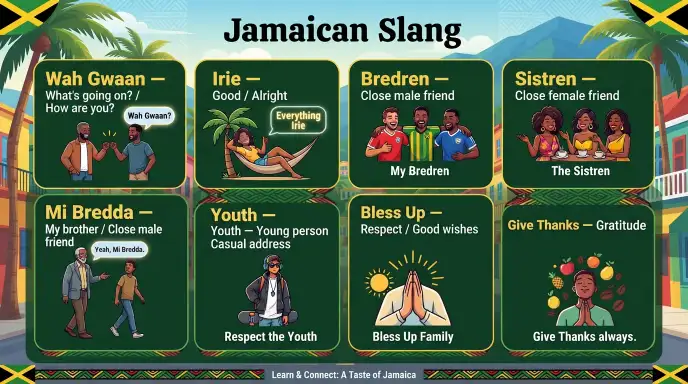
Wah Gwaan
Wah gwaan is one of the most recognizable Jamaican expressions.
It can mean:
- What’s going on?
- What’s up?
- How are you?
- What’s happening?
For example:
“Wah gwaan, my friend?”
It is commonly used as a casual greeting.
Irie
Irie generally expresses the idea of being good, peaceful, happy, or okay.
For example:
“Everything irie.”
This can mean:
“Everything is good.”
The word is strongly connected with Jamaican culture and reggae music.
Ya Man
Ya man is a relaxed expression that can mean yes, definitely, or okay.
For example:
“You coming with us?”
“Ya man!”
It usually has a friendly and informal tone.
Bredren
Bredren refers to a friend, brother, or close male companion.
For example:
“He’s my bredren.”
The word can express friendship, closeness, or brotherhood.
Sistren
Sistren refers to a female friend, sister, or close female companion.
For example:
“She is my sistren.”
It can communicate a sense of friendship and community.
Pickney
Pickney means child or children.
For example:
“The pickney dem are playing outside.”
This is a well-known expression associated with Jamaican Patois.
Nyam
Nyam means to eat.
For example:
“Mi waan nyam.”
This can be understood as:
“I want to eat.”
It is a good example of how Jamaican Patois vocabulary can differ from standard English.
Likkle
Likkle means little or small.
For example:
“Come here, likkle man.”
You may see this spelling in Jamaican speech, music, and online writing.
Mi
Mi can mean I, me, or my, depending on the sentence.
For example:
“Mi good.”
This can mean:
“I’m good.”
The exact meaning depends on the grammatical context.
Yuh
Yuh commonly represents you or your, depending on how it is used.
For example:
“How yuh doing?”
This corresponds roughly to:
“How are you doing?”
Jamaican Slang for Friends
Jamaican speech has several informal expressions for people who are close to you.
Bredren
Bredren can refer to a close male friend or companion.
“Mi bredren is coming.”
It often carries a friendly and familiar tone.
Sistren
Sistren can refer to a female friend or close companion.
“Mi sistren lives nearby.”
Mi Bredda
A close male friend or an actual brother may be called mi bredda in Jamaican Patois.
“My bredda is coming over later.”
“That’s mi bredda.”
The exact relationship depends on the context.
Youth
In casual Jamaican speech, youth can refer to a young person, especially when speaking to someone informally.
“Youth, come over here.”
Tone matters here. Depending on the situation, it can sound friendly, casual, or more serious.
Jamaican Slang for Greetings
Greetings are an important part of everyday Jamaican communication.
Wah Gwaan?
Wah gwaan? is a common informal greeting.
“Wah gwaan?”
It can mean “What’s going on?”, “What’s up?”, or “How are you?”
Mi Deh Yah
Mi deh yah can communicate the idea of “I’m okay,” “I’m here,” or “I’m doing fine.”
For example:
“Wah gwaan?”
“Mi deh yah.”
It can work as a relaxed response to a greeting.
Jamaican Slang for Positive Feelings
Jamaican expressions also include words and phrases connected with positivity, peace, and good energy.
Irie
Irie expresses a feeling of being good, peaceful, happy, or content.
“Mi feel irie today.”
Give Thanks
Give thanks can express gratitude or appreciation.
For example:
“Give thanks for everything.”
The phrase can have a deeper cultural or spiritual meaning depending on the context.
Bless Up
Bless up is a friendly expression used to communicate good wishes, respect, or positivity.
For example:
“Bless up, my friend.”
It is also commonly heard in Jamaican music and online conversations.
Jamaican Slang for Food
Food-related expressions are another part of everyday Jamaican speech.
Nyam
Nyam means to eat.
“Time fi nyam.”
This can mean:
“It’s time to eat.”
Bun
Bun can have several meanings depending on the context.
For example:
“Bun bad mind.”
Here, bun can express rejection or strong disapproval.
Because bun can be used in different ways, the surrounding words are important when interpreting it.
Jamaican Slang in Music and Popular Culture
Jamaican expressions have had a major influence on reggae, dancehall, ska, and other forms of Caribbean music. Artists often use Jamaican Patois because it reflects their identity, community, and everyday speech.
You may hear expressions such as wah gwaan, irie, bredren, likkle, and bless up in songs, interviews, music videos, and performances.
Reggae
Reggae helped introduce many Jamaican words and phrases to international audiences. Listeners who are unfamiliar with Jamaican Patois may first encounter these expressions through reggae music.
Dancehall
Dancehall has also played a major role in spreading Jamaican vocabulary. Its lyrics often contain informal expressions that reflect everyday Jamaican culture.
Why Context Matters
A word used in a song may have a slightly different meaning depending on the lyrics and situation. It is better to understand the complete phrase instead of translating every word separately.
Jamaican Slang on Social Media
Jamaican expressions are now easy to find online. Social media has helped Jamaican vocabulary reach people around the world.
You may see these expressions on:
- TikTok
- YouTube
- X
- Music communities
- Online comments
TikTok
Creators may use Jamaican expressions in captions, jokes, videos, and comments.
“Wah gwaan, TikTok?”
People may use expressions such as bless up or irie in captions.
“Bless up everyone!”
YouTube
Jamaican creators and musicians may use Patois naturally when speaking with their audience.
Text Messages
Friends may also use Jamaican expressions in casual chats.
“Wah gwaan?”
“Mi deh yah.”
Jamaican Slang for Everyday Conversation
Some expressions are useful for understanding casual Jamaican conversations.
Mi Deh Yah
Mi deh yah can mean that someone is doing okay or is present.
“How yuh doing?”
“Mi deh yah, everyting irie.”
How Yuh Stay?
This casual phrase is used to ask someone how they are doing or what is going on. can be used as a casual way to ask how someone is doing.
“Hey, how yuh stay?”
The phrase is informal and depends on context.
Seen
Seen can be used to show understanding, agreement, or acknowledgment.
For example:
“Meet me after work.”
“Seen.”
In this context, it can mean something like “Got it” or “Understood.”
Fi
Fi is commonly used in Jamaican Patois in ways that can correspond to “to,” “for,” or “of,” depending on the sentence.
For example:
“Time fi go.”
This means:
“Time to go.”
Jamaican Slang for People
Jamaican speech has many informal ways to describe or address people.
Man
Man can be used casually when talking to or about a person.
“That man knows what he’s doing.”
Youth
In informal Jamaican speech, youth may describe a young person or serve as a casual way to address someone.
“Youth, where you heading?”
Bredda
Bredda means brother and can also refer to a close male friend.
“Mi bredda is here.”
Sistren
Sistren refers to a female friend or close female companion.
“Mi sistren helped me.”
Pickney
Pickney means child or children.
“The pickney dem are outside.”
Jamaican Slang for Positive Energy
Jamaican language is often associated with expressions of positivity and good energy.
Irie
Irie can describe a feeling of being good, peaceful, or content.
“Everything irie.”
Bless Up
Used as a friendly expression, bless up can convey respect, positive wishes, or a warm farewell.
“Bless up, my friend.”
Give Thanks
In Jamaican speech, give thanks is often used to show gratitude or appreciation.
“Give thanks for everything.”
These expressions can have different levels of cultural or spiritual meaning depending on the speaker and situation.
Jamaican Slang for Food and Eating
Food is an important part of Jamaican culture, and several Jamaican expressions relate to eating.
Nyam
Nyam means eat.
“Mi waan nyam.”
Nyam-Nyam
Nyam-nyam can be used playfully around food or eating, although its exact use can vary.
“The food look nyam-nyam.”
Because informal expressions can vary between speakers, context is important.
Jamaican Slang With “Bun”
The word bun can appear in several Jamaican expressions.
Bun
In some contexts, bun can mean reject, condemn, or strongly disapprove of something.
“Bun bad mind.”
Here, the expression communicates strong disapproval of negative or malicious behavior.
Bun Fi Bun
Bun fi bun can refer to retaliation or responding to something in kind, depending on the context.
Because expressions involving bun can have different meanings, it is important to understand the complete phrase before using it.
Jamaican Slang for Small Things
Likkle
Likkle means little or small.
“Mi have a likkle problem.”
The spelling is often used to represent Jamaican pronunciation in informal writing.
Likkle More
Likkle more is a familiar Jamaican expression that can mean see you later or until next time.
“Alright, likkle more!”
It is generally casual and friendly.
Jamaican Slang for Money
Money also appears in Jamaican informal vocabulary.
Bills
Bills can refer to money or expenses, just as in other varieties of English.
“Mi need money fi pay mi bills.”
Bread
Bread can sometimes be used informally to mean money, although this usage is not uniquely Jamaican.
“Mi need some bread.”
The exact slang used can vary by speaker, generation, and setting.
Jamaican Slang for Trouble and Conflict
Some expressions are used when talking about problems or conflict.
Badmind
Badmind describes jealous, spiteful, or negative behavior toward another person.
For example:
“Don’t listen to badmind people.”
The expression is strongly associated with Jamaican speech and culture.
War
War can be used figuratively to describe serious conflict or confrontation.
For example:
“Dem a war over the issue.”
The meaning depends heavily on the surrounding conversation.
Trouble
Standard English words can also be combined with Jamaican Patois grammar and pronunciation to express conflict.
This is another reason why understanding the sentence as a whole is more useful than translating individual words.
Jamaican Slang and Pronunciation
One reason Jamaican expressions can look different in writing is that informal spelling often reflects pronunciation.
For example:
| Jamaican Form | Approximate Standard English |
| Mi | I / me / my |
| Yuh | You / your |
| Likkle | Little |
| Fi | To / for |
| Dem | Them / they |
| Di | The |
| Deh | Be / stay / located, depending on context |
These are only approximate comparisons. Jamaican Patois has its own grammar, so it should not be treated as a simple word-for-word version of English.
Why Is Jamaican Slang So Popular?
Jamaican expressions have gained international attention for several reasons.
Music
Reggae and dancehall have introduced Jamaican words to global audiences.
Sports
Jamaican athletes and sporting culture have also helped spread Jamaican expressions internationally.
Social Media
TikTok, Instagram, YouTube, and other platforms allow Jamaican creators to reach audiences around the world.
Jamaican Diaspora
Jamaican communities living outside Jamaica have helped maintain and share the language across different countries.
Pop Culture
Movies, television, music, and online entertainment have made some Jamaican expressions familiar even to people who have never visited Jamaica.
How to Use Jamaican Slang Respectfully
Learning Jamaican expressions can be fun, but context and respect matter.
Understand the Meaning First
Do not use a word simply because it sounds interesting. Make sure you understand what it means and how native speakers use it.
Avoid Stereotyping
Not every Jamaican speaks exactly the same way. Language can differ by age, region, community, and personal preference.
Do Not Force Expressions
Using Jamaican words in every sentence can sound unnatural if you are not familiar with the language.
Learn the Culture Too
Understanding the history and culture behind Jamaican Patois gives you a better idea of why certain expressions exist.
Common Mistakes When Learning Jamaican Slang
Treating It as “Broken English”
Jamaican Patois has its own grammar and structure. Calling it simply incorrect English ignores its linguistic history.
Translating Every Word Literally
A phrase may have a meaning that cannot be understood by translating each word separately.
Copying Lyrics Without Understanding Them
Music can use expressions in very specific contexts. A phrase that sounds casual in a song may not work the same way in everyday conversation.
Assuming Every Expression Is Universal
Some terms are more common among certain age groups, communities, or cultural settings.
Ignoring Tone
The same expression can sound friendly, humorous, serious, or disrespectful depending on how it is said.
Jamaican Slang vs. Standard English
| Jamaican Expression | Common English Meaning |
| Wah gwaan? | What’s up? / How are you? |
| Mi deh yah | I’m okay / I’m here |
| Irie | Good / peaceful / okay |
| Bredren | Brother / close male friend |
| Sistren | Sister / close female friend |
| Pickney | Child |
| Nyam | Eat |
| Likkle | Little |
| Likkle more | See you later |
| Bless up | Good wishes / respect |
| Ya man | Yes / definitely |
| Seen | Got it / understood |
| Fi | To / for, depending on context |
| Yuh | You / your |
| Mi | I / me / my |
These meanings are general. Actual usage can change depending on the sentence, speaker, and situation.
Jamaican Slang in Different Situations
Jamaican expressions can change meaning depending on where and how they are used. A phrase that sounds friendly between friends may not be appropriate in a formal setting.
Casual Conversations
Friends and family may use Jamaican Patois naturally in everyday conversations.
“Wah gwaan?”
“Mi deh yah.”
This is a relaxed exchange between people who are familiar with each other.
Social Media
Online, people often use shorter Jamaican expressions in captions and comments.
“Bless up everyone!”
Music
Reggae and dancehall frequently use Jamaican Patois to express emotions, identity, stories, and cultural ideas.
Formal Settings
Formal situations usually call for standard English or more careful language. Jamaican Patois remains an important part of Jamaican culture, but the choice between varieties depends on the setting and audience.
Jamaican Slang and Jamaican Identity
Language is closely connected to Jamaican identity. Jamaican Patois is more than a collection of interesting words. It is a way for people to express culture, humor, community, emotion, and everyday experiences.
Expressions such as bredren, sistren, wah gwaan, and irie can carry cultural meaning beyond their basic English translations.
Language and Community
Shared expressions can help people recognize a common cultural background.
Language and Music
Reggae and dancehall have helped Jamaican speech become recognizable around the world.
Language and Online Culture
Social media has made Jamaican expressions accessible to people who may never have visited Jamaica.
Jamaican Slang You May Hear in Reggae
Reggae music has introduced many Jamaican expressions to international listeners.
Roots
In roots reggae, language may be connected with identity, spirituality, community, and social issues.
Dancehall
Dancehall often uses more contemporary Jamaican Patois and informal expressions.
Lyrics vs. Everyday Speech
A phrase used in a song does not always represent how everyone speaks in daily life. Music can use creative language, wordplay, exaggeration, and cultural references.
Jamaican Slang in Texting
Texting allows speakers to shorten words and write them in ways that reflect pronunciation.
Common Forms
You may see:
Mi instead of I/me/my
Yuh instead of you/your
Di instead of the
Fi instead of to/for
Dem instead of them/they
These spellings are especially common in informal digital communication.
Example Conversation
Person 1: “Wah gwaan?”
Person 2: “Mi deh yah. Wah yuh say?”
Person 1: “Mi good.”
The exact grammar and spelling can vary between writers.
Jamaican Slang Captions for Social Media
If you understand the context, simple Jamaican expressions can appear naturally in social media captions.
Friendly Caption
“Bless up, everyone!”
Throwback Caption
“TBT to di good days.”
Positive Caption
“Everything irie.”
Goodbye Caption
“Likkle more!”
These examples are informal. The best way to use them is to understand the cultural context rather than copying phrases randomly.
Jamaican Slang for Goodbye
There are several informal ways to communicate that you will see someone later.
Likkle More
Likkle more can mean see you later or until next time.
“Alright, likkle more!”
It is a casual expression.
Walk Good
Walk good is a friendly Jamaican expression used when saying goodbye or wishing someone well.
“Alright, walk good.”
The phrase carries the idea of wishing someone a safe or positive journey.
Jamaican Slang for Agreement
Some Jamaican expressions can communicate agreement or acknowledgment.
Ya Man
Ya man can mean yes or definitely.
“You ready?”
“Ya man!”
Seen
Seen can communicate understood, got it, or okay.
“Meet me at six.”
“Seen.”
True
True can be used to agree with someone’s statement.
“That movie was good.”
“True.”
The exact meaning depends on the conversation.
Jamaican Slang for Respect
Respect is an important idea in many Jamaican expressions.
Big Up
Big up is used to give someone respect, praise, or recognition.
For example:
“Big up all the people who helped us.”
You may hear this expression in music, interviews, social media, and casual conversations.
Bless Up
As a friendly expression, bless up can show respect, goodwill, or positive wishes.
“Bless up, mi bredda.”
These expressions can sound especially natural in informal settings.
Jamaican Slang for Negative Behavior
Jamaican speech also has expressions for people or behavior viewed negatively.
Badmind
Badmind describes jealous, spiteful, or malicious behavior.
“Ignore the badmind.”
Dutty
Dutty literally relates to something dirty, but in some expressions it can describe something morally negative, unpleasant, or undesirable.
“Don’t bring that dutty behavior here.”
The meaning can vary by context.
Rass
Rass appears in several Jamaican expressions and can be used as an exclamation or intensifier. It can also be considered vulgar depending on how it is used.
Because of this, learners should understand the context before using it.
Jamaican Slang and Tone
Tone can completely change how an expression sounds.
Friendly Tone
A phrase like:
“Youth, come yah.”
may sound casual between friends.
Serious Tone
The same words can sound more forceful if spoken during an argument.
Humorous Tone
Jamaican expressions are also frequently used jokingly among friends.
This is why learning vocabulary alone is not enough. Listening to how native speakers use an expression can help you understand its real meaning.
Are Jamaican Slang Words Appropriate for Everyone?
Not every Jamaican expression is suitable for every situation.
Some words are:
- Very casual
- Regional
- Old-fashioned
- Strongly cultural
- Humorous
- Vulgar
- Context-dependent
If you are learning Jamaican expressions as a non-native speaker, start with simple and widely understood terms such as wah gwaan, irie, bless up, and likkle.
Avoid using unfamiliar or potentially offensive expressions until you understand their meaning and tone.
How to Learn Jamaican Slang Naturally
Learning individual words is useful, but listening to real Jamaican speakers provides much more context.
Listen to Jamaican Music
Reggae and dancehall can expose you to pronunciation, vocabulary, rhythm, and cultural references.
Watch Jamaican Interviews
Interviews can help you hear how expressions are used in natural conversations rather than only in songs.
Study Complete Phrases
Instead of memorizing:
“Wah = what”
learn:
“Wah gwaan?”
This helps you understand the expression as a complete unit.
Pay Attention to Context
Notice who is speaking, what they are talking about, and if the conversation is serious or casual.
Practice Carefully
Use simple expressions first and avoid forcing unfamiliar phrases into conversations.
Frequently Asked Questions
What is Jamaican slang called?
Many Jamaican expressions are associated with Jamaican Patois, also called Patwa. The term “Jamaican slang” is commonly used online to describe informal Jamaican words and phrases.
What does “Wah Gwaan” mean?
Wah gwaan can mean “What’s going on?”, “What’s up?”, or “How are you?” It is commonly used as an informal greeting.
What does “Irie” mean in Jamaican slang?
Irie generally means good, peaceful, happy, or okay. For example, “Everything irie” means that everything is going well.
What does “Bredren” mean?
Bredren means a brother, friend, or close male companion. It can express friendship and brotherhood.
What does “Pickney” mean?
Pickney means child or children. It is a well-known Jamaican Patois expression.
What does “Nyam” mean?
Nyam means to eat. For example, “Time fi nyam” means “It’s time to eat.”
What does “Likkle more” mean?
Likkle more is a casual goodbye expression that can mean “See you later” or “Until next time.”
What does “Bless up” mean?
Bless up is commonly used to express respect, good wishes, or positivity.
What does “Big up” mean in Jamaica?
Big up is used to give someone praise, respect, or recognition.
Is Jamaican Patois the same as English?
No. Jamaican Patois is an English-based creole with its own grammatical and linguistic features. Although English has strongly influenced it, it should not simply be treated as incorrect English.
Is Jamaican slang used on social media?
Yes. Jamaican expressions appear on platforms such as TikTok, Instagram, YouTube, Facebook, and X, as well as in text messages and online communities.
Can I use Jamaican slang if I am not Jamaican?
You can learn and understand Jamaican expressions, but it is best to use them respectfully and naturally. Understanding their cultural context is important, especially because some expressions can sound inappropriate or forced when used without familiarity.
Final Thoughts
Jamaican slang is closely connected to Jamaican Patois, music, culture, history, and everyday communication. Expressions such as wah gwaan, irie, bredren, sistren, pickney, nyam, likkle, bless up, big up, and likkle more are useful examples to know.
The most important thing to remember is that Jamaican speech cannot always be understood through direct word for word translation. Context, tone, pronunciation, and culture all matter.
If you encounter Jamaican expressions in a song, social media post, movie, or conversation, look at the entire sentence before deciding what a word means. This will help you understand the expression more accurately and avoid using it in the wrong situation.
Learning Jamaican expressions can also give you a better appreciation of the language and culture behind reggae, dancehall, and Jamaican online communities.
Learn more slang!

Daniel Carter – Short Bio (First Person)
Hi, I’m Daniel Carter, a slang language researcher and content writer. I enjoy exploring internet slang, texting abbreviations, and modern expressions to make them easy for everyone to understand. My goal is to explain slang in clear, simple English with real-life examples so readers can communicate confidently online and stay up to date with the latest language trends.