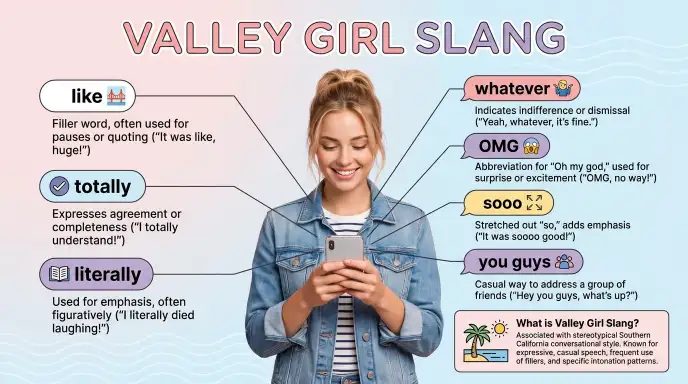
If you have ever watched an American movie, TV show, or social media video featuring the stereotypical fashionable girl from California, you may have heard phrases like “like,” “totally,” “literally,” “whatever,” or “OMG.” These expressions are often associated with Valley Girl slang.
The term became famous through the speech style linked to young women from California’s San Fernando Valley, especially in popular culture during the 1980s. Over time, many of its expressions spread far beyond California and became part of casual American English.
Today, some of these phrases still appear in TikTok videos, Instagram posts, texting, memes, movies, and casual conversations. However, not every phrase associated with the Valley Girl stereotype is actually exclusive to the San Fernando Valley.
Quick Answer: What Is Valley Girl Slang?
Valley Girl slang refers to a group of informal words, phrases, speech patterns, and expressions associated with the stereotypical “Valley Girl” style of speaking.
Common examples include like, totally, whatever, so, literally, OMG, duh, and as if.
The style is often portrayed as casual, expressive, dramatic, playful, and heavily conversational. It is strongly connected to California popular culture, although many of its expressions are now used across the United States and online.
Example: Like, seriously, that was totally amazing!
This sentence uses several expressions commonly associated with the stereotype.
What Does “Valley Girl” Mean?
Valley Girl originally refers to a young woman associated with the San Fernando Valley area of Los Angeles, California. However, the phrase also developed a broader cultural meaning.
In popular culture, a “Valley Girl” is often portrayed as someone who is:
- Fashion-conscious
- Social and expressive
- Casual in speech
- Interested in trends
- Dramatic or enthusiastic
- Fond of words like “like” and “totally”
This stereotype does not describe every person from the San Fernando Valley. It is mainly a pop-culture image that developed around a particular style of speech and behavior.
The stereotype became especially well known through 1980s American movies, music, television, and youth culture.
Where Did Valley Girl Slang Come From?
The Valley Girl speech style is strongly connected with Southern California, particularly the San Fernando Valley.
The style gained national attention in the 1980s, when movies and popular media began using the stereotype to portray young California women.
One major cultural influence was the 1982 song “Valley Girl” by Frank Zappa and Moon Zappa, which helped bring the phrase and its associated speech style to a much wider audience.
The style was already connected with Southern California youth culture, but popular media helped turn it into a recognizable national stereotype.
Over time, some of the expressions became ordinary parts of informal American English. Words such as “like” and “totally” are now used by many different groups and are not limited to Valley Girls.
Why Is “Like” Associated With Valley Girl Speech?
“Like” is probably the most recognizable word associated with the stereotype.
In Valley Girl-style speech, like can appear in several places in a sentence. It may introduce an approximation, add emphasis, or simply act as a conversational filler.
Example: I was, like, so surprised when she called.
Here, like does not have its usual meaning of comparison. Instead, it works as a conversation filler that makes the speech sound informal.
Another example:
Example: There were, like, a hundred people there.
Here, like can suggest that the number is approximate.
This use of like is not unique to Valley Girls. It became widespread in many forms of modern spoken English, especially among younger speakers.
Common Valley Girl Slang Words and Phrases
The following expressions are commonly associated with the Valley Girl stereotype. Some are still widely used today, while others are more strongly connected with older American pop culture.
Like
Like can be used as a filler, an approximation, or a way to introduce something someone said.
Example: She was, like, totally surprised.
The word makes the sentence sound casual and conversational.
Totally
Totally means completely or absolutely.
It is often used to show strong agreement or enthusiasm.
Example: That movie was totally amazing.
The expression gives the sentence an enthusiastic and informal tone.
Whatever
Whatever can show dismissal, indifference, annoyance, or disagreement.
Example: Whatever. I don’t care.
The exact tone depends heavily on how it is said and the surrounding context.
As If
As if is a sarcastic way of saying “I don’t believe that” or “That is very unlikely.”
Example: You think I’m going to apologize? As if!
This phrase became especially famous through 1990s teen culture and the movie Clueless.
Duh
Duh is an informal expression used when something seems obvious.
Example: Of course I knew that. Duh!
It can sound playful, sarcastic, or slightly rude, depending on the situation.
OMG
OMG is short for “Oh my God.” It expresses surprise, excitement, shock, or disbelief.
Example: OMG, look at this dress!
The abbreviation became extremely common in texting and social media, far beyond Valley Girl speech.
So
So is often used for emphasis before an adjective.
Example: That dress is so cute!
Here, so strengthens the adjective “cute.”
This is ordinary modern English today, but exaggerated uses of so are often included in the Valley Girl stereotype.
Bitchin’
Bitchin’ is older informal slang meaning excellent, impressive, or very cool.
Example: That car is bitchin’.
The expression is associated with older California slang and is less common in everyday speech today.
Because it contains a word that can be considered offensive, its use depends strongly on context and audience.
Grody
Grody means disgusting, unpleasant, or gross.
Example: That old food looks totally grody.
This is more strongly associated with older California youth slang than with everyday modern American English.
Gag Me
“Gag me” is an exaggerated way of saying “That is disgusting” or “I can’t stand that.”
Example: You ate that? Gag me!
The phrase is strongly associated with the 1980s Valley Girl stereotype and may sound dated today.
Valley Girl Slang in the 1980s
The 1980s were especially important in making Valley Girl speech recognizable across the United States.
During this period, expressions such as “gag me,” “grody,” “totally,” “like,” and “to the max” became strongly associated with the stereotype.
Movies, music, television, magazines, and advertising helped spread the image.
The speech style was often exaggerated for entertainment. Characters would speak with dramatic intonation, use lots of fillers, and react strongly to everyday situations.
This means that some examples people call Valley Girl slang today are actually pop-culture versions of the speech style rather than expressions used exclusively by real Valley residents.
Valley Girl Slang in the 1990s
The stereotype continued into the 1990s, but the language changed as youth culture changed.
Movies such as Clueless helped popularize California teen speech with a new generation.
Expressions such as “as if!” became particularly memorable.
The style was also influenced by broader American youth language, fashion, television, and music.
By this point, many expressions associated with Valley Girls had become part of mainstream American culture.
Is Valley Girl Slang Still Used Today?
Yes, but the style has changed over time.
Some expressions associated with Valley Girl slang are still common in everyday English, while others are now mostly used as retro references, jokes, or exaggerated stereotypes.
For example, words and expressions such as like, totally, awesome, OMG, whatever, and literally are still widely used.
Other expressions, such as “gag me,” “grody,” and “totally tubular,” are much more likely to sound old-fashioned or intentionally humorous today.
Social media has also brought some older expressions back through 1980s nostalgia, comedy videos, memes, and character-based content.
Valley Girl Slang on TikTok and Social Media
Today, Valley Girl-style speech can appear in TikTok skits, Instagram Reels, memes, comedy videos, and nostalgic content.
Creators may exaggerate the vocabulary, pronunciation, and dramatic style to create a funny or recognizable character.
Example: Like, OMG, I literally cannot deal with this right now.
This sentence combines several features commonly connected with the stereotype.
However, using this style online does not mean the speaker is actually from the San Fernando Valley. People often use it simply to create a funny, dramatic, fashionable, or retro personality.
The internet has also helped separate the expressions from their original regional setting. Many people now use individual words such as like or literally without thinking of them as Valley Girl slang.
Valley Girl Slang vs. California Slang
These terms are related, but they are not identical.
California slang is a broad category that can include informal expressions from different areas and communities throughout California.
Valley Girl slang is more specific. It refers to the speech style connected with the Valley Girl stereotype, especially the cultural image associated with the San Fernando Valley.
| Valley Girl Slang | California Slang |
| More closely linked to a specific stereotype | Much broader category |
| Strongly connected with the San Fernando Valley image | Can come from many parts of California |
| Often associated with young women in pop culture | Used by many different groups |
| Includes expressions such as “gag me” and “as if” | Includes many regional and youth expressions |
| Strongly shaped by movies and popular media | Can develop naturally within local communities |
California has many different speech communities, so it would be inaccurate to treat Valley Girl speech as representative of everyone in California.
Valley Girl Accent and Speech Style
Valley Girl speech is not only about vocabulary. The stereotype also includes a particular way of speaking.
One feature often associated with this style is a noticeable rise in pitch at the end of some statements. Linguists may discuss this type of intonation in relation to broader patterns of American English, so it is not accurate to say that this feature belongs only to Valley Girls.
The stereotypical style may also include:
- Frequent use of “like”
- Exaggerated reactions
- Expressive intonation
- Informal vocabulary
- Strong emphasis on certain words
- Dramatic or playful delivery
For example:
Example: Like, seriously? You did what?
The words themselves are simple, but the intonation and dramatic delivery can create the stereotypical Valley Girl effect.
Valley Girl Slang in Movies and TV
Movies and television played a major role in spreading the Valley Girl stereotype.
Characters portrayed as young, fashionable, social, or trend-focused were often given exaggerated versions of the speech style.
This made expressions such as “like,” “totally,” “whatever,” “as if,” and “gag me” recognizable to audiences outside California.
The important point is that entertainment often exaggerates real speech. A movie character may use more slang than an actual person would use in everyday conversation.
This is common with many regional speech stereotypes. Media creators make certain features more noticeable so viewers can quickly understand the character.
Famous Valley Girl Expressions and Their Meanings
Here are some expressions that are strongly connected with the traditional Valley Girl stereotype.
To the Max
“To the max” means to the highest possible level or extreme.
Example: She decorated her bedroom to the max.
The phrase was especially popular in 1980s youth culture and may sound retro today.
Totally Tubular
“Totally tubular” is an older slang expression meaning very cool, excellent, or impressive.
Example: That skateboard trick was totally tubular!
It is strongly associated with 1980s California youth culture and is often used today for a deliberately retro or humorous effect.
Radical
In older youth slang, radical could mean excellent, exciting, or impressive.
Example: That was a radical concert!
This meaning was used in several youth and California subcultures, so it should not be treated as exclusively Valley Girl slang.
Awesome
Awesome can mean very good, impressive, or exciting in casual English.
Example: Your new shoes are awesome!
Although it is sometimes included in lists of Valley Girl expressions, awesome is not exclusive to Valley Girl speech. It is now a very common informal English word.
What Does “Valley Girl” Sound Like?
The stereotype usually sounds casual, expressive, enthusiastic, and dramatic.
A sentence may contain several fillers and intensifiers.
Example: Like, I was totally going to go, but then she was, like, so annoying.
The meaning is simple:
“I was planning to go, but she annoyed me, so I decided not to.”
The Valley Girl style comes mainly from the delivery and choice of informal expressions, rather than from a completely different vocabulary.
Why Is “Literally” Associated With Valley Girl Speech?
Literally is sometimes included in modern lists of Valley Girl expressions because of its frequent use in exaggerated casual speech.
People may use it to add emphasis, even when something is not literally true.
Example: I literally died when I saw that outfit.
The speaker usually does not mean they actually died. They mean:
“I was extremely surprised or amused by the outfit.”
However, literally is used by many English speakers today. It should not be considered exclusive to Valley Girl slang.
Its association with the stereotype comes more from popular portrayals of expressive, exaggerated speech.
Is Valley Girl Slang Offensive?
Most Valley Girl expressions are not inherently offensive.
Words such as like, totally, awesome, and whatever are ordinary informal expressions.
However, the phrase “Valley Girl” can sometimes be used negatively when someone is trying to stereotype a person as shallow, unintelligent, overly materialistic, or overly concerned with appearance.
That stereotype is a cultural caricature, not a factual description of people from the San Fernando Valley.
Some older expressions may also sound rude depending on context. For example, “duh” can be playful between friends but may sound insulting when directed at someone seriously.
Valley Girl Slang vs. Modern Internet Slang
Modern internet slang and traditional Valley Girl slang overlap in some ways, but they developed in different cultural settings.
Valley Girl speech became widely known through California youth culture and mass media, especially during the 1980s and 1990s.
Internet slang developed through online communities, texting, social media, gaming, and digital communication.
Today, the two can mix.
For example, someone might combine a traditional Valley Girl expression with modern internet language:
Example: OMG, that outfit is literally so cute, I can’t.
The individual expressions may come from different periods and communities, but they can naturally appear together in modern casual speech.
Valley Girl Slang Examples in Conversation
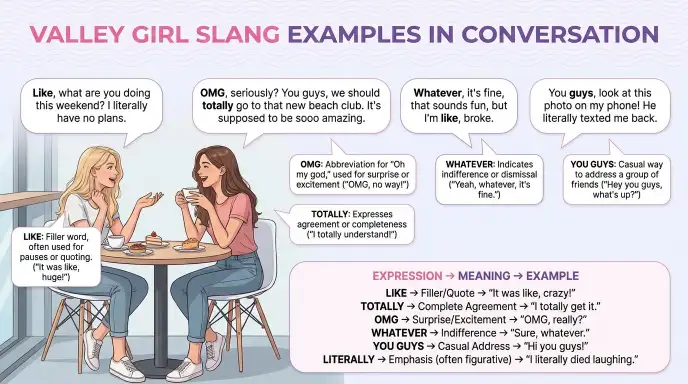
Seeing the expressions in context makes their meaning easier to understand.
Example 1: Excitement
Example: OMG, that concert was totally amazing!
Here, OMG expresses excitement, while totally adds emphasis.
Example 2: Disbelief
Example: You think I’m going to wear that? As if!
Here, as if shows sarcastic disbelief.
Example 3: Disgust
Example: You left food in the fridge for three weeks? Gag me!
Here, gag me means the speaker finds the situation disgusting.
Example 4: Casual Conversation
Example: I was, like, so tired after school.
Here, like acts as a conversational filler.
Example 5: Dismissal
Example: Whatever, do what you want.
Here, whatever shows indifference or annoyance.
Example 6: Obvious Information
Example: Duh, everyone knows that!
Here, duh suggests that the information seems obvious.
Are Valley Girl Words Still Popular?
Some are, but their connection to the stereotype has weakened.
Words such as like, awesome, literally, so, and OMG are now common across different age groups and communities.
Other expressions have become less common in everyday speech.
| Expression | Modern Usage |
| Like | Very common |
| Totally | Common |
| Awesome | Very common |
| OMG | Common online and in texting |
| Literally | Very common |
| Whatever | Common |
| Duh | Still recognized |
| As if | Recognized, often humorous |
| Grody | Mostly dated |
| Gag me | Mostly dated |
| Totally tubular | Mostly retro or humorous |
| To the max | Mostly retro |
This shows why it is useful to separate modern casual English from the older Valley Girl stereotype.
Frequently Asked Questions
What is Valley Girl slang?
Valley Girl slang refers to informal expressions and speech patterns associated with the stereotypical young California woman, especially the San Fernando Valley image popularized by American media.
What are common Valley Girl words?
Commonly associated expressions include like, totally, whatever, duh, OMG, as if, grody, gag me, and to the max.
Is “like” Valley Girl slang?
Like is strongly associated with the Valley Girl stereotype, especially when used as a conversational filler. However, this use is now widespread in modern spoken English and is not limited to Valley Girls.
What does “as if” mean in Valley Girl slang?
As if is a sarcastic expression meaning “I don’t believe you” or “That is not going to happen.”
What does “gag me” mean?
Gag me is an exaggerated way of saying “That is disgusting” or “I really dislike that.” It is strongly associated with older 1980s Valley Girl culture.
Is Valley Girl slang still used?
Yes. Some expressions remain common, especially like, totally, awesome, OMG, and literally. Others are now mostly used for humor, nostalgia, or retro references.
Is Valley Girl slang only from California?
The stereotype is strongly connected to Southern California, particularly the San Fernando Valley, but many expressions spread nationally and are now used far beyond California.
Is Valley Girl slang offensive?
The slang itself is generally not offensive, although calling someone a “Valley Girl” can sometimes be negative if it is being used to stereotype them as shallow or unintelligent.
Final Thoughts
Valley Girl slang is best understood as a combination of informal expressions, speech patterns, and a cultural stereotype connected with the San Fernando Valley and Southern California.Expressions such as “like,” “totally,” “whatever,” “OMG,” “duh,” and “as if” became especially recognizable through movies, music, television, and youth culture.Some expressions are still part of everyday English, while others now sound dated or intentionally retro.The most important thing to remember is that Valley Girl speech is a pop-culture stereotype, not a description of everyone from California. Many of its expressions have also become so common that people use them without any connection to the original stereotype.
Explore more slang!

Daniel Carter – Short Bio (First Person)
Hi, I’m Daniel Carter, a slang language researcher and content writer. I enjoy exploring internet slang, texting abbreviations, and modern expressions to make them easy for everyone to understand. My goal is to explain slang in clear, simple English with real-life examples so readers can communicate confidently online and stay up to date with the latest language trends.