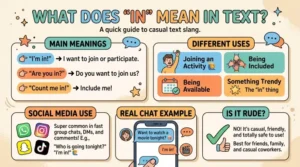
The word “in” in a text message usually means being included, interested, available, or willing to participate in something. However, its exact meaning depends on the conversation. People use it in everyday texting, TikTok comments, Snapchat messages, Instagram chats, and other social platforms.
Unlike internet abbreviations such as IDK or BRB, “in” is a regular English word rather than a specific slang acronym. Still, it can carry different meanings in casual online conversations.
For example, if someone asks, “Are you coming to the party?” and you reply, “I’m in,” you are saying that you want to join.
People often search for this expression because they see it in short messages or social media comments and want to understand what the sender actually means. Its meaning can change depending on the topic, tone, and situation.
“In” Meaning in Text
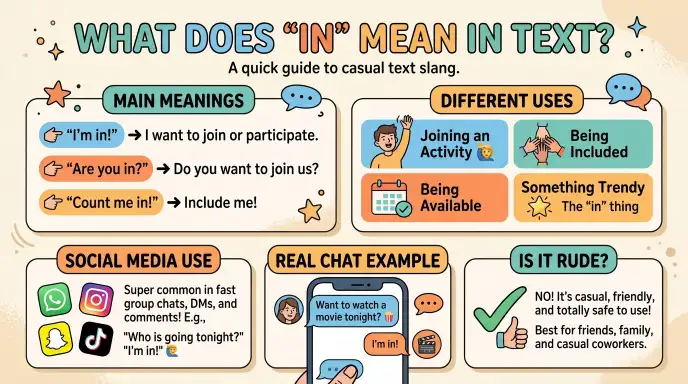
In texting, “in” commonly means agreeing to join an activity, accepting an invitation, or showing interest in a plan. It is a short way to tell someone that you are participating or willing to take part.
For example:
- Friend: We’re watching a movie tonight. Are you coming?
- You: I’m in!
Here, “I’m in” means you agree to join the movie plan.
However, the word can have several meanings depending on how someone uses it. It does not always indicate agreement or participation.
Is “In” Slang, an Acronym, or an Abbreviation?
The word “in” is not technically slang, an acronym, or an abbreviation. It is a standard English word that has developed several informal uses in digital conversations.
People often use it as a quick response because it communicates an idea without requiring a long sentence.
For example:
- I’m in: I want to participate.
- Are you in? Are you interested in joining?
- Count me in: Include me in the plan.
- I’m not in: I am not participating.
- You’re in: You have been accepted or included.
These expressions are common in everyday conversations, especially when friends are making plans.
Different Meanings of “In” Depending on Context
The meaning of this word can change depending on the sentence.
Here are some common interpretations:
1. Interested or willing
When someone says “I’m in,” they usually mean they are interested in an activity or plan.
Example:
A: Want to go shopping tomorrow?
B: I’m in!
2. Being included
Sometimes, “in” means someone is part of a group, activity, or conversation.
Example:
A: Is Sarah in our study group?
B: Yes, she’s in.
3. Available or present
In some conversations, the word can indicate that someone is available or currently present.
Example:
A: Are you in the office today?
B: Yes, I’m in.
4. Popular or fashionable
The expression “in” can also describe something that is currently popular or trendy.
Example:
A: Are oversized jackets still in?
B: Yes, they’re really popular right now.
Understanding the surrounding sentence is the easiest way to identify which meaning someone intends.
Where People Use “In” on Social Media
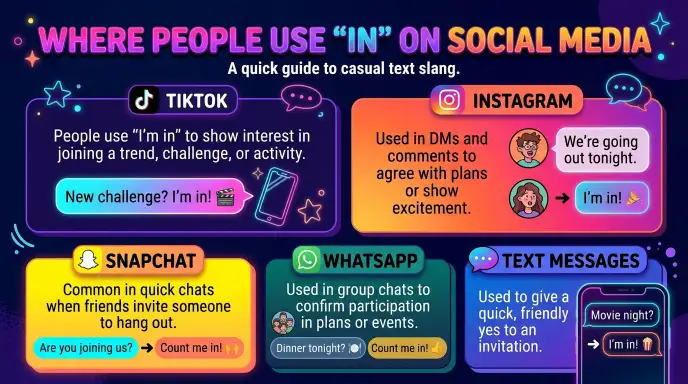
The word “in” appears across almost every messaging platform. Its meaning usually stays similar, but the way people use it can depend on the platform and conversation.
Let’s look at some common examples.
“In” on TikTok
On TikTok, people sometimes use “in” in comments when they want to participate in a trend, challenge, discussion, or online activity.
For example:
- Creator: Who wants to join this challenge?
- User: I’m in!
Someone might also comment “I’m in” when a creator invites followers to participate in a giveaway or community activity.
It can also appear in discussions about fashion, music, and trends. In those situations, “in” may mean something is fashionable or currently popular.
“In” on Snapchat
On Snapchat, people often use short expressions when chatting with friends.
For example:
- Friend: We’re meeting at 7. You in?
- You: Yeah, I’m in.
Here, the sender is confirming that they want to join the plan.
Because Snapchat conversations are usually informal, “in” works as a quick and natural response.
“In” on Instagram
On Instagram, “in” can appear in direct messages, group chats, and comment sections.
For example:
- Friend: We’re starting a new fitness group. Interested?
- You: I’m in!
It can also be used when discussing popular styles, products, or online trends.
For instance, someone might ask, “Is this color still in?” They want to know if that color is still fashionable.
“In” on WhatsApp
On WhatsApp, people use “in” when making plans with friends, family members, classmates, or coworkers.
Example:
- A: We’re ordering pizza tonight. Want some?
- B: I’m in.
The response means the person wants to participate in the plan.
It is also common in WhatsApp group chats when someone asks who wants to join an event or activity.
“In” in SMS Text Messages
Traditional SMS conversations also use this expression.
For example:
- A: Want to come with us this weekend?
- B: Count me in!
It is especially useful when someone wants to respond quickly without typing a complete explanation.
if someone uses an iPhone, Android phone, or another messaging device, the basic meaning remains the same.
10 Real Chat Examples of “In”
The following conversations show how people naturally use this word in different situations.
Example 1: Joining Friends
A: We’re going to the beach tomorrow. Want to come?
B: I’m in!
A: Great, see you at 9.
Meaning: The person agrees to join the beach trip.
Example 2: Movie Night
A: We’re watching a horror movie tonight.
B: I’m in, but don’t choose anything too scary.
A: Haha, no promises.
Meaning: The person wants to participate in movie night.
Example 3: Playing Games
A: We’re playing online games after dinner. You joining?
B: Count me in.
A: Awesome!
Meaning: The person agrees to play with the group.
Example 4: Starting a Project
A: Do you want to work on this project together?
B: Yeah, I’m in.
A: Let’s discuss the details tomorrow.
Meaning: The person is interested in participating in the project.
Example 5: Group Shopping
A: We’re going shopping this Saturday.
B: I’m in. I need some new clothes anyway.
A: Let’s meet at the mall.
Meaning: The person wants to join the shopping trip.
Example 6: Trying Something New
A: We’re thinking about learning photography.
B: I’m in! I’ve wanted to try that for ages.
A: Let’s start this week.
Meaning: The person is excited and willing to participate.
Example 7: Asking About Availability
A: Are you in today?
B: Yes, I’ll be at the office until 5.
A: Perfect, I’ll stop by.
Meaning: The sender is asking if the person is present or available.
Example 8: Discussing Fashion
A: Are cargo pants still in?
B: Definitely. They’re still popular.
A: I might buy a pair.
Meaning: The word refers to something fashionable or trendy.
Example 9: Joining a Challenge
A: Everyone is trying the new dance challenge.
B: I’m in! Send me the video.
A: I’ll send it now.
Meaning: The person wants to participate in the challenge.
Example 10: Accepting an Invitation
A: We’re having a small birthday dinner on Friday. Are you in?
B: Of course, I’m in!
A: Great, can’t wait to see you.
Meaning: The person accepts the invitation.
These examples show that “in” is a flexible word. The surrounding conversation helps explain what the sender means.
How to Reply When Someone Says “In”
Your response depends on the situation. If someone says “I’m in,” they are usually agreeing to participate. You can respond positively, casually, or humorously.
Here are some natural replies.
Funny Replies
If you’re chatting with close friends, a little humor can make the conversation more entertaining.
- “I knew you wouldn’t miss it!”
- “That’s the spirit!”
- “You’re officially on the team.”
- “Let’s hope you can keep up!”
- “No backing out now!”
These replies work well when friends are planning something fun.
Casual Replies
You don’t always need a long response. A simple message is often enough.
- “Awesome!”
- “Sounds good.”
- “Perfect!”
- “Cool, see you there.”
- “Great, let’s do it.”
These are suitable for everyday conversations.
Friendly Replies
When someone enthusiastically agrees to join you, a friendly response helps keep the conversation positive.
- “Glad you’re joining us!”
- “That’ll be fun!”
- “Looking forward to it!”
- “It wouldn’t be the same without you.”
- “Happy to have you with us!”
Use these when you want to sound welcoming.
Neutral Replies
In situations involving work, school, or more formal plans, you may prefer a straightforward response.
- “Okay, I’ll share the details.”
- “Thanks for confirming.”
- “I’ll add you to the group.”
- “Great, I’ll keep you updated.”
- “Understood. See you then.”
Choose a response that matches your relationship with the sender.
Is “In” Rude or Offensive?
No. The word “in” is not generally rude, offensive, or inappropriate. It is a normal English word that people use in everyday conversations.
When someone says “I’m in,” they are usually showing interest or agreeing to participate in something.
However, the tone and surrounding conversation can affect how the message feels.
Is It Safe to Use With Friends?
Yes. It is completely normal to use “in” with friends.
For example:
A: Want to grab some coffee?
B: I’m in!
This sounds friendly and natural.
Is It Appropriate at School?
Yes. Students can use expressions such as “I’m in” when talking about group projects, school activities, competitions, or events.
For example:
A: We’re forming a science project team. Want to join?
B: I’m in.
It is a casual expression, so it works best in informal school conversations.
Is It Appropriate at Work?
It depends on the workplace and situation.
In a casual office chat, saying “I’m in” is perfectly acceptable.
For example:
Coworker: We’re organizing a team lunch. Interested?
You: I’m in!
However, in formal emails or professional documents, a more complete response may sound better.
For example:
- “I would be happy to participate.”
- “I’d like to be included.”
- “I confirm my participation.”
The important thing is to match your language to the situation.
Who Uses This Term?
The word “in” is used by people of different ages because it is part of everyday English. Its informal meaning is especially common when people discuss activities, invitations, and plans.
Unlike newer internet slang, it isn’t limited to a particular generation or online community.
Teenagers and Young Adults
Teenagers and young adults frequently use short expressions such as “I’m in” when making plans.
They might use it when discussing:
- Weekend activities
- Gaming sessions
- Parties
- School projects
- Social media challenges
- Group outings
It helps them respond quickly without writing a long message.
Gen Z Usage
Gen Z users often prefer short, direct messages in casual online conversations.
Expressions like “I’m in,” “count me in,” and “you in?” fit naturally into this communication style.
However, the word itself is not exclusive to Gen Z. Older generations use it just as often in everyday situations.
Millennials and Older Adults
Millennials and older adults also use “in” when accepting invitations or discussing plans.
For example, a coworker might write:
“Are you in for the team dinner?”
A friend might respond:
“Absolutely, I’m in.”
The expression is widely understood across different age groups.
Common Platforms
People use this word on:
- TikTok comments and discussions
- Snapchat conversations
- Instagram direct messages
- WhatsApp group chats
- Facebook messages
- Traditional SMS texts
How Often Does It Appear Online?
The word “in” appears extremely frequently online because it is a basic English word.
However, its specific use as a response meaning agreement or participation is only one of many ways people use it.
It is better understood as a common conversational expression than as a trending internet slang term.
Origin of the Term “In”
The word “in” has a long history in the English language. It existed long before smartphones, social media, and internet messaging became popular.
Its original uses relate to being inside something, within a particular place, or involved in a situation.
Over time, expressions such as “I’m in” developed a broader conversational meaning.
How Did “I’m In” Become Popular?
The expression became a natural part of everyday spoken English.
People have used it to accept invitations, agree to plans, and show willingness to participate for many years.
When digital communication became common, people continued using the same expression in text messages.
It was especially convenient because it was short, clear, and easy to understand.
Internet Culture and Online Messaging
Social media helped make short responses more visible.
Today, people use “I’m in” when responding to:
- Online challenges
- Group activities
- Gaming invitations
- Social events
- Collaborative projects
- Community discussions
However, the internet did not create the word or its basic meaning.
Is the Exact Origin Known?
The origin of the word itself is well established in English, but there isn’t one specific internet event or social media platform responsible for making “I’m in” popular.
It developed naturally through everyday language and continued into modern digital communication.
Comparison: “In” vs IDK, IDC, IMO, and BRB
Although people sometimes search for these expressions together, they have different meanings and serve different purposes in conversations.
| Term | Meaning | Type | Usage | Popularity |
| In | Agreeing to join or participate | Common English word | Accepting invitations or showing interest | Very common |
| IDK | I Don’t Know | Acronym | Expressing uncertainty | Very common |
| IDC | I Don’t Care | Acronym | Showing a lack of concern | Common |
| IMO | In My Opinion | Acronym | Sharing a personal viewpoint | Common |
| BRB | Be Right Back | Acronym | Temporarily leaving a conversation | Common |
Key Differences
In: Shows that someone wants to join an activity or is included in something.
IDK: Expresses that someone doesn’t know the answer.
IDC: Communicates that someone doesn’t have a particular concern or preference.
IMO: Introduces a personal opinion.
BRB: Tells someone that the sender will return shortly.
For example:
A: Do you know where the party is?
B: IDK.
A: We’re going to the movies. You coming?
B: I’m in!
These expressions may appear in the same conversation, but their meanings are completely different.
Real-World Usage Example
Imagine that a group of friends is planning a weekend trip. One friend creates a WhatsApp group and asks everyone if they want to visit a nearby beach on Saturday.
The conversation might look like this:
Ali: We’re planning a beach trip this Saturday. Who wants to join?
Hamza: I’m in!
Sara: Sounds fun. What time are we leaving?
Ali: Around 8 in the morning.
Hamza: Perfect. I’ll be ready.
In this situation, Hamza uses “I’m in” to show that he agrees to participate in the trip.
He doesn’t need to write a long message explaining that he wants to come. The short expression communicates his decision clearly.
Now imagine a different situation.
A friend asks:
“Are you in the office today?”
Someone replies:
“Yes, I’m in.”
Here, the meaning is different. The person is saying they are present at the office.
This is why context matters. The same word can communicate different ideas depending on the situation.
Frequently Asked Questions
1. What does “in” mean in text messages?
In text messages, “in” often means someone agrees to join an activity, accepts an invitation, or wants to participate. For example, “I’m in” means “I want to join.”
2. What does “in” mean on TikTok?
On TikTok, “in” can mean participating in a trend, challenge, or activity. It can also describe something fashionable or popular.
3. Is “in” slang?
No. “In” is a regular English word, not an acronym or abbreviation. However, expressions like “I’m in” are commonly used in informal online conversations.
4. Is “in” rude or offensive?
No. The word is not generally rude or offensive. It is safe to use with friends, classmates, and coworkers, depending on the context.
5. How should you reply to “in”?
If someone says “I’m in,” you can reply with “Awesome!”, “Sounds good!”, “Perfect!”, or “See you there!” Your response should match the conversation.
Conclusion
The word “in” has several meanings in everyday texting, but one of its most common informal uses is showing interest or agreeing to participate in an activity.
When someone says “I’m in,” they usually mean they want to join a plan, event, or group activity. On platforms like TikTok, Snapchat, Instagram, and WhatsApp, it works as a quick and natural response.
Remember that context is important. Sometimes “in” means being included, while in other conversations it can refer to availability or something fashionable.
It is not rude or offensive, and you can comfortably use it in casual conversations. For formal situations, however, a more complete expression may be appropriate.
Understanding simple expressions like this can make online conversations easier and help you avoid misunderstandings.
Discover more slang!

Daniel Carter – Short Bio (First Person)
Hi, I’m Daniel Carter, a slang language researcher and content writer. I enjoy exploring internet slang, texting abbreviations, and modern expressions to make them easy for everyone to understand. My goal is to explain slang in clear, simple English with real-life examples so readers can communicate confidently online and stay up to date with the latest language trends.