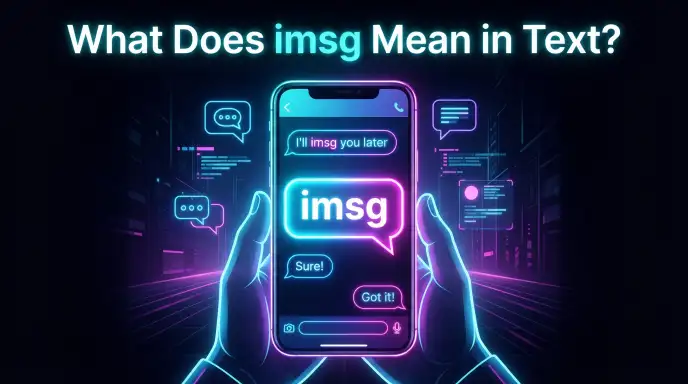
iMsg usually means “iMessage” in text slang. People use “imsg” as a short way to refer to Apple’s iMessage service, especially when talking about messaging someone through an iPhone, iPad, or Mac.
You may see imsg in texting, Snapchat, TikTok comments, Instagram conversations, or casual online chats. For example, someone might say, “I’ll imsg you later,” meaning “I’ll message you on iMessage later.”
People search for this term because abbreviations can be confusing when they appear without context. If you are not familiar with Apple messaging or online shorthand, imsg can look like a random collection of letters.
Quick Answer
imsg means “iMessage” in most texting conversations. It is an informal abbreviation used to talk about Apple’s messaging service or to say that someone will send a message through iMessage.
For example:
A: “Can you send me the address?”
B: “Yeah, I’ll imsg you.”
Here, “imsg” simply means send you an iMessage.
What Does imsg Mean in Text Slang?
The most common meaning of imsg in text slang is iMessage.
iMessage is Apple’s messaging system used between compatible Apple devices. Instead of writing the full word every time, some people shorten it to imsg when chatting casually.
You might see phrases such as:
- “I’ll imsg you.”
- “Imsg me when you get home.”
- “Did you imsg her?”
- “I sent it on imsg.”
- “Let’s talk on imsg.”
In each example, the person is referring to sending or receiving a message through iMessage.
Is imsg an Acronym or Abbreviation?
imsg is best described as an abbreviation or shortened form of “iMessage.”
It is not normally treated like classic acronyms such as IDK, LOL, or BRB, where each letter represents a separate word.
The shortening comes from taking the recognizable parts of iMessage and using imsg as a quick informal form.
What Does imsg Mean in Everyday Chat?
In everyday conversation, the meaning is usually very straightforward.
If someone says:
“Imsg me later.”
They are essentially saying:
“Message me on iMessage later.”
The exact meaning can depend slightly on the sentence. Sometimes it refers to the messaging service itself, while other times it works almost like a verb.
For example:
“I’ll imsg you tonight.”
Here, the speaker means they will send you an iMessage.
That casual use is common in conversations where both people already understand the context.
Why Do People Shorten iMessage to imsg?
Texting is built around speed and convenience. People naturally shorten words when they believe the other person will understand them.
Apple related terms can also become shortened in casual conversations. Someone who regularly uses an iPhone may not need to explain what imsg means to another iPhone user.
It is similar to saying:
“I’ll text you.”
The difference is that the speaker may specifically mean an iMessage rather than a generic text message.
Where People Use imsg
The abbreviation can appear across different online platforms, but its meaning usually stays connected to iMessage.
The surrounding conversation is still important because abbreviations can occasionally have other meanings in specific communities.
imsg on TikTok
On TikTok, you may see imsg in comments, captions, direct conversations, or discussions about contacting someone.
For example:
“I’ll imsg you about it.”
This normally means:
“I’ll message you about it on iMessage.”
TikTok users often mix platform specific language with general texting abbreviations, so a short term such as imsg may appear alongside words like “DM,” “text,” or “message.”
If someone says:
“Don’t comment it, just imsg me.”
They are probably asking the other person to communicate privately through iMessage.
imsg on Snapchat
Snapchat has its own messaging system, so context matters more here.
If someone on Snapchat says:
“I’ll imsg you later,”
they are usually referring to contacting the person through iMessage rather than continuing the Snapchat conversation.
A person might move a conversation from Snapchat to iMessage because they want to exchange phone numbers, send something privately, or simply use their regular messaging app.
imsg on Instagram
Instagram users may also use imsg when moving a conversation from Instagram Direct Messages to Apple’s messaging service.
For example:
“Can you imsg me the pictures?”
This could mean:
“Can you send the pictures to me through iMessage?”
The term is informal, so you are more likely to see it in casual conversations than in professional Instagram communication.
imsg on WhatsApp
WhatsApp users can also mention iMessage when discussing how they want to communicate.
For example:
“I don’t check WhatsApp much. Just imsg me.”
The speaker is making a preference clear: they would rather receive the message through iMessage.
However, if both people are already using WhatsApp, imsg would be less likely to appear unless they are specifically talking about switching messaging platforms.
imsg in SMS and Regular Texting
The abbreviation can also appear in ordinary text conversations.
Someone might send:
“Imsg me when you’re free.”
This is essentially an instruction to contact them through iMessage.
Because iMessage and regular SMS can appear within Apple’s Messages app, people sometimes use the terms loosely. The important point is that imsg normally points to Apple’s messaging service rather than a particular emotional reaction or slang phrase.
Real Chat Examples
Seeing the abbreviation in realistic conversations makes its meaning much easier to understand.
Example 1: Making Plans
A: “Are we still going out tonight?”
B: “Yeah, I’ll imsg you when I leave.”
A: “Perfect.”
Here, B means they will send A an iMessage when they leave.
Example 2: Sending an Address
A: “What’s the address again?”
B: “I’ll imsg it to you.”
A: “Thanks.”
The person plans to send the address through iMessage.
Example 3: Moving From Social Media
A: “Can you send me the video?”
B: “Sure. I’ll imsg you.”
A: “Okay.”
The conversation may have started on a social platform, but B wants to send the video through iMessage.
Example 4: Talking About a Friend
A: “Did you talk to Mia?”
B: “Yeah, I imsg’d her yesterday.”
A: “What did she say?”
Here, “imsg’d” is being used informally as a past tense form of “iMessage.”
Example 5: Contact Preference
A: “Should I DM you?”
B: “Nah, just imsg me.”
A: “Got it.”
B prefers iMessage instead of an Instagram direct message.
Example 6: Sharing Photos
A: “I have the photos from yesterday.”
B: “Nice, imsg them to me when you can.”
A: “Will do.”
The speaker is asking for the photos to be sent through iMessage.
Example 7: After Getting Someone’s Number
A: “I saved your number.”
B: “Cool, imsg me sometime.”
A: “Definitely.”
Here, B is inviting A to start a conversation through iMessage.
Example 8: Making a Quick Request
A: “Can you send me the details?”
B: “Yeah, imsg you in a minute.”
A: “Thanks!”
The response means the information will be sent through iMessage shortly.
Example 9: Choosing Between Apps
A: “Want to talk here or somewhere else?”
B: “Imsg is easier for me.”
A: “Okay, send me a message there.”
The person prefers Apple’s messaging service.
Example 10: Checking a Message
A: “Did you imsg Jake?”
B: “Yeah, but he hasn’t replied.”
A: “Maybe he’s busy.”
The abbreviation refers to sending Jake a message through iMessage.
How to Reply When Someone Says “imsg”
How you respond depends on what the person means in the conversation.
If someone says “I’ll imsg you,” they are probably telling you that they will contact you through iMessage. A simple response is enough.
Casual Replies
For everyday conversations, you can keep your answer short:
- “Okay.”
- “Sure.”
- “Sounds good.”
- “Got it.”
- “No problem.”
- “Alright.”
- “Cool, talk later.”
For example:
A: “I’ll imsg you tonight.”
B: “Sounds good.”
There is no need to make the conversation complicated.
Friendly Replies
If you want your response to sound warmer, try:
- “Sure, talk soon!”
- “Sounds good, send it over.”
- “Okay, I’ll look out for it.”
- “Perfect, thanks!”
- “Yep, message me whenever.”
These replies work well when you are already having a friendly conversation.
Funny Replies
If the conversation is playful, you could respond with something humorous:
- “My Messages app is ready.”
- “Say less 😂”
- “I’ll be waiting.”
- “Incoming iMessage, got it.”
- “The blue bubbles await.”
These work best with friends who understand your sense of humor.
Neutral Replies
When you want to stay polite but not overly casual, use:
- “Okay, thank you.”
- “Sure, that works.”
- “Understood.”
- “That’s fine.”
- “I’ll check my messages.”
These are useful when you do not know the person very well.
Is imsg Rude or Offensive?
No, imsg is generally not rude or offensive.
It is simply an informal abbreviation for iMessage.
There is no insulting or inappropriate meaning associated with the term in its usual texting context. Someone using imsg is normally just talking about how they want to communicate.
Is imsg Safe to Use?
Yes, it is generally safe to use in casual digital conversations.
You might use it with:
- Friends
- Family
- Classmates
- People you regularly text
- Casual online contacts
However, remember that abbreviations can be less clear when the other person does not know what they mean.
Is imsg Appropriate at School?
In casual messages between classmates, imsg is generally fine.
For school assignments, formal emails, applications, or academic writing, it is better to write iMessage or simply message rather than using informal shorthand.
For example, instead of:
“I’ll imsg you about the project.”
A more formal message would be:
“I’ll message you about the project.”
Is imsg Appropriate at Work?
It depends on the workplace and the relationship.
If you are chatting casually with a coworker who regularly uses abbreviations, imsg may be understood. But in formal workplace communication, clearer wording is usually better.
For professional communication, write:
“I’ll send you a message.”
or
“I’ll message you on iMessage.”
That removes any possibility of confusion.
Who Uses This Term?
The people most likely to use imsg are people who regularly communicate through Apple devices.
Gen Z Usage
Gen Z users are comfortable with shortened language, abbreviations, and platform specific expressions. They may shorten familiar technology names when talking casually with friends.
That does not mean every Gen Z user says imsg. Many simply say “text me” or “message me.”
The abbreviation is more likely to appear when the specific messaging platform matters.
Younger Internet Users
Teenagers and young adults who use iPhones may understand the abbreviation quickly because iMessage is part of their everyday communication.
However, familiarity varies by device and region. People who primarily use Android phones or other messaging platforms may not use the term regularly.
Older Users
Older users can certainly understand and use imsg, particularly if they regularly use Apple devices.
Internet abbreviations are not limited strictly to one age group. Usage usually depends more on someone’s messaging habits than their age alone.
Where Is It Most Common?
You are most likely to encounter the term in:
- Casual texting
- iPhone related conversations
- Social media chats
- Private messages
- Conversations about switching messaging apps
- Informal discussions between friends
It is not one of the most universal abbreviations online. Someone who does not use Apple devices may be less familiar with it.
Origin of the Term
The origin of imsg is fairly straightforward.
It comes from shortening the name iMessage for casual communication. Apple introduced iMessage as its messaging service, and over time people developed informal ways of referring to it.
The exact point when imsg became used as a shortened form is difficult to establish. Unlike some famous internet slang terms, there is not a single person or event that can clearly be identified as the creator of this abbreviation.
Internet Culture and Shortened Words
Online communication encourages people to shorten familiar terms.
When a word or service is already well known, people often remove unnecessary letters while keeping enough of the original word for the meaning to remain obvious.
For an iPhone user, imsg can be immediately understandable because the context already points toward iMessage.
This is similar to how people use many shortened forms when communicating quickly.
Is the Origin Completely Certain?
The meaning is much clearer than the exact history of the abbreviation.
There is no widely established single origin story for imsg as a slang term. It is best understood as an informal shortening that developed naturally from people discussing iMessage in digital conversations.
imsg vs. IDK vs. IDC vs. IMO vs. BRB
These abbreviations can all appear in text conversations, but they serve very different purposes.
| Term | Meaning | Type | Usage | Popularity |
| imsg | iMessage | Abbreviation | Talking about Apple’s messaging service | Less common |
| IDK | I Don’t Know | Acronym | Showing uncertainty or lack of knowledge | Very common |
| IDC | I Don’t Care | Acronym | Showing indifference | Very common |
| IMO | In My Opinion | Acronym | Introducing a personal opinion | Common |
| BRB | Be Right Back | Acronym | Saying you will return shortly | Common |
The biggest difference is that imsg refers to a messaging service, while the other four usually communicate an idea, feeling, or conversational action.
For example:
“IDK what happened.”
means the person does not know what happened.
“IDC what we watch.”
means the person does not care what they watch.
“IMO, that movie was better.”
means the speaker is giving their opinion.
“BRB, dinner.”
means the speaker will be back shortly.
But:
“I’ll imsg you.”
means the person plans to contact you through iMessage.
Real World Usage Example
Imagine two friends meet at a coffee shop and make plans for the weekend.
One friend has an iPhone and wants to send the other person the location of the event later.
The conversation might look like this:
Friend 1: “What time should we meet Saturday?”
Friend 2: “Around 7?”
Friend 1: “Works for me.”
Friend 2: “Cool, I’ll imsg you the location tomorrow.”
In this situation, imsg simply means that Friend 2 will send the location through iMessage.
There is no hidden meaning or emotional message behind the abbreviation. It is just a convenient way to identify the messaging method.
If the same person said:
“I’ll message you tomorrow,”
the meaning would be almost identical. The word imsg simply makes the communication method more specific.
Why Context Still Matters
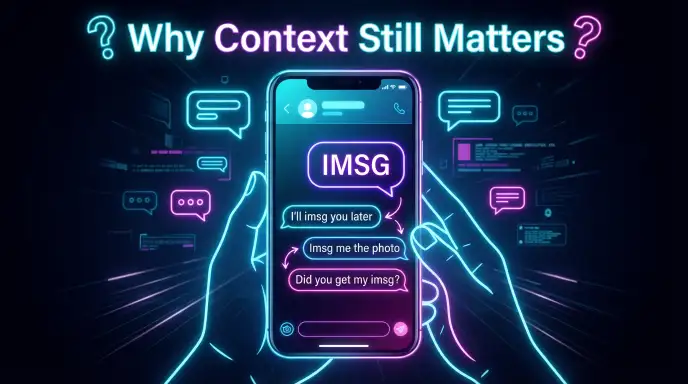
Although imsg usually means iMessage, context is always useful when interpreting internet abbreviations.
Someone might use a similar looking abbreviation as a username, brand name, community term, or personal shorthand.
For example, if you see:
“I’ll imsg you.”
the meaning is quite obvious because “you” follows it.
But if you only see:
“IMSG”
without any surrounding words, you may need more context before deciding exactly what the person means.
A good rule is to look at the words before and after the abbreviation.
If the conversation is about:
- iPhones
- Apple devices
- texting
- phone numbers
- messages
- switching from Instagram or Snapchat
then iMessage is the natural interpretation.
Common Mistakes When Understanding imsg
One common mistake is assuming that every short internet term has a complicated slang meaning.
Sometimes an abbreviation is exactly what it looks like: a shortened name for a familiar service.
Another mistake is confusing imsg with general texting.
Technically, saying “I’ll imsg you” can indicate a specific method of communication. It is not necessarily the same as saying you will send an ordinary SMS.
A third mistake is treating it like an emotional abbreviation.
Unlike IDC, IDK, or IMO, the term does not normally express an opinion, attitude, or feeling.
It mainly identifies iMessage or sending a message through that service.
Is imsg the Same as “Text Me”?
Not always, although the practical result can be similar.
“Text me” is a broad expression. It can mean “send me a message” without specifying the messaging technology.
“imsg me” is more specific and usually points toward iMessage.
For example:
“Text me when you arrive.”
could mean sending an SMS, iMessage, or potentially another type of text depending on the context.
“imsg me when you arrive.”
more specifically suggests using iMessage.
That distinction matters most when someone is choosing between different messaging platforms.
When You Should Avoid Using imsg
Even though the abbreviation is harmless, it is not appropriate for every situation.
Avoid it when writing:
- School essays
- Academic assignments
- Formal emails
- Job applications
- Business reports
- Official documents
- Professional announcements
In these situations, clear standard English is preferable.
Instead of:
“I’ll imsg you the details.”
write:
“I’ll send you the details by message.”
Or, if the platform matters:
“I’ll send you the details through iMessage.”
The goal is not to avoid abbreviations completely. It is simply to use the right level of formality for the situation.
Frequently Asked Questions
What does imsg mean in text messages?
imsg usually means “iMessage.” It is an informal abbreviation used when someone is talking about sending a message through Apple’s messaging service.
What does imsg mean on TikTok?
On TikTok, imsg generally means iMessage. Someone may use it when asking another person to continue a conversation or send something through iMessage.
Is imsg slang?
imsg is an informal abbreviation rather than traditional slang. It is a shortened way of referring to iMessage in casual digital communication.
Is imsg rude or offensive?
No. imsg is normally neutral and harmless. It does not have an offensive meaning in ordinary texting.
How should you reply to imsg?
Keep your response natural. You can say “Sure,” “Okay,” “Sounds good,” or “Got it.” If the person says they will imsg you, simply acknowledge the message.
Final Thoughts
imsg usually means “iMessage” in text slang. It is an informal abbreviation people use when talking about Apple’s messaging service or saying they will contact someone through iMessage.
You may encounter it in texting and social media conversations, especially when someone is moving a conversation from Instagram, Snapchat, or another platform to iMessage.
The term is generally neutral, safe, and easy to understand once you know the context. It works well in casual conversations, but writing out “iMessage” or “message” is a better choice for school, work, and other formal situations.
If you see “imsg” in a sentence such as “I’ll imsg you later,” the simplest interpretation is usually the right one: “I’ll message you on iMessage later.”
Read more about slang!

Daniel Carter – Short Bio (First Person)
Hi, I’m Daniel Carter, a slang language researcher and content writer. I enjoy exploring internet slang, texting abbreviations, and modern expressions to make them easy for everyone to understand. My goal is to explain slang in clear, simple English with real-life examples so readers can communicate confidently online and stay up to date with the latest language trends.