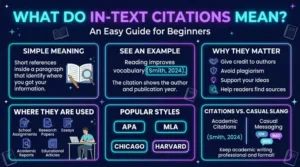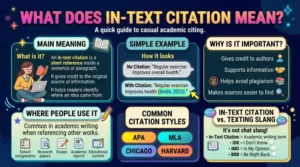
In-text citations are short references included within a sentence or paragraph to show where information comes from. They help readers identify the original source of a fact, quotation, idea, or research finding.
You may come across this term while reading school assignments, research papers, online articles, or educational posts on TikTok, Instagram, and other social media platforms. Students and writers often search for it because they want to understand how citations work and when they should use them.
Although the phrase may look like an internet abbreviation, in-text citations are not slang or a texting acronym. They are part of academic and professional writing. Their main purpose is to give credit to the original author and help readers check the information being shared.
Understanding this term can make essays, reports, and online content easier to write. Once you know what an in-text citation does, you can recognize one in a document and use it correctly in your own work.
Quick Answer: What Do In-Text Citations Mean?
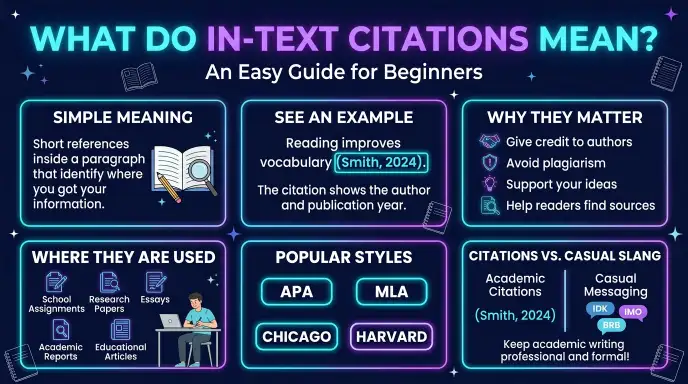
In-text citations are brief references placed inside the main body of a written document. They tell readers which source supports a particular statement, quotation, or idea.
For example:
Regular sentence: Reading regularly can improve vocabulary.
Sentence with an in-text citation: Reading regularly can improve vocabulary (Smith, 2024).
The second example includes a citation that points readers toward the source of the information. The complete publication details are usually provided in a reference list or bibliography at the end of the document.
In simple words, an in-text citation gives credit to the source while allowing the writer to keep the main paragraph readable.
In-Text Citations Meaning in Text
The phrase in-text citations refers to references that appear within the actual text of an article, essay, report, or research paper.
Writers use them when they include information from another source. That information might be a direct quotation, a statistic, a research finding, or an idea explained in their own words.
For example:
According to recent research, regular exercise can support better sleep (Brown, 2023).
Here, the citation (Brown, 2023) identifies the source behind the statement. A reader can look for Brown’s work in the reference list to find more information.
What Is the Simple Definition?
An in-text citation is a short note inside a written paragraph that identifies the source of borrowed information.
It usually contains details such as:
- The author’s last name
- The publication year
- A page number when required
- Other source details depending on the citation style
Not every citation includes all these details. The exact format depends on the academic style being followed.
Is It Slang, an Acronym, or an Abbreviation?
In-text citation is not a slang expression, acronym, or texting abbreviation. It is a standard academic writing term.
The word citation means a reference or acknowledgment of a source. The phrase in-text explains where that reference appears: inside the main body of the writing.
You might see students shorten the phrase to “citation” when discussing an assignment, but that does not make it internet slang.
What Does It Mean in Everyday Communication?
In everyday communication, people may use the phrase when talking about schoolwork, research, writing instructions, or source information.
For example:
- “My teacher said I need in-text citations.”
- “Can you check if these citations are correct?”
- “I forgot to add a citation after that paragraph.”
- “Does this sentence need an in-text citation?”
In these situations, the speaker is talking about giving proper credit to information used in a written assignment.
Where People Use In-Text Citations
In-text citations are mainly used in academic and informational writing. However, people also discuss them on social media, messaging apps, and online learning platforms.
The term does not have a different slang meaning on each platform. Its meaning stays connected to referencing sources.
TikTok
On TikTok, students, teachers, and educational creators sometimes discuss citation rules through short tutorials and study-related videos.
A creator might explain how to add an APA citation to an essay or show the difference between a direct quotation and a paraphrased sentence.
You might see a comment such as:
“How do I add in-text citations in APA?”
The person is asking for help with academic formatting, not using a popular TikTok abbreviation.
Snapchat
People may discuss citations on Snapchat when sharing school updates, assignment questions, or study notes with friends.
For example:
Person A: Have you finished the history essay?
Person B: Almost. I still need to add my citations.
The word “citations” refers to references that support the information in the assignment.
Instagram contains educational pages, study accounts, writing tips, and academic content.
Creators may publish posts explaining how to use APA, MLA, or Chicago citation styles. Students can also ask questions in comments.
For example:
“Can someone explain where in-text citations go?”
This is a normal academic question about writing structure.
WhatsApp is commonly used for group discussions about assignments and classroom work.
Students may share documents, ask classmates for formatting help, or discuss reference requirements.
Example:
Student A: Does our teacher want citations in every paragraph?
Student B: Add them wherever you use information from another source.
Here, the conversation is about proper academic referencing.
SMS and Regular Text Messages
People also use regular text messages to discuss citations when working on school projects, reports, or research papers.
For example:
A: I finished the introduction.
B: Did you include the source references?
A: Yes, I added the in-text citations.
The phrase has the same meaning in SMS as it does in an academic document.
10 Real Chat Examples of In-Text Citations
These examples show how people might naturally discuss citations in everyday conversations. They are not examples of the term being used as slang.
Example 1: Assignment Discussion
A: Have you completed your English assignment?
B: Almost done.
A: Did you add the in-text citations?
B: Yes, I added them after the borrowed information.
Example 2: Asking for Help
A: I don’t understand the citation format.
B: Which style are you using?
A: APA.
B: I can show you a simple example.
Example 3: Group Project
A: Who is checking the references?
B: I am handling that part.
A: Please make sure the in-text citations match the reference list.
B: Sure, I’ll check them.
Example 4: Teacher Feedback
A: My teacher returned my essay.
B: Was everything okay?
A: She said I forgot some in-text citations.
B: You should add the sources before submitting it again.
Example 5: Research Paper
A: I found a useful article for our research.
B: Great. Did you save the author information?
A: Yes, so I can cite it properly.
Example 6: Last-Minute Editing
A: The deadline is tonight!
B: Is your report ready?
A: The writing is finished, but I still need to check the citations.
B: Don’t forget the reference page too.
Example 7: Online Class
A: What did the professor say about sources?
B: We need to use academic sources and cite them inside the paper.
A: Okay, I’ll update my paragraphs.
Example 8: Helping a Friend
A: Can you check my second paragraph?
B: Sure. Where did you get that statistic?
A: From a research article.
B: Add an in-text citation so readers know its source.
Example 9: Writing Advice
A: Should I cite a sentence if I rewrite it in my own words?
B: Yes, if the idea came from another source.
A: Thanks, I wasn’t sure about that.
Example 10: Final Submission
A: I’m uploading the essay now.
B: Did you check the citation style?
A: Yes, everything follows the required format.
B: Good luck!
How to Reply When Someone Says “In-Text Citations”
If someone mentions in-text citations in a conversation, your response should depend on what they are discussing.
They might be asking for help, reminding you about an assignment, or explaining a writing requirement.
Here are some natural ways to reply.
Funny Replies
If you’re talking with a friend and want to keep the conversation light, you can use a little humor.
- “Those tiny references are doing a lot of work!”
- “My essay and citations are still fighting.”
- “I think my reference list needs its own reference list.”
- “At this point, citations are my study partners.”
Casual Replies
Use these responses in normal conversations with classmates or friends.
- “Okay, I’ll add them.”
- “Thanks for reminding me.”
- “I’ll check the format.”
- “I still need to finish that part.”
Friendly Replies
These work when someone is helping you understand academic writing.
- “Thanks for explaining that.”
- “Could you show me an example?”
- “That makes more sense now.”
- “I appreciate your help.”
Neutral Replies
If you’re communicating with a teacher, colleague, or someone in a formal setting, keep your response clear and respectful.
- “Understood. I’ll review the citations.”
- “I’ll make the necessary corrections.”
- “I’ll follow the required citation style.”
- “Thank you for the feedback.”
The best response is usually a simple one that matches the situation. You do not need a special slang reply because the phrase is an academic term.
Is In-Text Citations Rude or Offensive?
No. In-text citations are not rude, insulting, or offensive. They are a normal part of academic writing and are used to acknowledge the sources behind information.
There is nothing inappropriate about asking someone to include citations in an assignment or explaining how they should be formatted.
Is It Safe to Use?
Yes. The phrase is completely safe to use in schoolwork, research papers, professional reports, educational discussions, and everyday conversations.
It does not contain offensive language or an inappropriate hidden meaning.
Is It Appropriate at School?
Yes. In-text citations are especially important in schools, colleges, and universities.
Teachers often require students to include them when using information from books, websites, journals, and other publications.
Using citations correctly helps students demonstrate that they understand academic honesty and responsible research.
Is It Appropriate at Work?
Yes. In professional settings, citations can help support claims in reports, presentations, business documents, and research-based articles.
For example, an employee preparing a report about industry trends may include citations to show where the statistics came from.
The main thing to remember is that the citation format should match the requirements of the document or organization.
Who Uses This Term?
The phrase is used by people who write, read, teach, or study documents containing information from outside sources.
It is especially common in education and research.
Students
Students are among the most frequent users of the term. They learn about citations when writing essays, completing homework, preparing presentations, and working on research projects.
Many students search for explanations because different citation styles have different rules.
Teachers and Professors
Teachers explain citation requirements and help students understand how to acknowledge sources.
They may also review assignments to check if students have included suitable references.
Researchers and Academic Writers
Researchers use in-text citations to connect their work with earlier studies and published information.
These references help readers understand which ideas are supported by existing research.
Bloggers and Online Writers
Bloggers and website owners may use citations when publishing educational or research-based content.
For example, an article discussing a scientific study may include a reference to the original research so readers can investigate it further.
Does Gen Z Use This Term?
Gen Z students and young writers may use the phrase in conversations about homework, college assignments, online courses, and research projects.
However, it is not a Gen Z slang expression. Its use comes from academic writing rather than youth internet culture.
How Often Does It Appear Online?
The phrase appears in educational websites, university writing guides, research articles, student discussions, and academic tutorials.
It is also discussed in social media videos and online study communities.
Its popularity is connected to education and writing rather than entertainment or everyday internet slang.
Origin of the Term
The phrase in-text citation comes from established academic referencing practices.
Writers have long needed ways to identify the sources behind information used in books, essays, and research. As formal academic writing developed, citation systems became more organized.
The term itself describes a straightforward idea: a citation is placed within the text instead of appearing only in a separate list at the end.
How Academic Writing Influenced In-Text Citations
Academic writing played an important role in making in-text citations a standard part of research and educational documents.
As scholarly work expanded, writers needed consistent methods to show where their information came from. Readers also needed ways to verify facts, explore earlier research, and distinguish original ideas from borrowed material.
Different academic organizations and style guides developed rules for presenting these references. Some systems use an author’s last name and publication year, while others use numbered notes or other formats.
For example, APA commonly uses an author-date format:
(Taylor, 2024)
This short reference helps readers locate the complete source in the reference list.
Over time, in-text citations became a familiar feature of essays, research papers, dissertations, reports, and other formal documents.
Did Internet Culture Create the Term?
No. Internet culture did not create the concept of in-text citations.
The term belongs to academic writing and existed as part of formal referencing practices before modern social media platforms became popular.
However, the internet has made citation instructions easier to access. Students can now learn about referencing through online tutorials, educational videos, writing websites, and digital libraries.
Is Its Origin Completely Clear?
The underlying practice of identifying sources has a long history, but there is no single person or social media platform that can be credited with inventing the modern phrase.
Citation systems developed over time through academic publishing, research, and educational standards.
The important point is that the phrase describes a writing method, not a recent internet trend.
Common Types of In-Text Citation Styles
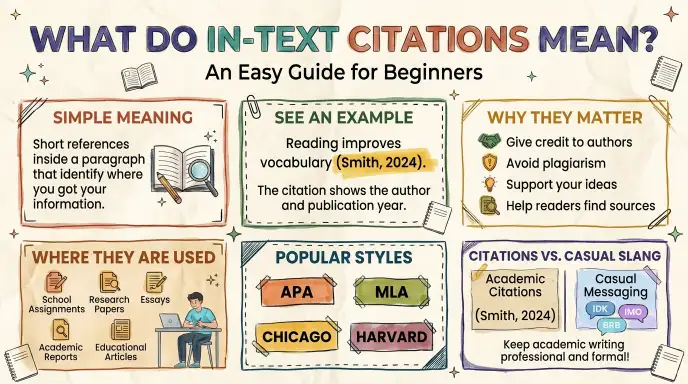
Different schools, universities, publishers, and professional organizations may require different citation styles.
Although their formatting rules vary, they share a common purpose: identifying the source of information used in a document.
APA Style
Example: (Smith, 2024)
The American Psychological Association (APA) style commonly uses the author’s last name and publication year.
It is widely used in psychology, education, social sciences, and related fields.
A direct quotation may also require a page number.
MLA Style
Example: (Smith 25)
Modern Language Association (MLA) style commonly uses the author’s last name and page number.
It is frequently used in literature, language, humanities, and related subjects.
Chicago Style
Chicago style supports different documentation systems. One common option uses footnotes or endnotes, while another uses author-date references.
An author-date example may look like this:
(Smith 2024, 25)
The required format depends on which Chicago system the writer is using.
Harvard Style
Example: (Smith 2024)
Harvard referencing generally uses an author-date approach.
It is commonly found in university assignments and academic writing, although exact formatting rules can vary between institutions.
Why Do These Styles Look Different?
Each style has its own rules for organizing source information.
For example, APA emphasizes the publication year, while MLA commonly includes the page number in its in-text reference.
A writer should always follow the style requested by their teacher, university, publisher, or organization.
In-Text Citation vs. Reference List vs. Footnote
These terms are related, but they do not mean exactly the same thing.
| Term | Meaning | Type | Usage | Popularity |
| In-text citation | Short source reference inside the writing | Academic referencing | Identifies borrowed information | Very common |
| Reference list | Complete details of sources cited in a document | Source list | Helps readers locate sources | Very common |
| Bibliography | List of sources consulted or included, depending on the style | Source list | Documents research materials | Common |
| Footnote | Additional information or a source reference at the bottom of a page | Note | Provides references or explanations | Common |
An in-text citation usually works together with a reference list or another source-detail system.
For example, the paragraph may contain (Smith, 2024), while the reference list provides the full title, publication information, and other details needed to locate the source.
A footnote works differently because it directs readers to a note, often placed at the bottom of the page.
Comparison Table: In-Text Citations, IDK, IDC, IMO, and BRB
Because people sometimes search for unfamiliar terms online, it is useful to understand the difference between academic phrases and actual texting abbreviations.
| Term | Meaning | Type | Usage | Popularity |
| In-text citations | References placed inside written content | Academic term | Essays, reports, research papers | Common in education |
| IDK | I Don’t Know | Texting abbreviation | Casual chats and social media | Very common |
| IDC | I Don’t Care | Texting abbreviation | Messages and online conversations | Common |
| IMO | In My Opinion | Texting abbreviation | Sharing opinions online | Very common |
| BRB | Be Right Back | Texting abbreviation | Informal messages and chats | Common |
The main difference is that IDK, IDC, IMO, and BRB are shortened expressions used in everyday digital communication.
In-text citations, on the other hand, are references used to identify sources in written content.
They belong to different categories, even though someone might encounter all five terms while reading or communicating online.
Real-World Usage Example
Imagine a college student named Alex is preparing an assignment about the benefits of regular exercise.
While researching the topic, Alex finds a useful journal article containing information about physical activity and sleep quality.
Alex wants to include one of the article’s findings in the assignment. Instead of presenting the information as an original discovery, Alex adds an in-text citation.
The paragraph might look like this:
“Regular physical activity may support better sleep quality and overall well-being (Smith, 2024).”
The citation tells the reader that the information comes from Smith’s work.
At the end of the assignment, Alex includes the complete publication details in the reference list. This allows the teacher to identify the original article and check the information.
Without the citation, the reader might assume that the statement is based entirely on Alex’s own research or knowledge.
This simple example shows why citations matter. They make writing more transparent and help readers understand where information comes from.
Common Mistakes People Make With In-Text Citations
Learning the meaning of a citation is only the first step. Writers also need to understand how to use it correctly.
Here are some common mistakes worth avoiding.
Adding a Citation Without a Complete Reference
An in-text citation usually needs to connect to a full source entry in the reference list or another required documentation system.
Writing (Smith, 2024) without providing the corresponding source details may make it difficult for readers to find the original work.
Forgetting to Cite Paraphrased Information
Some students think citations are only necessary when copying someone’s exact words.
That is incorrect. If you explain another person’s idea in your own words, you generally still need to acknowledge the source.
Using the Wrong Citation Style
APA, MLA, Chicago, and Harvard do not follow identical formatting rules.
Mixing their formats can make a document inconsistent. Always check the style required for your assignment.
Placing Citations in the Wrong Location
A citation should appear where readers can understand which information it supports.
If a paragraph contains several different claims from different sources, placing one citation at the end may not clearly identify every source.
Treating a Citation as Proof That Everything Is Correct
A citation identifies where information came from, but it does not automatically prove that the source is accurate or reliable.
Writers should still evaluate their sources carefully.
Frequently Asked Questions
What Do In-Text Citations Mean in Text Messages?
They refer to short source references used inside written content. In messages, people usually discuss them when talking about essays, assignments, or research.
What Do In-Text Citations Mean on TikTok?
On TikTok, the phrase generally refers to academic references placed within essays or research papers. Educational creators may explain how to format them.
Are In-Text Citations Slang?
No. In-text citations are an academic writing term, not slang, an acronym, or a texting abbreviation.
Are In-Text Citations Rude or Offensive?
No. The phrase is neutral and appropriate for school, work, research, and everyday educational discussions.
How Should You Reply to In-Text Citations?
You can respond naturally with phrases such as “I’ll add them,” “Can you show me an example?” or “I’ll check the citation format.”
What Is an Example of an In-Text Citation?
An example is (Smith, 2024). It identifies the author and publication year in a common author-date format.
Do In-Text Citations Need a Reference List?
In many citation styles, yes. The in-text reference connects to a complete source entry in the reference list or another required source list.
Do I Need a Citation When I Paraphrase?
Yes, generally. Rewriting someone else’s idea in your own words does not remove the need to acknowledge the original source.
What Is the Difference Between APA and MLA In-Text Citations?
APA commonly uses the author’s last name and publication year, while MLA generally uses the author’s last name and page number.
Can I Use In-Text Citations in a Blog Post?
Yes. You can use citations in blog posts when referring to research, statistics, studies, or information from other sources. They help readers check the original material.
Conclusion
In-text citations are short references placed inside written content to show where information comes from. They are commonly used in essays, research papers, reports, and other educational or professional documents.
Although people may discuss them on TikTok, Snapchat, Instagram, WhatsApp, and through regular text messages, they are not internet slang or texting abbreviations. Their purpose is to acknowledge original sources and help readers verify information.
You should use them whenever your writing includes ideas, facts, quotations, or research from another source. If you are writing a formal assignment, follow the required citation style and make sure your in-text references connect to the correct source details.
Understanding this simple concept can help you write more responsibly, avoid accidental plagiarism, and make your work easier for others to trust.
Learn more slang!

Hi, I’m Ethan Carter. I write easy-to-read articles about slang, texting abbreviations, and digital communication. My goal is to make modern English simple and useful for students, professionals, and anyone curious about internet language.