“What does in-text citation mean?” is a common question among students and anyone working with academic writing. An in-text citation is a short reference placed inside a sentence or paragraph to show where information came from. It helps readers identify the original source of an idea, fact, or quotation.
You may see this term in school assignments, research papers, essays, online discussions, and educational posts on platforms such as TikTok, Instagram, and Snapchat. It is especially common when people discuss homework, writing tips, or research.
People often search for its meaning because they are asked to add citations to an assignment but are unsure what that actually involves. The good news is that the concept is simple once you see a few examples.
One important detail: “in-text citation” is an academic writing term, not internet slang or a texting abbreviation. It refers to giving credit to a source within the main body of your writing.
What Does In-Text Citation Mean?
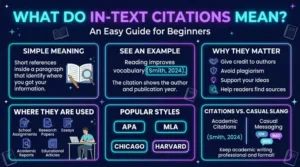
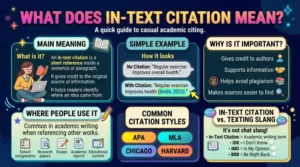
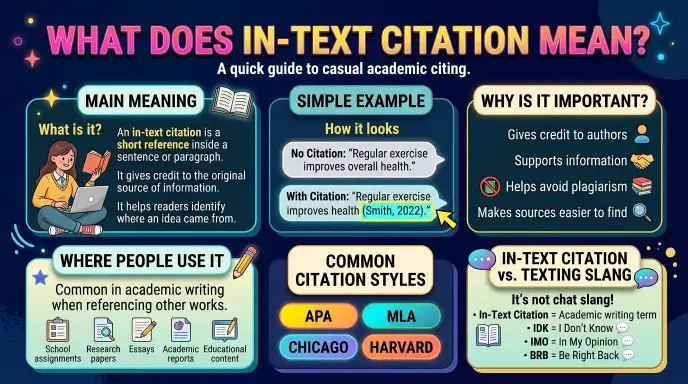
An in-text citation is a brief reference included directly in your writing. It tells the reader that a particular statement, fact, quotation, or idea comes from another source.
For example:
Regular exercise can improve overall health (Smith, 2022).
The words “Smith, 2022” are the in-text citation. They help readers identify the source used to support the statement.
Instead of placing all source information inside the paragraph, writers use a short citation and provide the full publication details in a separate reference list or bibliography.
Is In-Text Citation Slang, an Acronym, or an Abbreviation?
It is none of these in the usual internet slang sense.
An in-text citation is a standard academic writing term. It describes a method of acknowledging sources within an essay, report, research paper, or other written work.
People sometimes shorten the phrase to “citation” when discussing assignments, but the full term has a specific meaning in academic writing.
What Does It Mean in Everyday Language?
In simple words, it means giving credit to the person or source that provided the information you are using.
Imagine reading an article and learning an interesting fact. Later, you include that fact in your school essay. An in-text citation shows your teacher where you found it.
It helps readers:
- Identify the original source of information.
- Check if a statement is supported by evidence.
- Distinguish your own ideas from borrowed information.
- Find the complete source in the reference list.
- Recognize the work of other writers and researchers.
A Simple Example
Without an in-text citation:
Online learning gives students more flexibility.
With an in-text citation:
Online learning gives students more flexibility (Brown, 2023).
The second example identifies the source behind the statement. The exact citation format depends on the required academic style.
Where Do People Use In-Text Citations?
You will mostly encounter in-text citations in academic and educational settings. However, people also discuss them on social media when sharing study advice, writing tutorials, and research tips.
TikTok
On TikTok, students and educational creators may explain how to cite sources in essays and research papers.
A video might show the difference between a sentence with a citation and one without it. Creators may also share quick tutorials about APA, MLA, and Chicago formatting.
Example:
“Don’t forget to add an in-text citation after using information from a source.”
Snapchat
Students may discuss citations through private messages or study group conversations on Snapchat.
For example, someone might ask a friend if a particular sentence needs a source reference before submitting an assignment.
Example:
“Did you add the in-text citations to your essay?”
Instagram educational pages often share writing tips, study guides, and academic reminders.
An infographic might explain how to place an author’s name and publication year inside a paragraph. Students can save these posts for later reference.
Example:
“Your research paper needs in-text citations and a reference list.”
WhatsApp is commonly used for class groups and assignment discussions.
Students may send screenshots of their essays and ask classmates if their citations are correct.
Example:
“Can someone check if my in-text citations are in APA format?”
SMS and Regular Text Messages
In ordinary text messages, people usually use the phrase when discussing homework, college applications, or research assignments.
Example:
“My teacher said I need to include in-text citations in every section.”
The phrase is not normally used as a casual greeting or reaction. Its meaning stays connected to writing and referencing.
10 Real Chat Examples of In-Text Citation
These examples show how students and writers might naturally use the term in everyday conversations.
1. Asking About Homework
A: Have you finished the research essay?
B: Almost. I’m still adding the in-text citations.
A: Okay, make sure you check the format.
2. Helping a Classmate
A: Do I need to cite this information?
B: Yes, add an in-text citation after the sentence.
A: Got it. Thanks!
3. Discussing APA Style
A: My teacher wants APA formatting.
B: Then you usually need the author’s last name and publication year.
A: I’ll fix mine.
4. Checking an Assignment
A: Can you review my introduction?
B: Sure. You forgot an in-text citation in the second paragraph.
A: I’ll add one.
5. Group Study Conversation
A: Who knows how to write citations?
B: I can help. Are you using MLA or APA?
A: APA.
6. Talking About a Research Paper
A: Why does my professor keep mentioning citations?
B: Because you need to show where your information came from.
A: That makes sense now.
7. Asking for an Example
A: Can you send me an example of an in-text citation?
B: Sure. Something like (Taylor, 2024).
A: Thanks, that’s helpful.
8. Correcting a Mistake
A: I added all my sources at the end.
B: You may also need in-text citations throughout the paper.
A: Oh, I didn’t know that.
9. Before Submission
A: Ready to submit your assignment?
B: Not yet. I’m checking my citations one last time.
A: Good idea!
10. Sharing Study Advice
A: What’s one thing I should remember for research writing?
B: Always give credit to your sources with proper citations.
A: I’ll remember that.
How to Reply When Someone Says “In-Text Citation”
If someone mentions an in-text citation in a conversation, your response will depend on what they are asking. They might need help with an assignment, want to check a citation, or simply be discussing academic writing.
Here are a few natural ways to respond.
Funny Replies
- “The little reference that saves my grade!”
- “My essay and citations are having a long relationship.”
- “I think my paper has more citations than sentences.”
- “Time to give those sources some credit!”
Casual Replies
- “Yeah, I know what you mean.”
- “I’m adding those to my assignment now.”
- “Which citation style are you using?”
- “I still need to check mine.”
Friendly Replies
- “I can help you check the formatting.”
- “Send me an example, and we can figure it out.”
- “Let’s make sure all the sources are credited.”
- “I found a useful example that might help.”
Neutral Replies
- “An in-text citation identifies the source used in a paragraph.”
- “It depends on the citation style your teacher requires.”
- “You usually need a matching reference entry as well.”
- “Check your assignment guidelines before choosing a format.”
The best response is one that fits the conversation. If someone is asking for help, a useful explanation is better than simply repeating the term.
Is In-Text Citation Rude or Offensive?
No. An in-text citation is not rude, offensive, or inappropriate language. It is a normal academic expression used in schools, colleges, universities, and professional research.
The term does not carry an insulting or negative meaning. It simply describes how writers acknowledge the sources they use.
Is It Safe to Use?
Yes. You can use the phrase in academic conversations, classroom discussions, emails, and messages about assignments.
For example:
“Please check if the in-text citations are correct before submitting the report.”
This is a completely normal and respectful sentence.
Is It Appropriate at School or Work?
Yes. In fact, the term is especially appropriate in educational and professional environments.
Students use it when writing essays and research papers. Teachers use it when explaining academic standards. Researchers and professionals use citations to support claims and identify published work.
If you are discussing a casual topic with friends, the phrase may sound formal, but that does not make it offensive. It is simply more relevant to writing and research than everyday slang.
Who Uses This Term?
People who study, teach, research, or create educational content are the most likely to use the phrase.
It is not limited to one age group or social media community. Anyone who works with source-based writing may need to understand it.
Students
High school, college, and university students frequently encounter in-text citations. They use them in essays, assignments, reports, presentations, and research projects.
Students often search for examples because citation rules can feel confusing when they first begin academic writing.
Gen Z
Gen Z students may use the term in class group chats, study communities, and educational videos. They might discuss it while preparing assignments or sharing tips about writing.
Although younger users may talk about citations on TikTok or Instagram, the term itself is not Gen Z slang. It is a standard academic expression used by different generations.
Teachers and Professors
Teachers explain citation rules to help students avoid plagiarism and support their arguments with reliable sources.
Professors may also provide feedback such as:
“You need to add an in-text citation to support this claim.”
Researchers and Writers
Academic researchers, journalists, authors, and professional writers may use citations to identify where their information came from.
The frequency of the term depends on the setting. It appears regularly in academic writing instructions but is less common in ordinary personal conversations.
Origin of the Term
The phrase “in-text citation” comes from the established practice of referencing sources within written documents.
As books, academic papers, and research publications developed more formal standards, writers needed consistent ways to show where their information came from.
The expression describes exactly what the method does: a citation appears in the text rather than only in a separate list of sources.
How Academic Writing Influenced It
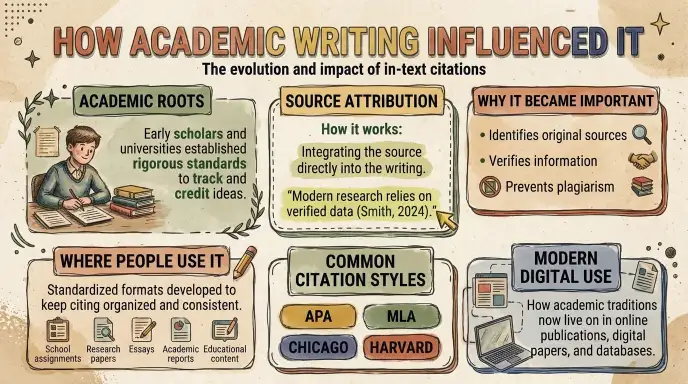
Different academic organizations and style guides developed rules for referencing sources. These rules helped readers identify books, articles, websites, and other materials used by writers.
Some common citation styles include:
- APA: Often used in psychology, education, and social sciences.
- MLA: Common in literature, languages, and humanities.
- Chicago: Used in history and several other academic fields.
- Harvard: A widely used author-date referencing approach.
Each style has its own formatting rules. For example, APA commonly uses an author’s last name and publication year, while MLA generally uses the author’s last name and a page number when available.
Did Social Media Create the Term?
No. Social media did not create the expression.
The phrase belongs to academic writing and existed as part of formal referencing practices before modern social platforms became popular.
Today, social media helps spread explanations of citation rules to students who want quick examples and writing advice. However, its original purpose remains the same: showing readers where information came from.
Is Its Origin Clear?
The meaning and academic use of the phrase are clear. It is a descriptive term rather than a slang expression with an uncertain internet origin.
In-Text Citation vs. IDK, IDC, IMO, and BRB
An in-text citation is different from common texting abbreviations. The terms in the table below serve different purposes, even though people may encounter all of them while reading or communicating online.
| Term | Meaning | Type | Usage | Popularity |
| In-text citation | A reference to a source within written content | Academic writing term | Essays, reports, research papers | Common in education |
| IDK | I Don’t Know | Texting abbreviation | Showing uncertainty | Very common |
| IDC | I Don’t Care | Texting abbreviation | Expressing indifference | Very common |
| IMO | In My Opinion | Internet abbreviation | Sharing a personal view | Common |
| BRB | Be Right Back | Chat abbreviation | Saying you will return shortly | Common |
The main difference is purpose. IDK, IDC, IMO, and BRB are commonly used in casual digital conversations. An in-text citation is used to credit a source in written work.
In-Text Citation vs. Reference List
These two terms are related, but they are not interchangeable.
An in-text citation appears within the main body of an essay or paper. A reference list provides the full details of the sources cited in that work.
For example:
Reading regularly can help improve vocabulary (Brown, 2023).
The citation identifies the source briefly. The corresponding reference list entry provides enough information for the reader to locate the publication.
In most academic formats, the in-text citation and the reference entry should match. If you cite a source in your paragraph, include the required full details in the reference list or bibliography.
In-Text Citation vs. Footnote
A footnote is a note placed at the bottom of a page. Depending on the referencing system, it may provide a source reference, extra explanation, or additional information.
An in-text citation appears directly within the main writing instead.
Both methods can help readers understand the origin of information, but they are formatted differently. Always follow the style required by your teacher, institution, or publisher.
Real-World Usage Example
Imagine a college student named Alex is preparing a research paper about the benefits of reading.
While researching, Alex finds an online article that explains how regular reading can improve vocabulary. Alex wants to include that information in an assignment.
Instead of presenting the information as a personal discovery, Alex paraphrases the idea and adds a citation:
Regular reading can help people develop a stronger vocabulary (Brown, 2023).
The citation tells the teacher that the information came from another source.
At the end of the assignment, Alex includes the complete reference details for the article, following the required citation style.
Now the reader can identify the original source and check the information if needed.
This is how in-text citations work in everyday academic writing. They connect statements in an essay to the materials used during research.
What If Alex Uses the Exact Words?
If Alex copies a sentence word for word, the citation requirements may be different.
For example, some styles require quotation marks, the author’s name, the publication year, and a page number or another location marker when available.
The exact rules depend on the style guide. A citation does not automatically make copied writing acceptable if quotation and attribution rules are ignored.
What If Alex Rewrites the Information?
If Alex explains the original idea using different wording, that is called paraphrasing.
Paraphrased information still needs a citation because the underlying idea came from another source. Changing the wording does not remove the responsibility to give credit.
This is an important point for students who are learning academic writing.
Frequently Asked Questions
What Does In-Text Citation Mean in Text Messages?
It refers to a short reference added within written content to identify the source of information. People may discuss it in text messages when talking about schoolwork or research.
What Does In-Text Citation Mean on TikTok?
On TikTok, it usually refers to the academic writing method of crediting sources inside an essay or paragraph. Educational creators may explain how to format one.
Is In-Text Citation Slang?
No. It is a formal academic writing term, not internet slang, an acronym, or a texting abbreviation.
Is In-Text Citation Rude or Offensive?
No. It is a neutral expression used in education, research, and professional writing. It is completely appropriate for school and workplace discussions.
How Should You Reply to In-Text Citation?
You can ask which citation style someone is using, offer to check their formatting, or explain that it identifies the source of information within a paragraph.
What Is an Example of an In-Text Citation?
An example in APA style is:
Exercise can support better physical health (Smith, 2022).
The author’s last name and publication year identify the source.
Do I Need an In-Text Citation When Paraphrasing?
Yes. If you explain someone else’s idea in your own words, you generally still need to acknowledge the original source.
What Is the Difference Between an In-Text Citation and a Bibliography?
An in-text citation appears within the main writing. A bibliography or reference list provides fuller details about the sources used.
Conclusion
An in-text citation is a short reference placed within an essay, paragraph, or research paper to show where information came from. It helps readers identify original sources and gives proper credit to other writers and researchers.
You will mainly see this term in school assignments, academic research, educational content, and conversations about writing. Although people may discuss it on TikTok, Instagram, Snapchat, or WhatsApp, it is not slang or a texting abbreviation.
Use in-text citations whenever your academic writing requires you to acknowledge information from another source. Always follow the citation style requested by your teacher or institution.
Discover more slang!

Hi, I’m Ethan Carter. I write easy-to-read articles about slang, texting abbreviations, and digital communication. My goal is to make modern English simple and useful for students, professionals, and anyone curious about internet language.