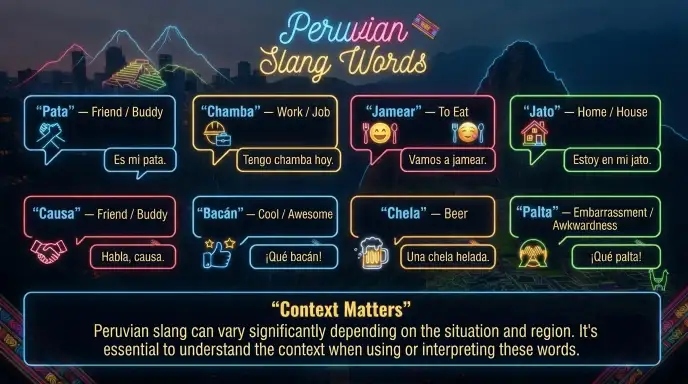
Learning Spanish from textbooks can help you understand grammar, but real conversations often sound very different. Peru has its own collection of informal expressions that locals use with friends, family, and people in everyday situations.
Words such as jato, chamba, causa, pata, and bacán may seem confusing if you have only studied standard Spanish. Some expressions are also used in other Latin American countries, while others are strongly associated with Peruvian speech.
These terms can appear in conversations, text messages, social media, music, videos, and casual interactions. Their meaning can also depend on tone and context.
In this guide, you’ll learn common Peruvian slang words with simple meanings and natural examples so you can recognize them more easily.
Why Is Peruvian Slang Different?
Peruvian Spanish has developed through a mix of Spanish, Indigenous languages, local traditions, and modern cultural influences. This has created a rich informal vocabulary that you may not find in a standard Spanish dictionary.
You may hear local expressions when people are:
- Talking with friends
- Sending text messages
- Using social media
- Discussing work
- Going out
- Talking about food
- Making jokes
- Hanging out
Knowing these expressions can help you understand how Spanish sounds in relaxed Peruvian conversations.
Common Peruvian Slang Words
Here are some useful expressions to know when listening to informal Peruvian Spanish.
1. Jato
Jato means home or house.
It is a casual term used when talking about someone’s home or going home.
Example:
“Voy a mi jato.”
“I’m going home.”
Because it is informal, you would normally use it with friends or in relaxed conversations.
2. Pata
Pata can mean friend, buddy, or pal in Peruvian slang.
Example:
“Ese pata es mi amigo.”
“That guy is my friend.”
It is commonly used in casual speech when referring to someone you know.
3. Causa
Causa can be used as a friendly word for friend or buddy.
Example:
“¿Qué pasa, causa?”
“What’s up, buddy?”
There is another important meaning: causa is also the name of a popular Peruvian dish. The surrounding context tells you which meaning is intended.
4. Chamba
Chamba means work or job.
Example:
“Tengo mucha chamba hoy.”
“I have a lot of work today.”
It is a very useful informal word for talking about employment, tasks, or daily work.
5. Champear
Champear is an informal verb related to working.
Example:
“Tengo que champear mañana.”
“I have to work tomorrow.”
It belongs to the same informal vocabulary family as chamba.
6. Chela
Chela is a casual word for beer.
Example:
“Vamos por unas chelas.”
“Let’s go for some beers.”
It is informal and is generally used in relaxed social situations.
7. Jamear
Jamear means to eat.
Example:
“Vamos a jamear.”
“Let’s go eat.”
You are more likely to hear it in casual conversations than in formal situations.
8. Tono
In Peruvian informal speech, tono can mean a party or social gathering.
Example:
“¿Vas al tono esta noche?”
“Are you going to the party tonight?”
It is useful when talking about casual events with friends.
9. Pituco
Pituco describes someone perceived as wealthy, upper-class, or associated with an affluent lifestyle.
Example:
“Ese barrio es bastante pituco.”
“That neighborhood is pretty upscale.”
Depending on the speaker and tone, it can sound neutral, teasing, or critical.
10. Pituca
Pituca is the feminine form of pituco.
It can describe a woman perceived as wealthy or associated with an upper-class lifestyle.
Example:
“Ella parece pituca.”
“She seems upper-class.”
As with pituco, the tone and context are important.
Words for Young People and Friends
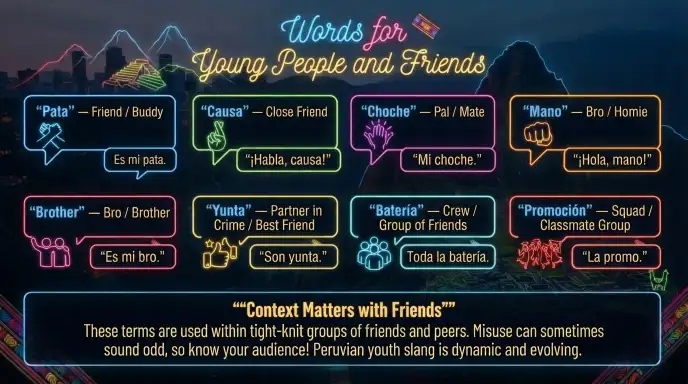
Peruvian Spanish has several casual expressions for talking about people you know, especially friends and younger people.
11. Chibolo
Chibolo commonly refers to a kid, boy, or young person.
Example:
“Cuando era chibolo, jugaba fútbol.”
“When I was a kid, I played soccer.”
It is an informal word and is often used when talking about someone’s younger years.
12. Chibola
Chibola can refer to a young girl or young woman, depending on context.
Example:
“Esa chibola vive cerca.”
“That girl lives nearby.”
The age suggested by the term can vary between speakers and situations.
13. Choche
Choche is an informal term for a close friend or buddy.
Example:
“Ese es mi choche.”
“That’s my close friend.”
It has a friendly and familiar tone.
14. Chochear
Chochear can mean hanging out or spending relaxed time with friends.
Example:
“Vamos a chochear un rato.”
“Let’s hang out for a while.”
It is mainly used in informal situations.
15. Manya
Manya can mean “I understand,” “I get it,” or “I see.”
Example:
“Manya, ahora entiendo.”
“Oh, I get it now.”
It is a casual reaction to information or something someone has just explained.
Slang for Reactions and Warnings
Some Peruvian expressions are useful when reacting to surprising situations, giving warnings, or describing something embarrassing.
16. Alucina
Alucina can mean “imagine,” “believe it,” or “you won’t believe this.”
Example:
“Alucina que llegó temprano.”
“Believe it or not, he arrived early.”
It is often used before sharing something surprising.
17. Bacán
Bacán means cool, great, or awesome.
Example:
“Tu idea está bacán.”
“Your idea is awesome.”
It has a positive tone and is useful in casual conversations.
18. Chévere
Chévere means cool, nice, or great.
Example:
“El lugar está chévere.”
“The place is really nice.”
This word is also common in several other Latin American countries, so it is not unique to Peru.
19. Yara
Yara means “watch out,” “be careful,” or “pay attention.”
Example:
“¡Yara con ese carro!”
“Watch out for that car!”
It works as a quick informal warning.
20. Piña
In Peruvian slang, piña can describe someone who is unlucky.
Example:
“Qué piña, perdió el bus.”
“What bad luck, he missed the bus.”
It can be used humorously when something unfortunate happens.
Slang for Embarrassing Situations
Some expressions are especially useful for describing awkward or embarrassing moments.
21. Roche
Roche refers to embarrassment, awkwardness, or an embarrassing situation.
Example:
“Qué roche.”
“How embarrassing.”
You may hear it when someone makes an awkward mistake in front of others.
22. Rocón
Rocón can describe a very embarrassing or awkward situation.
Example:
“Fue un rocón delante de todos.”
“It was really embarrassing in front of everyone.”
It can express a stronger sense of embarrassment than roche.
23. Meterse un Roche
Meterse un roche means to get into an embarrassing or awkward situation.
Example:
“Se metió un roche en la reunión.”
“He got himself into an embarrassing situation at the meeting.”
This expression is usually used in informal conversations.
Slang About Money and Work
Money and work are common topics in everyday conversations, so several informal expressions are useful to recognize.
24. Misio
Misio means broke or short on money.
Example:
“Estoy misio este mes.”
“I’m broke this month.”
It is often used casually or humorously among friends.
25. Estar Misio
Estar misio means to have little or no money.
Example:
“No puedo salir, estoy misio.”
“I can’t go out; I’m broke.”
The expression describes a temporary financial situation.
26. Estar Aguja
Estar aguja is another informal way to say you are short on money.
Example:
“Estoy aguja esta semana.”
“I’m short on money this week.”
It can be used when someone does not have enough cash for an activity or purchase.
27. Floro
Floro refers to talk, excuses, persuasive words, or smooth talk.
Example:
“Eso es puro floro.”
“That’s just talk.”
The expression is informal and its exact meaning depends on the situation.
28. Meter Floro
Meter floro can mean to make excuses, talk around an issue, or try to persuade someone with words.
Example:
“No me metas floro.”
“Don’t give me excuses.”
It can also describe someone trying to charm another person through smooth talk.
29. Florear
Florear means to talk persuasively, flatter someone, or use lots of words to convince them.
Example:
“Deja de florear y dime la verdad.”
“Stop making excuses and tell me the truth.”
The intended meaning depends on the conversation.
Slang for Something Good
Peruvian speakers also have informal ways to describe something as excellent, enjoyable, or impressive.
30. Mostro
Mostro can mean great, excellent, or impressive in casual Peruvian speech.
Example:
“Tu trabajo quedó mostro.”
“Your work turned out great.”
It is generally positive when used in this way.
31. Buenazo
Buenazo means really good, excellent, or very tasty.
Example:
“El ceviche está buenazo.”
“The ceviche is really good.”
It can describe food, experiences, places, or things that someone really likes.
32. Paja
In informal Peruvian speech, paja can mean cool, nice, or enjoyable.
Example:
“La película estuvo paja.”
“The movie was really cool.”
It is casual, so it is better suited to conversations with friends.
33. Pajita
Pajita can be used as a softer or playful form related to paja.
Example:
“Qué pajita el lugar.”
“What a cool little place.”
Usage can vary, so context is important.
Peruvian Slang and Everyday Conversations
The best way to understand these words is to see how they work naturally. A conversation between friends might sound something like this:
“¿Qué pasa, causa?”
“What’s up, buddy?”
“Todo bien. ¿Vamos a jamear?”
“All good. Want to go eat?”
“Sí, pero estoy misio.”
“Sure, but I’m broke.”
“No hay roche, yo invito.”
“No problem, I’ll pay.”
This type of informal vocabulary makes everyday Peruvian Spanish sound much more natural than textbook Spanish alone.
Are These Words Used Everywhere in Peru?
Not necessarily. Peru is a large and culturally diverse country, so slang can vary by city, age group, social circle, and situation.
Some expressions are widely recognized, while others may be more common among particular groups.
The same word can also have a slightly different tone depending on who says it. That is why listening to native speakers is one of the best ways to learn local slang.
How to Learn Peruvian Slang Naturally
Listen to Native Speakers
Peruvian interviews, videos, podcasts, and casual conversations can help you hear how expressions sound in real life.
Learn the Situation
Do not memorize only the English translation. Pay attention to who is speaking, who they are talking to, and what is happening.
Start With Friendly Expressions
Words such as causa, pata, chamba, jato, and bacán are useful for recognizing casual speech.
Avoid Overusing Slang
Understanding slang does not mean every expression should be used in every situation. Some words are highly informal or can sound different depending on tone.
Compare With Standard Spanish
Knowing the standard Spanish equivalent makes it easier to recognize slang when you hear it.
For example:
- Jato → casa
- Chamba → trabajo
- Jamear → comer
- Pata → amigo
- Roche → vergüenza
This comparison helps you connect informal vocabulary with words you already know.
More Popular Peruvian Slang Words
Peruvian Spanish has many informal expressions that make everyday conversations more colorful. Some are used between close friends, while others are common when talking about work, money, food, or social life.
34. Huarique
A huarique is a small, informal place known for serving good local food.
Example:
“Conozco un huarique buenazo.”
“I know a really good local food spot.”
The word is strongly connected with Peruvian food culture.
35. Hacer Hora
Hacer hora means to pass time, hang around, or wait casually.
Example:
“Vamos a hacer hora hasta que llegue.”
“Let’s hang around until he arrives.”
It is useful in relaxed conversations when people are waiting for something.
36. La Gente
In casual Peruvian speech, la gente can refer to your friends, your group, or the people you are with.
Example:
“Voy a salir con la gente.”
“I’m going out with my friends.”
The exact meaning depends on the situation.
37. Tirar Dedo
Tirar dedo can mean pointing someone out, identifying someone, or giving information about them.
Example:
“No tires dedo.”
“Don’t point me out.”
The expression can have different shades of meaning depending on the conversation.
38. Jamear con la Gente
This casual expression means to eat with friends or a group.
Example:
“Vamos a jamear con la gente.”
“Let’s go eat with everyone.”
It combines the informal verb jamear with la gente.
39. Pataza
Pataza can be used as a stronger or more affectionate form of pata, referring to a very close friend or buddy.
Example:
“Él es mi pataza.”
“He’s my really close friend.”
It is friendly and informal.
40. Causa
Causa can also be used as a casual way to address someone directly.
Example:
“Oye, causa, ¿qué hacemos?”
“Hey, buddy, what should we do?”
The tone is usually friendly when used between people who know each other.
Peruvian Slang for Parties and Social Life
Social situations are another place where local expressions appear frequently. If you are talking with friends about going out, you may hear several of these terms.
41. Tono
As mentioned earlier, tono can mean party in casual Peruvian Spanish.
Example:
“Hay un tono el sábado.”
“There’s a party on Saturday.”
It is an informal way to describe a social gathering.
42. Jatear
Jatear means to sleep in informal Peruvian speech.
Example:
“Estoy cansado, quiero jatear.”
“I’m tired; I want to sleep.”
It is a casual expression and is not suitable for formal situations.
43. Jato
Besides meaning home, jato can sometimes appear in expressions connected with staying at home.
Example:
“Nos quedamos en el jato.”
“We’re staying at home.”
The context makes the meaning easy to understand.
44. Chela
Chela is the informal word for beer.
Example:
“Compramos unas chelas para el tono.”
“We bought some beers for the party.”
It is commonly heard in relaxed social conversations.
Peruvian Slang for Food
Food is an important part of Peruvian culture, and informal conversations often include local expressions.
45. Huarique
A huarique usually refers to a small, local food spot that may be famous for tasty dishes.
Example:
“Ese huarique prepara un ceviche buenazo.”
“That local food spot makes really good ceviche.”
46. Buenazo
Buenazo is useful when you want to say something is really good.
Example:
“Este pollo está buenazo.”
“This chicken is really good.”
It can also describe non-food items.
“La película estuvo buenaza.”
“The movie was really good.”
47. Jamear
Jamear means to eat.
Example:
“Primero vamos a jamear.”
“First, let’s eat.”
It is a relaxed alternative to the standard verb comer.
Peruvian Slang for Money
Money-related slang is common in casual conversations, especially between friends.
48. Misio
Misio means broke or having very little money.
Example:
“Estoy misio hasta fin de mes.”
“I’m broke until the end of the month.”
49. Aguja
When someone says “estoy aguja,” they mean they are short on money.
Example:
“No puedo comprar eso, estoy aguja.”
“I can’t buy that; I’m short on money.”
50. Estar Misio
This phrase directly describes the situation of being broke.
Example:
“Después del viaje quedé misio.”
“I was broke after the trip.”
Peruvian Slang for Embarrassment
Some expressions are particularly useful when describing awkward moments.
51. Roche
Roche means embarrassment or an awkward situation.
Example:
“Qué roche.”
“How embarrassing.”
52. Rocón
Rocón describes a big or especially embarrassing situation.
Example:
“Fue un rocón frente a todos.”
“It was really embarrassing in front of everyone.”
53. Pasar Roche
Pasar roche means to experience embarrassment or an awkward moment.
Example:
“Pasé roche en la entrevista.”
“I was embarrassed during the interview.”
Peruvian Slang for Talking and Persuading
Peruvian conversations also use floro and related words when someone talks a lot or tries to convince another person.
54. Floro
Floro means talk, excuses, or persuasive speech.
Example:
“No quiero escuchar tu floro.”
“I don’t want to hear your excuses.”
55. Florear
Florear means to use persuasive or flattering talk.
Example:
“Está floreando para conseguir el trabajo.”
“He’s using smooth talk to get the job.”
56. Meter Floro
Meter floro can mean giving excuses or trying to convince someone with words.
Example:
“No me metas floro.”
“Don’t give me excuses.”
Peruvian Slang for Cool Things
When Peruvians want to describe something positively, you may hear several informal expressions.
57. Bacán
Bacán means cool, great, or awesome.
Example:
“Tu carro está bacán.”
“Your car is awesome.”
58. Mostro
Mostro can mean excellent, impressive, or great.
Example:
“Tu presentación estuvo mostro.”
“Your presentation was great.”
59. Paja
In informal Peruvian speech, paja can mean cool, enjoyable, or nice.
Example:
“El concierto estuvo paja.”
“The concert was really cool.”
Because the word has other meanings in Spanish, context is important.
Peruvian Slang in Text Messages
Modern Peruvian slang is not limited to spoken conversations. Many expressions appear in WhatsApp messages, Instagram comments, TikTok captions, and other online chats.
For example:
“Qué paja 😂”
This can mean something like “That’s cool” in the right context.
You might also see:
“Nos vemos en mi jato.”
This means:
“See you at my place.”
Online conversations often combine traditional Peruvian slang with emojis, abbreviations, and international internet expressions.
Peruvian Slang on TikTok and Instagram
Younger speakers may use local expressions alongside modern social media language.
A TikTok caption might say:
“El tono estuvo buenazo 😂”
This means:
“The party was really good.”
An Instagram comment might say:
“Qué bacán 🔥”
This means:
“How cool!”
The visual content often provides additional clues about what the slang means.
Peruvian Slang in Everyday Conversations
A short conversation can show how naturally these expressions fit together.
“¿Qué pasa, causa?”
“What’s up, buddy?”
“Todo bien. ¿Vamos a jamear?”
“All good. Want to go eat?”
“Sí, pero estoy aguja.”
“Sure, but I’m short on money.”
“No hay roche.”
“No problem.”
This is why learning slang can be useful for understanding informal conversations beyond textbook Spanish.
Are Peruvian Slang Words Used Everywhere?
Not every expression is equally common throughout Peru. Usage can vary by region, age, social group, and personal style.
Some terms are widely recognized, while others may be more common in particular communities or among younger speakers.
A word can also change meaning depending on tone. A friendly expression between close friends may sound strange or inappropriate in a formal conversation.
How to Use Peruvian Slang Naturally
Pay Attention to Context
Do not translate slang word-for-word. Look at the complete sentence and the situation.
Listen Before Using It
Native speakers can help you understand if an expression sounds natural, playful, old-fashioned, or overly informal.
Match the Tone
Slang is generally best for casual conversations. Avoid using unfamiliar expressions in professional situations until you know exactly how they work.
Learn Groups of Words
Learning related terms together makes them easier to remember.
For example:
- Chamba → work
- Champear → work
- Misio → broke
- Aguja → short on money
- Jato → home
- Jatear → sleep
Peruvian Slang vs. Standard Spanish
Knowing the standard Spanish equivalent can make local slang much easier to understand.
| Peruvian Slang | Standard Spanish | English |
| Jato | Casa | Home |
| Pata | Amigo | Friend |
| Causa | Amigo | Buddy |
| Chamba | Trabajo | Work |
| Jamear | Comer | Eat |
| Jatear | Dormir | Sleep |
| Chela | Cerveza | Beer |
| Roche | Vergüenza | Embarrassment |
| Yara | Cuidado | Watch out |
| Misio | Sin dinero | Broke |
| Bacán | Genial | Cool |
| Floro | Excusas / charla | Excuses / talk |
This comparison is especially useful for Spanish learners because it connects informal
How Peruvian Slang Changes With Context
A slang word does not always have one fixed meaning. The situation, tone, and people involved can change how an expression is understood.
For example, causa can mean “friend” in one conversation, while causa can refer to a traditional Peruvian dish in another.
Similarly, paja can have different meanings depending on how it is used. This is why learning slang through complete sentences is often more useful than memorizing individual translations.
Example
“¿Qué pasa, causa?”
“What’s up, buddy?”
Here, causa clearly refers to a friend.
But:
“La causa está buenaza.”
“The causa dish is really good.”
In this sentence, causa refers to food.
Peruvian Slang for Friends
Several expressions can describe friends or people you know well.
Pata
Pata means friend or buddy.
Example:
“Voy con mi pata.”
“I’m going with my friend.”
Causa
Causa is another casual way to address a friend or buddy.
Example:
“Oye, causa, ven acá.”
“Hey, buddy, come here.”
Choche
Choche refers to a close friend.
Example:
“Él es mi choche.”
“He’s my close friend.”
Pataza
Pataza can emphasize that someone is a very close friend or buddy.
Example:
“Es mi pataza de toda la vida.”
“He’s been my close friend for years.”
Peruvian Slang for Home and Daily Life
Everyday activities also have their own informal vocabulary.
Jato
Jato means home or house.
Example:
“Nos vemos en mi jato.”
“See you at my place.”
Jatear
Jatear means to sleep.
Example:
“Estoy cansado, voy a jatear.”
“I’m tired, I’m going to sleep.”
Hacer Hora
Hacer hora means to hang around or pass the time.
Example:
“Vamos a hacer hora aquí.”
“Let’s hang around here.”
These words are especially useful when listening to informal conversations.
Peruvian Slang for Work
Work-related conversations often include informal vocabulary.
Chamba
Chamba means work or job.
Example:
“Tengo que ir a la chamba.”
“I have to go to work.”
Champear
Champear means to work in informal speech.
Example:
“Mañana toca champear.”
“Tomorrow I have to work.”
These terms are much more casual than the standard Spanish words trabajo and trabajar.
Peruvian Slang for Money Problems
Talking about money is another situation where informal expressions are common.
Misio
Misio means broke or without much money.
Example:
“Estoy misio hasta el próximo pago.”
“I’m broke until the next payday.”
Aguja
Aguja can describe someone who is short on money.
Example:
“Estoy aguja, mejor no salgo.”
“I’m short on money, so I’d better not go out.”
Both expressions are informal and can sound humorous between friends.
Peruvian Slang for Parties
Social events can also have their own local vocabulary.
Tono
Tono means party or social gathering.
Example:
“Hay un tono esta noche.”
“There’s a party tonight.”
Chela
Chela means beer.
Example:
“Compramos unas chelas.”
“We bought some beers.”
La Gente
La gente can refer casually to friends or the group you are with.
Example:
“Voy al tono con la gente.”
“I’m going to the party with my friends.”
Peruvian Slang for Food
Peru is famous for its food, and casual speech includes several expressions related to eating and local food spots.
Jamear
Jamear means to eat.
Example:
“Vamos a jamear primero.”
“Let’s eat first.”
Huarique
A huarique is a small, informal food place known for good local dishes.
Example:
“Ese huarique tiene comida buenaza.”
“That little local spot has great food.”
Buenazo
Buenazo means really good or excellent.
Example:
“El ceviche está buenazo.”
“The ceviche is really good.”
Peruvian Slang for Something Cool
If you want to recognize positive reactions in Peruvian Spanish, these words are useful.
Bacán
Bacán means cool, awesome, or great.
Example:
“Tu idea está bacán.”
“Your idea is awesome.”
Chévere
Chévere means cool, nice, or great.
Example:
“El lugar está chévere.”
“The place is really nice.”
Mostro
Mostro can mean excellent or impressive.
Example:
“Tu trabajo quedó mostro.”
“Your work turned out great.”
Peruvian Slang for Embarrassment
If someone makes an awkward mistake, these expressions can help you understand the reaction.
Roche
Roche means embarrassment or an awkward situation.
Example:
“Qué roche.”
“How embarrassing.”
Rocón
Rocón describes a very embarrassing situation.
Example:
“Fue un rocón frente a todos.”
“It was really embarrassing in front of everyone.”
Pasar Roche
Pasar roche means to experience embarrassment.
Example:
“Pasé roche en la reunión.”
“I was embarrassed at the meeting.”
Peruvian Slang for Talking
Some expressions describe people who talk too much or try to persuade others.
Floro
Floro means talk, excuses, or persuasive speech.
Example:
“Eso es puro floro.”
“That’s just talk.”
Florear
Florear means to use persuasive or flattering words.
Example:
“Está floreando para convencerlo.”
“He’s using smooth talk to convince him.”
Meter Floro
Meter floro can mean making excuses or trying to persuade someone with talk.
Example:
“No me metas floro.”
“Don’t give me excuses.”
Peruvian Slang on Social Media
Modern slang is not limited to face-to-face conversations. Young Peruvians may use local expressions on TikTok, Instagram, WhatsApp, Facebook, and other social platforms.
For example:
“Ese tono estuvo buenazo 😂”
This means:
“That party was really good.”
Another example is:
“Qué bacán 🔥”
This means:
“That’s so cool.”
Online conversations often combine Peruvian slang with emojis, abbreviations, and international internet expressions.
Peruvian Slang in Texting
Text messages are one of the easiest places to encounter informal expressions.
A message might say:
“Causa, ¿vas a mi jato?”
This means:
“Buddy, are you coming to my place?”
Another message could be:
“Estoy misio 😂”
This means:
“I’m broke.”
Because texting is informal, people often use slang more freely than they would in professional communication.
Is Peruvian Slang Used in Formal Situations?
Generally, slang is most appropriate in casual conversations.
You may use these expressions with:
- Friends
- Close relatives
- People your age
- Informal online communities
However, standard Spanish is usually safer in:
- Job interviews
- Business emails
- Academic writing
- Formal presentations
- Professional meetings
For example, instead of saying:
“Tengo mucha chamba.”
a formal speaker would normally say:
“Tengo mucho trabajo.”
Both communicate the same basic idea, but the tone is different.
Tips for Learning Peruvian Slang
Learning slang is more than memorizing a list of translations. You need to understand how people actually use the words.
Learn the Standard Word First
Knowing the standard Spanish word makes the slang easier to remember.
For example:
Trabajo → chamba
Casa → jato
Comer → jamear
Dormir → jatear
Pay Attention to Tone
Some words sound friendly, while others can sound teasing or critical.
Listen to Native Speakers
Peruvian videos, interviews, podcasts, and conversations can show you how expressions sound naturally.
Learn Full Sentences
Instead of memorizing only jato = home, remember:
“Voy a mi jato.”
This helps you understand how the word works in conversation.
Don’t Force Slang
Using too much slang can make your Spanish sound unnatural. Start by understanding the expressions, then use the ones that fit your situation.
Peruvian Slang vs. Standard Spanish
Here is a quick comparison of some common terms:
| Peruvian Slang | Standard Spanish | English |
| Jato | Casa | Home |
| Pata | Amigo | Friend |
| Causa | Amigo | Buddy |
| Chamba | Trabajo | Work |
| Champear | Trabajar | To work |
| Jamear | Comer | To eat |
| Jatear | Dormir | To sleep |
| Chela | Cerveza | Beer |
| Tono | Fiesta | Party |
| Roche | Vergüenza | Embarrassment |
| Yara | Cuidado | Watch out |
| Misio | Sin dinero | Broke |
| Bacán | Genial | Cool |
| Floro | Charla / excusas | Talk / excuses |
| Huarique | Lugar de comida | Local food spot |
Are Peruvian Slang Words the Same Everywhere?
No. Peru has many regions and communities, so slang can vary.
A word that is common among young people in one place may be less common among older speakers or in another region. Some expressions may also be shared with neighboring Latin American countries.
This does not mean the words are incorrect. Slang naturally changes over time and across communities.
The safest approach is to learn the common meaning first and then pay attention to how native speakers use the expression.
Frequently Asked Questions
What are some common Peruvian slang words?
Some common expressions include jato, pata, causa, chamba, chela, jamear, tono, bacán, roche, yara, and misio.
What does “jato” mean in Peru?
Jato is an informal Peruvian word for home or house.
What does “causa” mean in Peruvian slang?
Causa commonly means friend or buddy when used as slang. It can also refer to a traditional Peruvian dish, so context matters.
What does “chamba” mean?
Chamba means work or a job. It is an informal word commonly heard in casual conversations.
What does “pata” mean in Peru?
Pata can mean friend, buddy, or pal in informal Peruvian Spanish.
What does “jamear” mean?
Jamear means to eat. It is a casual alternative to the standard Spanish verb comer.
What does “roche” mean?
Roche means embarrassment, awkwardness, or an embarrassing situation.
What does “yara” mean?
Yara is an informal warning that can mean “watch out,” “be careful,” or “pay attention.”
What does “misio” mean?
Misio means broke or short on money.
What does “bacán” mean?
Bacán means cool, great, or awesome. It is used in casual conversations.
What does “tono” mean in Peru?
In Peruvian slang, tono can mean a party or social gathering.
Final Thoughts
Peruvian Spanish has a lively informal vocabulary that can make everyday conversations much more interesting. Expressions such as jato, causa, pata, chamba, jamear, roche, misio, bacán, and tono can help you understand what people are saying outside formal Spanish.
The most important thing is to learn context, tone, and usage, not just translations. Some words are friendly and common, while others may sound highly informal or have different meanings in other Spanish-speaking countries.
If you listen to native Peruvian speakers and practice these expressions in the right situations, you will gradually become more comfortable with the natural rhythm of Peruvian Spanish.
Related slang terms!

Daniel Carter – Short Bio (First Person)
Hi, I’m Daniel Carter, a slang language researcher and content writer. I enjoy exploring internet slang, texting abbreviations, and modern expressions to make them easy for everyone to understand. My goal is to explain slang in clear, simple English with real-life examples so readers can communicate confidently online and stay up to date with the latest language trends.