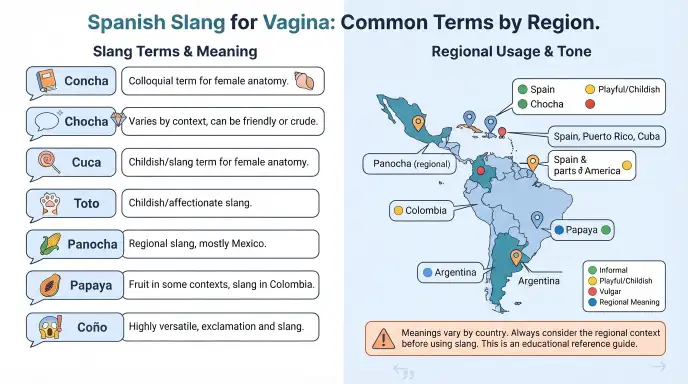
Spanish has many slang words for vagina, and their meanings can change depending on the country, region, and social setting. Some terms are playful or humorous, while others may be considered vulgar or offensive. Understanding the context is important because a word that is common in one Spanish speaking country may be unfamiliar or inappropriate in another.
In this guide, you’ll learn the most common Spanish slang terms, where they are used, what they generally mean, and when they may or may not be appropriate.
What Is the Spanish Slang for Vagina?
Quick Answer
There is no single Spanish slang word for vagina. Different countries use different informal terms, and many of them carry different levels of politeness or offensiveness.
Some expressions are used among close friends or in comedy, while others are considered vulgar and should be avoided in formal conversations.
Why Are There So Many Spanish Slang Terms?
Spanish is spoken in more than 20 countries, and each region has developed its own slang over time.
The meaning of a slang word may depend on:
- The country
- The speaker’s age
- The tone of the conversation
- if the setting is casual or formal
Because of these differences, context is essential when interpreting slang.
Common Spanish Slang Terms
Concha
Meaning: A slang term used in some Spanish speaking countries to refer to the vagina.
Common in: Argentina and Uruguay.
Context: In these countries, it is generally considered vulgar. In other countries, concha may simply refer to a seashell or a sweet bread, so the meaning changes with location.
Cuca
Meaning: An informal slang term for the vagina.
Common in: Spain and parts of Latin America.
Context: Depending on the region, it may sound playful, childish, or vulgar.
Chocha
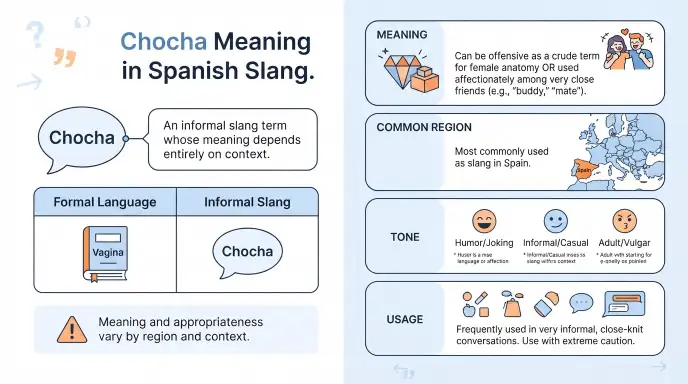
Meaning: An informal slang word for the vagina.
Common in: Spain.
Context: This term is generally considered vulgar and is mostly heard in casual or adult conversations.
Toto
Meaning: A childish or playful nickname for the vagina.
Common in: Several Latin American countries.
Context: Parents may sometimes use this word with young children instead of anatomical terms.
Panocha
Meaning: A slang term that has different meanings depending on the country.
Common in: Mexico, the U.S. Southwest, and other regions.
Context: In some places, it refers to the vagina, while in others it refers to a type of sweet food or another everyday object. Always consider the regional context.
More Spanish Slang Terms
Coño
Meaning: Although this word originally refers to the vagina, it is more commonly used as an exclamation, swear word, or expression of frustration in many Spanish speaking regions.
Common in: Spain, Puerto Rico, Cuba, the Dominican Republic, and parts of Latin America.
Context: This term is generally considered vulgar. Depending on the country and tone, it may be used to express surprise, anger, or emphasis rather than referring to anatomy.
Almeja
Meaning: Literally means “clam” and is sometimes used as a humorous slang term for the vagina.
Common in: Some parts of Latin America.
Context: This comparison is informal and may appear in jokes or casual conversations.
Papaya
Meaning: In some countries, papaya is used as slang for the vagina.
Common in: Colombia, Venezuela, and a few other Spanish speaking regions.
Context: The meaning depends entirely on the country. In many places, it simply refers to the tropical fruit.
Flor
Meaning: Literally means “flower.”
Common in: Various Spanish speaking regions.
Context: This is a softer, more poetic expression rather than a common slang term. It is occasionally found in literature or romantic language.
Conejita
Meaning: Literally means “little rabbit.”
Common in: Spain and parts of Latin America.
Context: This nickname may appear in playful or romantic conversations. The intended meaning depends on the relationship and context.
Regional Differences Matter
Spanish slang changes significantly from one country to another. A word that is common in one place may be confusing or offensive somewhere else.
For example:
| Country | Common Slang Examples |
| Argentina | Concha |
| Uruguay | Concha |
| Spain | Chocha, Coño |
| Mexico | Panocha (regional), Cuca (less common) |
| Colombia | Papaya (in some contexts) |
Always remember that these meanings can vary, even within the same country.
Tone and Context
The same word can have completely different meanings depending on how it is used.
Casual Conversations
Some slang terms may appear between close friends or in humorous conversations.
Adult Humor
Certain expressions are common in comedy, memes, or stand up performances.
Offensive Language
Some terms are considered vulgar and may offend people if used with strangers or in formal situations.
When you are unsure, it is better to use the standard anatomical word instead of slang.
Where You May See These Terms
Spanish slang words for body parts may appear in:
- Social media posts
- Memes
- Comedy videos
- Movies
- TV shows
- Music lyrics
- Online discussions
Because slang reflects everyday speech, these words are more common in informal settings than in professional communication.
Common Mistakes
Assuming Every Country Uses the Same Word
Spanish slang is highly regional. A term used in Argentina may be unknown in Mexico or Spain.
Using Slang in Formal Situations
Many of these expressions are informal or vulgar. They are not appropriate for workplaces, schools, or professional conversations.
Ignoring Context
Some words have multiple meanings. For example, papaya, concha, and panocha can refer to everyday objects or foods in some countries while carrying slang meanings in others.
Translating Slang Literally
Literal translations often miss the intended meaning. Understanding local usage is more important than translating each word directly.
Similar Spanish Slang Terms
Spanish has many regional slang words for the vagina. Some are playful, while others are considered vulgar. Their meanings can vary depending on the country and context.
Common examples include:
- Concha
- Cuca
- Chocha
- Toto
- Panocha
- Coño
- Papaya
- Almeja
Always remember that a word may have a completely different meaning in another Spanish speaking country.
Tips for Understanding Spanish Slang
Learn the Regional Meaning
The same slang word may have different meanings in Spain, Mexico, Argentina, Colombia, or other Spanish speaking countries.
Pay Attention to Context
A word that sounds harmless in one conversation may be considered offensive in another. The speaker, setting, and tone all matter.
Avoid Using Unfamiliar Slang
If you are learning Spanish, it is usually better to use standard vocabulary until you understand how local slang is used.
Choose Formal Language When Needed
In professional, educational, or medical situations, use the standard Spanish word instead of slang.
Frequently Asked Questions
What is the Spanish slang for private parts?
Spanish has many slang words for private parts, and the terms vary by country and region. Some are playful, while others are considered vulgar.
What is cuca slang for?
Cuca is an informal slang term that may refer to the vagina in some Spanish speaking countries. Its meaning and tone vary depending on the region.
How do you say vagina in Spanish?
The standard Spanish word for vagina is vagina. It is the appropriate term to use in medical, educational, and formal contexts.
Is Spanish slang the same in every country?
No. Spanish slang changes from one country to another. A word that is common in one region may have a different meaning or may not be used at all elsewhere.
Are these slang words appropriate in formal conversations?
No. Most Spanish slang terms for body parts are informal, and many are considered vulgar. Standard vocabulary is more appropriate in formal or professional settings.
Why do some Spanish slang words have multiple meanings?
Many slang terms have developed differently across Spanish speaking countries. As a result, the same word may refer to a body part in one place and an everyday object or food in another.
Conclusion
Spanish slang for the vagina varies widely across the Spanish speaking world. Words such as concha, cuca, chocha, toto, and panocha may all refer to the same body part, but their meanings, tone, and level of offensiveness depend on the country and situation.
If you’re learning Spanish, understanding the regional context is just as important as learning the words themselves. When speaking in formal, educational, or medical settings, the standard term vagina is the safest and most appropriate choice.
Discover more articles!

Hi, I’m Liam Carter, a slang language enthusiast and content writer. I research internet slang, social media terms, texting abbreviations, and online expressions to help readers understand modern English. I enjoy breaking down trending slang into simple, easy-to-read explanations with real-world examples, making online communication clearer and more enjoyable.