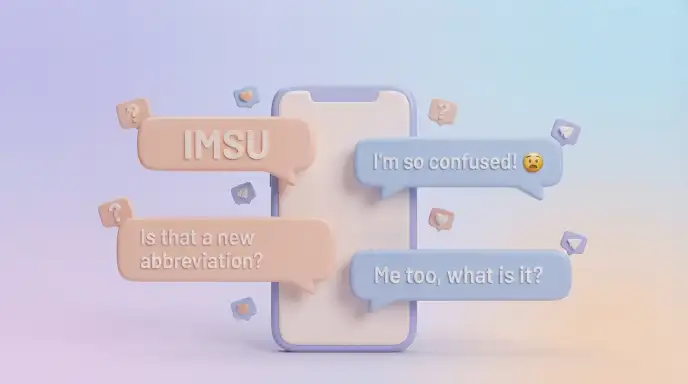
IMSU does not have one widely recognized meaning in texting and social media. It may be a context specific abbreviation, a personal shortcut, or a typo. If you see IMSU on TikTok, Snapchat, Instagram, or in a text message, the surrounding conversation can help you understand what the sender intended.
People use short forms online to save time, communicate casually, and express themselves in fewer words. Some abbreviations become popular across the internet, while others remain limited to a small group of friends.
If someone sends you “imsu,” you might wonder if it is slang, an acronym, or a shortened phrase. Unlike familiar texting abbreviations such as IDK and BRB, IMSU does not have one consistently established meaning in everyday online conversations.
In this guide, you will learn how to interpret IMSU, where you might encounter it, how to respond naturally, and how it compares with other common texting abbreviations.
IMSU Meaning in Text
IMSU is an uncommon abbreviation whose exact meaning depends on the context. It does not have one universally accepted definition in everyday texting, so it is important not to assume that the letters always stand for a particular phrase.
When you encounter IMSU in a message, there are a few possible explanations:
- A personal abbreviation: The sender may use the letters as a shortcut understood by their friends.
- A typing mistake: The person may have accidentally typed IMSU instead of another word or abbreviation.
- A context specific acronym: The letters may represent a phrase used within a particular conversation, group, or online community.
For example, if someone sends you “imsu” without any other information, it may be impossible to identify the intended meaning confidently.
The best way to understand the message is to look at the conversation around it. Previous messages, the topic being discussed, and your relationship with the sender can provide useful clues.
Is IMSU Slang, an Acronym, or an Abbreviation?
IMSU looks like an acronym or initialism because it consists of four letters. However, its appearance does not establish what those letters represent.
An acronym is generally formed from the initial letters of a phrase and pronounced as a word. An initialism is usually pronounced letter by letter. An abbreviation is a shortened form of a word or expression.
IMSU could function as an initialism in a specific conversation, but there is insufficient evidence to assign it one standard expansion across texting and social media.
This distinction matters because unfamiliar letter combinations are sometimes presented online as established slang even when their meanings are unclear or inconsistent.
What Does IMSU Mean in Everyday Chat?
In everyday messaging, the meaning of IMSU depends on what the sender is trying to communicate.
Imagine that a friend sends you this message:
“Hey, imsu?”
You might not know if the person intended to type another abbreviation, used a private expression, or made a typing mistake.
Instead of guessing, you could reply:
“Wait, what does imsu mean?”
This response keeps the conversation simple and gives the sender an opportunity to explain.
If the person provides a specific meaning, you can understand IMSU in that conversation. However, their explanation does not automatically establish the meaning for everyone else.
Where People Use IMSU
Unfamiliar abbreviations can appear on almost any platform that supports messaging, comments, or direct communication. However, seeing IMSU on a particular platform does not mean it has a specific, established meaning there.
IMSU on TikTok
TikTok is known for short videos, comments, memes, and rapidly changing internet expressions. Users often encounter abbreviations while watching videos or talking to other people through comments and direct messages.
If you see IMSU in a TikTok comment, read the entire sentence before deciding what it means.
For example, a comment containing only “imsu” provides very little information. A longer discussion might reveal if the person is referring to a specific topic, using an inside joke, or making a typing mistake.
Do not assume that a definition from one comment applies to every use of IMSU on TikTok.
IMSU on Snapchat
Snapchat conversations are often informal and personal. Friends may use private jokes, nicknames, shortened expressions, and abbreviations that make sense only within their social circle.
If someone sends IMSU in a Snapchat message, consider what you were discussing immediately before receiving it.
For instance, a message sent during a conversation about school might have a different intended meaning from one sent during a conversation about weekend plans.
If you cannot work out what the sender means, asking directly is usually the easiest solution.
IMSU on Instagram
Instagram users communicate through comments, captions, Stories, and direct messages. The context surrounding an abbreviation can vary depending on where it appears.
A short comment may not provide enough information to interpret IMSU accurately. A direct message conversation may contain earlier messages that help explain the sender’s intention.
Look at the topic, the wording, and any relevant replies. These details can help you make a reasonable interpretation, although they may not provide a definite answer.
IMSU on WhatsApp
WhatsApp is used for personal conversations, family groups, school discussions, and workplace communication.
People sometimes develop their own shortcuts within group chats. An abbreviation may be familiar to several friends but confusing to everyone outside that group.
If someone uses IMSU in a WhatsApp conversation, ask them what they mean if the surrounding messages do not make it clear.
This is especially helpful in group chats, where one person’s private abbreviation might confuse several other participants.
IMSU in SMS Text Messages
SMS messages often contain short forms because people may prefer quick, informal communication.
However, an unfamiliar abbreviation can be harder to interpret in a short text because there may be little surrounding context.
If you receive IMSU from someone you know, you can ask what they intended. If the message comes from an unknown number and includes suspicious links or requests for personal information, avoid clicking the links or sharing sensitive details.
The key point is that IMSU does not acquire one universally accepted definition simply because it appears in an SMS message.
Real Chat Examples
The following conversations illustrate how people might encounter an unfamiliar abbreviation and respond naturally. These are hypothetical examples, not proof that IMSU has a particular established meaning.
Example 1: Asking a Friend
A: Hey, imsu?
B: Wait, what does imsu mean?
A: I saw it in another chat.
B: Oh, I thought you knew what it meant.
This conversation shows how an unfamiliar abbreviation can create confusion between friends.
Example 2: Snapchat Message
A: Someone just sent me “imsu.”
B: Do you know what they meant?
A: Not really.
B: Just ask them.
When an abbreviation is unclear, asking the sender can be easier than searching through uncertain definitions.
Example 3: Instagram DM
A: Have you seen this comment? It says imsu.
B: No, is that a common abbreviation?
A: I don’t recognize it either.
B: Maybe it’s a typo or an inside joke.
Neither person assumes that the letters have one definite meaning.
Example 4: School Group Chat
A: What did the last message mean?
B: Which one?
A: The one that says imsu.
B: Ask the person who sent it.
This is a sensible approach when an unfamiliar expression appears in a group discussion.
Example 5: Talking to a Close Friend
A: You sent me imsu yesterday.
B: Did I? I might have mistyped something.
A: I couldn’t figure it out.
B: Let me check the conversation.
Sometimes the explanation for an unfamiliar abbreviation is simply a typing error.
Example 6: A TikTok Comment
A: Why is everyone using these short forms?
B: Some are popular, and others are specific to certain groups.
A: So, does imsu have a common meaning?
B: I haven’t seen a reliable, widely accepted definition for it.
This conversation demonstrates why it is important to distinguish common abbreviations from uncertain ones.
Example 7: An Unknown Sender
A: I received a text that says imsu.
B: Do you know the number?
A: No, it’s unfamiliar.
B: Don’t assume what it means. Ask for clarification if needed.
This approach is particularly useful when you do not recognize the sender.
Example 8: A Family WhatsApp Group
A: What does this abbreviation mean?
B: Which abbreviation?
A: IMSU.
B: Maybe the person who sent it can explain.
Family members may have different texting habits, so a direct question can prevent misunderstandings.
Example 9: Comparing Texting Abbreviations
A: I know IDK and BRB, but what about IMSU?
B: Those first two are common abbreviations.
A: Is IMSU equally popular?
B: It doesn’t have the same widely established meaning.
This example highlights the difference between familiar texting shortcuts and an abbreviation with an uncertain meaning.
Example 10: Clearing Up a Misunderstanding
A: I thought your message meant something else.
B: No, that’s not what I intended.
A: Sorry, I wasn’t sure what imsu meant.
B: It’s okay. You can always ask me.
The conversation shows how asking for clarification can prevent a small misunderstanding from becoming a bigger problem.
How to Reply When Someone Says “IMSU”
Your response should depend on the conversation and your relationship with the sender. Since IMSU does not have one reliably established texting meaning, it is better to understand the message before responding as though you know what it means.
Funny Replies
If you are talking to a close friend, you can use humor to make the conversation more relaxed.
- “My slang dictionary needs an update!”
- “Wait, did my keyboard miss a meeting?”
- “I’m going to need subtitles for that one.”
- “New abbreviation unlocked?”
- “Help me out. What does that mean?”
These responses work best when the conversation is casual and the other person appreciates jokes.
Casual Replies
If you simply want to understand the message, try one of these replies:
- “What does imsu mean?”
- “What do you mean by that?”
- “Can you explain that abbreviation?”
- “Did you mean to type something else?”
- “I’m not familiar with that one.”
These short questions make it easy for the sender to explain without interrupting the conversation too much.
Friendly Replies
When messaging a friend or classmate, you can keep your response warm and conversational.
- “Haha, explain that one to me.”
- “I haven’t heard that before. What does it mean?”
- “Teach me your texting language!”
- “I might be missing something. Can you explain?”
- “Tell me what you meant so I don’t misunderstand.”
A friendly question shows that you want to understand rather than criticize the person’s texting style.
Neutral Replies
For unfamiliar people, professional contacts, or situations where clarity matters, choose a straightforward response.
- “Could you clarify what IMSU means?”
- “I’m not sure I understand your message.”
- “Can you write that out in full?”
- “Did you mean to send a different abbreviation?”
- “Please explain what you intended.”
Neutral replies are particularly useful in school, workplace, and customer service conversations.
Should You Reply Immediately?
You do not need to respond immediately if you are unsure what the sender means.
For an ordinary conversation, you can ask for clarification whenever you are ready. If the message comes from an unknown sender and includes suspicious links, requests for money, or demands for private information, do not share sensitive details simply to discover what the abbreviation means.
Is IMSU Rude or Offensive?
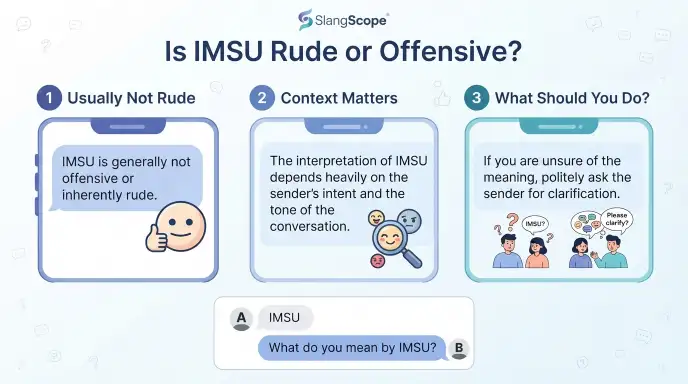
IMSU is not inherently rude or offensive based on the letters alone. Because its intended meaning is uncertain, it would be inaccurate to label it universally polite or impolite.
The tone depends on what the sender intended, the situation, and the relationship between the people communicating.
Is IMSU Safe to Use With Friends?
It is generally fine to ask about an unfamiliar abbreviation or discuss it with friends.
However, before using IMSU yourself, make sure you understand its meaning in the context where you encountered it. Copying an abbreviation without knowing what it means can lead to an awkward or confusing exchange.
If a friend explains a private meaning, remember that other people may interpret the same letters differently.
Is IMSU Appropriate at School?
In school related messages, clarity is more important than using unfamiliar shortcuts.
When discussing homework, schedules, or group projects, use language that everyone can understand. If a classmate or teacher sends IMSU, politely ask what they intended.
There is no reason to consider the abbreviation inappropriate simply because it is unfamiliar.
Can You Use IMSU at Work?
In professional emails, meetings, and workplace chats, it is usually better to avoid obscure abbreviations unless everyone involved understands them.
Clear wording reduces the risk of misunderstandings and makes communication easier for colleagues who may not be familiar with internet slang.
If someone uses IMSU at work, ask what they mean instead of assuming that the abbreviation is offensive.
Who Uses This Term?
Because IMSU does not have one widely established texting definition, there is no reliable basis for identifying a particular age group or platform as its main audience.
However, understanding how different groups use online language can help explain why unfamiliar abbreviations appear in messages.
Gen Z and Internet Slang
Gen Z users are often associated with internet slang, memes, and short form messaging. They may encounter new expressions through social media, gaming, group chats, and online communities.
However, it would be misleading to claim that IMSU is a widely used Gen Z expression without reliable evidence.
Even among people of the same age, slang knowledge varies according to their interests, location, and online communities.
Teenagers and Younger Users
Teenagers may use abbreviations to save time, express humor, or communicate with friends in a style that feels natural to their group.
Some shortcuts spread quickly across social media, while others remain limited to a few people. One teenager using an unusual abbreviation does not mean it is popular among teenagers generally.
Parents and teachers can handle unfamiliar expressions by asking what they mean instead of immediately assuming they are inappropriate.
Adults and Older Users
Adults also use texting abbreviations, particularly when messaging friends, family members, or colleagues.
They may recognize common terms such as IDK and BRB but be unfamiliar with newer expressions or private shortcuts. The same is true in reverse: younger users may not recognize abbreviations commonly used by older people.
Age alone does not determine if someone understands a particular expression.
Which Platforms Use IMSU Most Often?
There is not enough reliable information to rank TikTok, Snapchat, Instagram, WhatsApp, and SMS by how frequently IMSU appears.
The letters could appear on any of these platforms, but an isolated example does not establish that the term is popular there.
It is more useful to examine the actual message than to assume that a particular platform has a standard definition.
Origin of the Term
The exact origin of IMSU as a texting expression is unclear. Without reliable early examples or an authoritative explanation, it is not possible to identify when it began, who created it, or what the letters originally represented.
This uncertainty is common with internet language. Many abbreviations develop informally through conversations rather than being introduced by one identifiable person.
How Internet Abbreviations Develop
Texting abbreviations often develop because people want to communicate quickly. Users shorten familiar phrases, combine initials, and create expressions that their friends understand.
If a phrase becomes popular outside its original group, other users may adopt it and give it a broader meaning.
However, not every abbreviation follows this path. Some remain private expressions, while others disappear after a short period.
The Influence of Social Media
Social media can help unfamiliar expressions spread through comments, videos, memes, and direct messages.
A term may appear repeatedly in a small community without becoming widely understood by the general public. A viral post may also cause people to search for an abbreviation they have never encountered before.
That does not necessarily mean the abbreviation is a long established slang term.
Why the Origin Is Uncertain
To establish an abbreviation’s origin, researchers would ideally need dated examples, reliable explanations from users, or consistent usage across independent sources.
Without that evidence, assigning IMSU a specific expansion or claiming it originated on a particular platform would be speculation.
If you encounter a proposed meaning on a slang website, check if it includes credible examples and if the definition matches the actual conversation.
IMSU vs. IDK, IDC, IMO, and BRB
IMSU differs from common texting abbreviations because its meaning is not consistently established across everyday online communication.
The following table compares it with four widely recognized shortcuts.
| Term | Meaning | Type | Usage | Popularity |
| IMSU | No universally established texting meaning | Unclear or context specific abbreviation | Requires context or clarification | Uncertain |
| IDK | I don’t know | Initialism | Expressing uncertainty or lack of knowledge | Very common |
| IDC | I don’t care | Initialism | Expressing indifference | Very common |
| IMO | In my opinion | Initialism | Introducing a personal view | Very common |
| BRB | Be right back | Initialism | Telling someone you will return shortly | Very common |
IDK
IDK stands for “I don’t know.” It is useful when someone asks a question and you do not have the answer.
Example:
A: What time does the movie start?
B: IDK. Let me check.
Unlike IMSU, IDK has a widely recognized meaning in everyday texting.
IDC
IDC stands for “I don’t care.” It can communicate indifference, but its tone depends on the conversation.
Example:
A: Do you want pizza or burgers?
B: IDC, either is fine.
Although this can sound casual among friends, it may sound dismissive in a more sensitive conversation.
IMO
IMO means “in my opinion.” People use it when sharing a personal viewpoint rather than presenting something as an unquestionable fact.
Example:
A: Which movie was better?
B: IMO, the first one was much better.
This abbreviation signals that the speaker is offering a personal judgment.
BRB
BRB means “be right back.” It is commonly used when someone needs to step away from a conversation temporarily.
Example:
A: Are you still there?
B: BRB, getting some water.
It provides a quick explanation for a short absence.
Why Is IMSU Different?
The other four expressions have established meanings that many people recognize without additional explanation.
IMSU does not have the same level of consistent recognition. It is therefore better to ask what the sender intended instead of treating it as interchangeable with a familiar texting abbreviation.
Real World Usage Example
Imagine you are chatting with a friend on WhatsApp after school. You are discussing plans for the weekend when your friend suddenly sends a message containing “imsu.”
You read it twice but still cannot work out what the person means.
You might be tempted to search for a definition and immediately apply the first result you find. However, that definition may come from an unrelated conversation or an unsupported slang list.
A more practical response would be:
“You sent ‘imsu’ just now. What did you mean?”
Your friend might explain that it was a typo, a personal shortcut, or an abbreviation they use with another group of friends.
Once you understand the intended meaning, you can continue the conversation without confusion.
This example highlights an important principle of online communication: context matters more than guessing when an abbreviation is unfamiliar.
The same approach works for messages on Snapchat, Instagram, TikTok, and SMS. Check the surrounding conversation, consider if the sender may have made a typing error, and ask for clarification when necessary.
Frequently Asked Questions
What does IMSU mean in text messages?
IMSU does not have one widely established meaning in everyday text messages. It may be a personal abbreviation, a typo, or a context specific acronym. Ask the sender what they intended if the message is unclear.
What does IMSU mean on TikTok?
There is no reliably established universal meaning for IMSU on TikTok. Its intended meaning may depend on the video, comment, or conversation where it appears.
Is IMSU slang?
IMSU may function as slang or an abbreviation in a particular group, but its status as a widely recognized slang term is uncertain. The surrounding context can help clarify its use.
Is IMSU rude or offensive?
The letters themselves are not inherently offensive. However, because the intended meaning is uncertain, check the context before deciding if a particular message is rude or appropriate.
How should you reply to IMSU?
A simple reply is, “What do you mean by IMSU?” You can also say, “Is that a typo?” or “Can you explain that abbreviation?” These responses help you understand the message without making assumptions.
Conclusion
IMSU is an unfamiliar texting abbreviation without one reliably established meaning across major messaging and social media platforms. Its interpretation may depend on the sender, the conversation, or a possible typing error.
You might encounter it on TikTok, Snapchat, Instagram, WhatsApp, or through ordinary SMS messages. However, seeing the same letters on different platforms does not guarantee that they mean the same thing.
If someone sends you IMSU, check the surrounding conversation and ask for clarification when necessary. Avoid assuming it is rude, romantic, or offensive without understanding the intended message.
The simplest rule is to check the context before guessing. Clear communication is more useful than relying on an uncertain definition.
Read more slang!

Daniel Carter – Short Bio (First Person)
Hi, I’m Daniel Carter, a slang language researcher and content writer. I enjoy exploring internet slang, texting abbreviations, and modern expressions to make them easy for everyone to understand. My goal is to explain slang in clear, simple English with real-life examples so readers can communicate confidently online and stay up to date with the latest language trends.