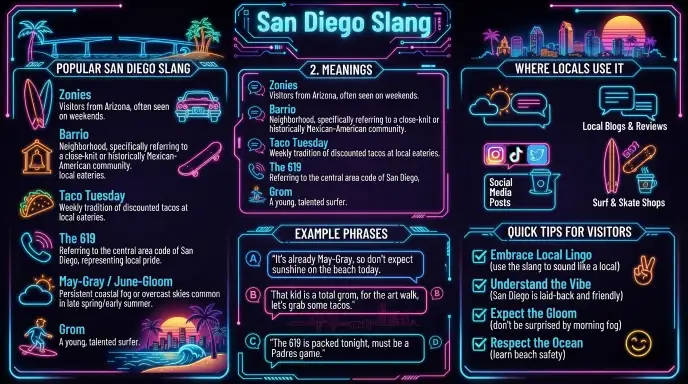
If you’re visiting Southern California or chatting with someone from the area, you may hear words and phrases that sound unique to San Diego. While many expressions are shared across California, San Diego has its own mix of beach culture, surfing language, military influence, Mexican border culture, and laid back SoCal lifestyle. Together, these influences have created what many people call San Diego slang.
Learning San Diego slang can help you understand conversations with locals, enjoy social media content, and feel more connected to the city’s culture. if you’re planning a trip, moving to San Diego, or you’re simply curious about California slang, this guide explains the most common words and phrases in simple English with real life examples.
What Is San Diego Slang?
Quick Answer
San Diego slang refers to the informal words, phrases, and expressions commonly used by people in San Diego, California. It combines Southern California slang, surf culture, skateboarding terms, military vocabulary, and influences from Spanish and Mexican culture.
Unlike internet slang, San Diego slang is mostly spoken in everyday conversations. However, many of these expressions also appear on TikTok, Instagram, YouTube, and other social media platforms where Southern California culture is popular.
Why Does San Diego Have Its Own Slang?
San Diego has a unique identity because of its location and culture.
Several factors have shaped the city’s vocabulary, including:
- Surfing and beach communities
- Skateboarding culture
- Military bases and Navy presence
- Mexican American culture
- Southern California lifestyle
- College students and young adults
- Outdoor living and coastal communities
Many local expressions are also shared with nearby cities like Los Angeles and Orange County, but some words are especially common in San Diego.
How Is San Diego Slang Different From Other California Slang?
Although San Diego shares many expressions with the rest of California, its slang often reflects the city’s relaxed beach lifestyle.
People in San Diego are generally known for speaking casually, using friendly greetings, and incorporating surf inspired language into everyday conversations.
You’ll also hear more Spanish words and phrases because of San Diego’s close connection to the U.S. Mexico border.
Where Is San Diego Slang Commonly Used?
You’ll hear San Diego slang in many places, including:
- Everyday conversations
- Schools and colleges
- Beaches
- Surf shops
- Skate parks
- Coffee shops
- Local restaurants
- TikTok videos
- Instagram Reels
- YouTube vlogs
- Reddit communities
- Local podcasts
Visitors often hear these expressions while exploring neighborhoods like Pacific Beach, Ocean Beach, La Jolla, Mission Beach, and Downtown San Diego.
Most Popular San Diego Slang Words
1. Dude
Meaning
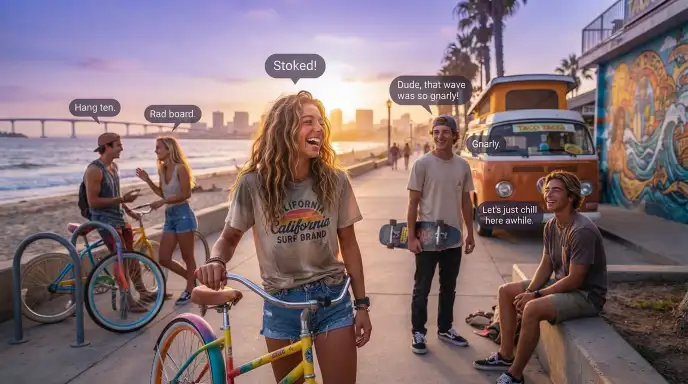
“Dude” is one of the most common words in San Diego. It can refer to almost anyone regardless of gender, depending on the conversation.
Tone
Friendly and casual.
Example
“Dude, that sunset at La Jolla was amazing.”
2. Bro
Meaning
A casual way to address a friend.
Tone
Relaxed and informal.
Example
“Bro, let’s hit the beach this afternoon.”
3. Stoked
Meaning
Very excited or extremely happy.
Tone
Positive and enthusiastic.
Example
“I’m so stoked for the surfing competition this weekend.”
4. Gnarly
Meaning
Originally used by surfers to describe large waves, “gnarly” now means something amazing, difficult, intense, or shocking depending on the situation.
Tone
Positive or negative depending on context.
Example
“Those waves were absolutely gnarly today.”
5. Sick
Meaning
In San Diego slang, “sick” usually means something is really cool or impressive.
Tone
Positive.
Example
“That skateboard trick was sick!”
6. Rad
Meaning
Short for “radical,” meaning awesome or excellent.
Although it became popular decades ago, many surfers and skaters still use it today.
Example
“That’s a rad surfboard.”
7. Chill
Meaning
Relaxed, calm, or easygoing.
It can describe both people and situations.
Example
“Everyone here is super chill.”
8. Cruise
Meaning
To drive around or travel somewhere without rushing.
Example
“Let’s cruise down the coast this evening.”
9. Hang Loose
Meaning
Take it easy or relax.
It’s commonly associated with surfing culture.
Example
“Don’t worry about it—just hang loose.”
10. Grom
Meaning
A young surfer who is still learning or improving.
Example
“The beach is full of talented groms this summer.”
11. Kook
Meaning
Someone who behaves poorly while surfing or doesn’t understand surf etiquette.
Tone
Usually playful but can be mildly insulting.
Example
“Don’t paddle right into everyone else—you’ll look like a kook.”
12. Shred
Meaning
To surf or skateboard with great skill.
Example
“She absolutely shreds every weekend.”
13. Bomb
Meaning
Something excellent or very impressive.
Example
“Those fish tacos were bomb.”
14. Hella
Meaning
Very or extremely.
Although originally associated with Northern California, many younger Californians—including some in San Diego—also use it.
Example
“The weather is hella nice today.”
15. Taco Shop
Meaning
In San Diego, saying “Let’s go to the taco shop” usually refers to local Mexican restaurants that serve burritos, tacos, and California style Mexican food.
Food culture is an important part of local identity.
Example
“We’re grabbing breakfast at the taco shop before surfing.”
16. Cali Burrito
Meaning
Short for California Burrito—a famous San Diego food filled with carne asada, fries, cheese, and other ingredients.
Locals often simply call it a “Cali Burrito.”
Example
“You can’t visit San Diego without trying a Cali Burrito.”
17. June Gloom
Meaning
A local weather expression describing the cloudy mornings that often happen during late spring and early summer.
Example
“It’s June Gloom again, but it’ll be sunny this afternoon.”
18. Marine Layer
Meaning
A layer of coastal clouds that often covers the city during the morning.
Locals mention it frequently when talking about the weather.
Example
“The marine layer should clear by noon.”
19. The 5
Meaning
Locals often place “the” before freeway numbers.
“The 5” refers to Interstate 5, one of San Diego’s major highways.
Example
“Take the 5 north to reach Oceanside.”
20. PB
Meaning
PB is the common nickname for Pacific Beach.
Locals almost always shorten the neighborhood’s name.
Example
21. OB
Meaning
OB is the local nickname for Ocean Beach, a laid back neighborhood known for its surf culture, pier, and relaxed atmosphere.
Example
“We’re spending the afternoon in OB.”
22. LJ
Meaning
LJ is short for La Jolla, one of San Diego’s most famous coastal communities.
Example
“We watched the sea lions in LJ today.”
23. Mission
Meaning
Locals often shorten Mission Beach to simply “Mission.”
Example
“Let’s meet at Mission around sunset.”
24. South Bay
Meaning
South Bay refers to the southern part of San Diego County, including cities like Chula Vista, Imperial Beach, and National City.
Example
“My cousins live in South Bay.”
25. The Cove
Meaning
“The Cove” usually refers to La Jolla Cove, one of San Diego’s most popular beaches.
Example
“We went snorkeling at the Cove.”
26. Sunset Cliffs
Meaning
Locals often say “Sunset Cliffs” instead of the full park name because it’s a well known place to watch the sunset.
Example
“Let’s catch the sunset at Sunset Cliffs.”
27. Flip Flops Year Round
Meaning
People jokingly use this phrase because San Diego’s weather stays warm most of the year.
Example
“In San Diego, it’s flip flops year round.”
28. Beach Day
Meaning
Although common elsewhere, “beach day” is part of everyday conversation in San Diego because of the city’s coastal lifestyle.
Example
“Saturday is officially a beach day.”
29. Taco Tuesday
Meaning
San Diego has embraced Taco Tuesday thanks to its strong Mexican food culture.
Example
“We never miss Taco Tuesday.”
30. Surf’s Up
Meaning
Originally a surfing expression, it means the waves are good for surfing.
Today, it’s also used jokingly to suggest it’s time to head to the beach.
Example
“Surf’s up! Grab your board.”
31. Local
Meaning
In surfing culture, a “local” is someone who regularly surfs at a particular beach.
Example
“Respect the locals when you’re surfing.”
32. Touron
Meaning
A humorous combination of “tourist” and “moron.” It’s sometimes used for visitors who ignore local rules or behave carelessly.
Tone
Playful but can be insulting.
Example
“That touron stopped in the middle of the road to take pictures.”
33. Beach Bum
Meaning
Someone who spends most of their free time at the beach.
Example
“He’s a total beach bum.”
34. No Worries
Meaning
A relaxed way of saying “It’s okay” or “Don’t worry about it.”
Example
“Thanks for waiting.”
“No worries.”
35. SoCal
Meaning
SoCal is the common abbreviation for Southern California.
Although it includes several cities, San Diego residents use it regularly.
Example
“SoCal weather is hard to beat.”
How San Diego Slang Is Used in Everyday Conversations
San Diego slang isn’t about using unusual words in every sentence. Instead, locals naturally mix these expressions into everyday conversations.
At the Beach
Friend 1: The waves look gnarly today.
Friend 2: Yeah, I’m stoked to surf.
At a Taco Shop
Friend: Want a Cali Burrito?
You: Dude, absolutely
While Driving
Friend: Which freeway should we take?
You: Just hop on the 5.
Planning the Weekend
Friend: What are you doing Saturday?
You: Probably cruising through PB and watching the sunset.
The Influence of Surf Culture on San Diego Slang
Surfing has had one of the biggest influences on San Diego’s vocabulary.
Words like:
- Gnarly
- Stoked
- Grom
- Kook
- Shred
- Hang loose
all began in surf communities before becoming popular across California and even other parts of the United States.
Today, many people use these words even if they’ve never surfed.
The Influence of Mexican Culture
Because San Diego borders Mexico, Spanish words naturally appear in everyday conversations.
You’ll often hear people talk about:
- Taco shops
- Burritos
- Carne asada
- Baja style food
- Fiesta celebrations
This cultural connection makes San Diego’s slang different from many other American cities.
Is San Diego Slang Still Popular?
Yes. While some older slang terms like “Rad” are less common than they once were, many expressions remain popular today.
Words like:
- Dude
- Bro
- Stoked
- Sick
- Chill
- No worries
are still widely used by locals of all ages.
You’ll also hear them frequently on TikTok, Instagram, YouTube, and podcasts created by Southern California creators.
San Diego Slang vs. Los Angeles Slang
Although San Diego and Los Angeles share many slang terms, there are a few differences.
People in both cities commonly use words like “Dude,” “Bro,” and “Sick.” However, San Diego slang tends to have a stronger connection to surfing, beaches, military communities, and Mexican culture.
Los Angeles slang is often influenced more by the entertainment industry, fashion, music, and urban culture.
While visitors may not notice a huge difference, locals often recognize the unique feel of each city’s vocabulary.
“We’re meeting everyone in PB tonight.”
Tips for Understanding San Diego Slang
If you’re new to San Diego or planning a visit, don’t worry about memorizing every local expression. Most slang is easy to understand once you hear it in context.
Listen to Local Conversations
Spend time at beaches, cafés, or local events, and you’ll naturally hear expressions like “stoked,” “dude,” and “no worries.”
Watch Local Content
Many San Diego vloggers, surfers, and travel creators use authentic local language on platforms like YouTube, TikTok, and Instagram. Watching their content is a fun way to learn how locals actually speak.
Learn the Context
Some words can have different meanings depending on the situation. For example, “gnarly” can describe something amazing, difficult, or even dangerous. Always pay attention to the speaker’s tone.
Don’t Force the Slang
It’s perfectly fine if you don’t use every local phrase. Using slang naturally is always better than trying to fit it into every conversation.
Common Mistakes About San Diego Slang
Thinking Every Californian Speaks the Same Way
California is a large state with many regional differences. While some slang is shared across the state, San Diego has its own expressions influenced by surfing, beach life, and Mexican culture.
Assuming Every Word Is Exclusive to San Diego
Many terms such as “dude,” “bro,” and “chill” are popular throughout the United States. However, they are especially common in San Diego because of the city’s relaxed lifestyle.
Using Surf Slang Incorrectly
Words like “grom,” “kook,” and “shred” come from surfing. While many people understand them, using them incorrectly can sound unnatural, especially around experienced surfers.
Should You Use San Diego Slang?
Yes—if you’re in a casual setting.
Great Times to Use It
- Talking with friends
- Visiting San Diego
- Chatting with surfers or skaters
- Posting on social media
- Traveling around Southern California
When to Avoid It
Avoid using local slang in:
- Business emails
- Academic writing
- Job interviews
- Professional presentations
- Formal documents
In those situations, standard English is the better choice.
Frequently Asked Questions
What is San Diego slang?
San Diego slang refers to the informal words and phrases commonly used by people in San Diego, California. It is influenced by surfing, beach culture, Southern California lifestyle, military communities, and Mexican culture.
What words are popular in San Diego?
Some of the most common San Diego slang words include “dude,” “bro,” “stoked,” “gnarly,” “sick,” “rad,” “chill,” “grom,” “kook,” and “shred.”
Is San Diego slang different from Los Angeles slang?
Yes, but only slightly. Both cities share many California expressions, but San Diego slang has stronger influences from surfing, beaches, military life, and Mexican culture.
Why do people in San Diego say “stoked”?
“Stoked” is a surf inspired expression that means very excited or extremely happy. It has become one of the most recognizable words in Southern California slang.
What does “gnarly” mean in San Diego?
Originally, “gnarly” described large or challenging surf waves. Today, it can mean amazing, intense, difficult, or shocking depending on the context.
Is San Diego slang used on social media?
Yes. Many local creators and influencers use San Diego slang on TikTok, Instagram, YouTube, and other social media platforms, especially when sharing beach, surf, travel, or lifestyle content.
Can tourists use San Diego slang?
Absolutely. Visitors can use common expressions like “dude,” “stoked,” and “no worries.” Just remember to use them naturally rather than forcing them into every conversation.
Is San Diego slang still popular today?
Yes. Many traditional expressions remain part of everyday conversations, while newer slang continues to evolve with younger generations and online culture.
Final Thoughts
San Diego slang reflects the city’s friendly personality, coastal lifestyle, and diverse cultural influences. From classic surf terms like “stoked” and “gnarly” to everyday favorites like “dude” and “no worries,” these expressions are a natural part of how locals communicate.
if you’re visiting for a weekend, moving to Southern California, or simply interested in regional American English, understanding San Diego slang will help you connect with locals and better appreciate the city’s unique culture. As with any regional slang, the key is to learn the meaning, understand the context, and use it naturally when the situation feels right.
Read more slang!

Hi, I’m Ethan Carter. I write easy-to-read articles about slang, texting abbreviations, and digital communication. My goal is to make modern English simple and useful for students, professionals, and anyone curious about internet language.